 OfferBull
Software Engineer Behavioral Interview Questions (With STAR Answers) | OfferBull

Software Engineer Behavioral Interview Questions (With STAR Answers)
Coding round: fine. Then the manager asks, “Tell me about a time you shipped something you weren’t proud of.”
You freeze. Not because it never happened. Because you drilled algorithms, not the ugly stories.
That’s where a lot of strong engineers quietly lose ground. Whiteboard speed shows problem-solving. Behavioral shows what you do when the pager fires, a design review gets sharp, or a junior is stuck and the sprint is already late.
This is the engineer cut of software engineer behavioral interview questions. What shows up after coding. About fifteen STAR samples you can reshape. Leveling signals. A short FAQ.
Samples are illustrative. Names, ticket IDs, employers: made up. Steal the shape. Not the words.
Need the scaffolding with timing? STAR method guide. Broader bank: behavioral interview questions and answers. Conflict and failure get their own drill: conflict and failure in tech interviews.
What they ask when coding stops
Most loops mix some of these:
- Ownership of a messy production issue
- Design disagreement with a peer or staff engineer
- Tech debt you paid (or deliberately skipped)
- Mentoring, code review, raising the bar
- Cross-team friction (platform vs product, backend vs mobile)
- Fuzzy requirements and how you scoped them
- A miss: bad estimate, bad rollout, silent failure
My honest take: they’re not hunting a perfect hero arc. They want judgment. Escalate early or hide the fire? Argue with data or ego? Can you name a trade-off without rewriting history?
Hard project without drowning people in jargon: explain complex technical projects. Culture-fit questions that sneak in after: cultural fit without faking it.
Say the story out loud. Notes help. A timer helps more.
Leveling signals (what “senior” usually sounds like)
Same question. Different answers by level.
Mid / mid-plus: clear “I” moves, one solid result, owned a service or feature end to end.
Senior: same, plus cross-team scope, a trade-off you chose on purpose, and how you unblocked others. Mentorship shows up without being asked.
Staff-ish: org-level impact, cutting repeated pain (toil, incidents, fuzzy ownership), influence without a title.
Don’t force staff language into a mid story. Inflated scope dies on the first follow-up.
~15 questions with STAR samples
Say these under two minutes. Action eats most of the clock. Situation stays short.
1. Tell me about a production outage you owned
Pager at 9:40pm. Payments API. Card auth errors around 18%.
I flipped the feature flag that routed a new retry path back to the old client. Errors dropped in a few minutes. Then I traced it to a config deploy that shortened timeouts. Rolled that back. Posted a timeline in the incident channel. Tagged the deploy owner for a follow-up.
Full recovery in roughly twenty minutes. Next day we added a canary on that config key. I still hate that I shipped the change without a canary myself. That line went in the write-up on purpose.
 Stabilize first. Root cause second. What you changed last.
2. Describe a design disagreement with another engineer
“We were building a new search path. Peer wanted Elasticsearch now. I wanted Postgres full-text for v1. Corpus still under a few million docs. Ops had zero ES experience.
I wrote a one-pager: spike latency numbers, ops cost, exit criteria for revisiting ES. We shipped Postgres behind a flag with a revisit date. Three months later traffic still fit. Never paid the ES tax that quarter.
Wasn’t personal. We disagreed on when to buy complexity.”
3. Tech debt you chose to tackle
Order service had a god class. Every feature touched it. Reviews crawled. Regressions kept sneaking in.
I didn’t pitch a six-month rewrite. Extracted pricing rules into a module behind an interface. Three small PRs. Paired on the first cut so ownership wasn’t just me.
Review time on that area dropped. Pricing bugs stopped hitchhiking on unrelated features. Still not pretty. Touchable, though.
4. Tech debt you deliberately left alone
“Product wanted a one-week checkout copy experiment. Checkout module was a mess. Cleanup would eat the window.
I left the debt. Scoped the experiment behind a flag. Parked a cleanup ticket on next planning with a measured cost. Experiment shipped. Failed. We deleted the flag and never paid the cleanup. Right call for that week.”
I’d skip the hero rewrite for a one-week A/B. Interviewers smell that.
5. Mentoring someone
Junior kept shipping flaky integration tests. Two pairing sessions. Not a lecture. We rewrote one test together to hit the real failure mode. Then they rewrote the next two alone and pinged me for review.
Flakes from that suite dropped. Better: they started catching flaky patterns in other people’s PRs. Mentoring that sticks shows up in the team’s output, not your title.
6. Ownership without being asked
“Support kept escalating the same double-charge tickets. Nobody owned root cause. I pulled a week of tickets, found a race on the webhook handler, shipped a lock plus idempotency key, wrote a short runbook for Support.
That ticket type fell off. I didn’t wait for a mandate. I waited for enough evidence the pain was real.”
7. Ambiguous requirements
PM: “Make the dashboard faster.” No target. No which view.
I asked for the top three slowest pages by support complaints. Picked a p95 goal with them. Scoped one page for sprint one. Cut that page’s p95 roughly in half. Then we decided if the next page was worth it.
Ambiguity isn’t a vibe problem. It’s a scoping problem.
8. Bad news to stakeholders
“We were going to miss feature freeze by a week. I told the PM on Tuesday, not Friday. Brought options: cut scope A, slip five days, or ship a read-only cut.
They cut scope. Painful. Better than a Friday surprise.”
9. Code review conflict
I blocked a PR that added a DB table with no migration rollback plan. Author was annoyed. I walked through a failed migrate from two months earlier and offered to pair on the rollback script that afternoon.
Shipped next day with a reversible migrate. Relationship fine. I argued the risk, not the person.
10. A time you failed
“I shipped a caching layer that served stale prices for about forty minutes. Wrong invalidation key pattern.
Owned it in the incident channel. Wrote the postmortem. Added a test that would have caught the pattern. Failure stories work when you stop defending yourself halfway through.”
11. Cross-team friction
Mobile needed a breaking API change. Backend wanted a versioned endpoint. Timeline tight.
Dual-write for two weeks with a deprecation header. Mobile unblocked. Old path deleted on schedule. Friction dropped once both sides had a date, not a Slack vibe.
12. Prioritization under pressure
Two sev-2s: billing emails delayed, search index lag. Billing emails hit payouts that day. Search was annoying, not blocking checkout.
Billing first. Search got a status and an ETA. Then I swapped. Prioritization is saying no with a reason, not doing both poorly.
13. Influence without authority
Platform owned the shared auth library. I needed a small claim for a B2B flow. They were slammed.
Tiny RFC: claim shape, a failing test, offer to open the PR under their review. Merged that week. Influence often looks like less work for them, not more demands from you.
14. Raising the quality bar
“CI noise was normal. I added a quarantine lane for known flakes and a weekly ten-minute review of quarantined tests. People started trusting red builds again.”
15. Why leave / why this company
Keep it short. What you want more of next. One concrete thing about their team or product. No trash talk. If this lands after the opener, polish with tell-me-about-yourself sample answers.
 Design disagreements land better after you’ve sketched the two options once out loud.
STAR on a napkin
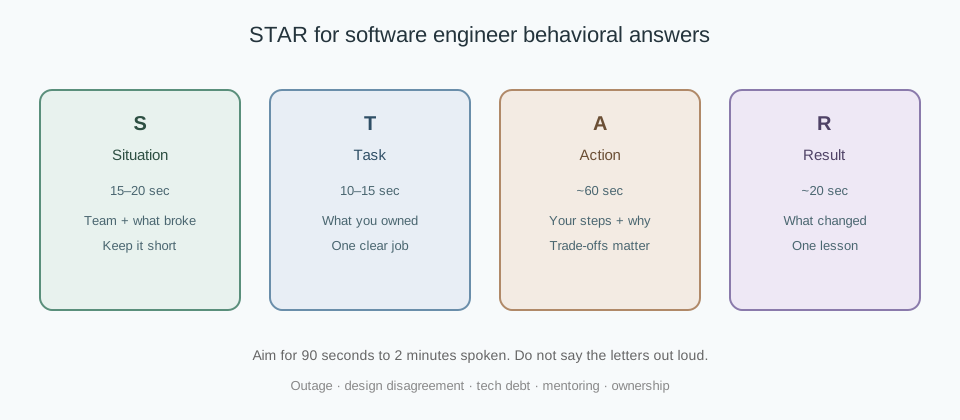 Situation short. Action long. Result specific. One lesson, not a TED talk.
Use STAR as scaffolding. Don’t say the letters out loud.
Mistakes that sink engineer stories
Tool dump instead of judgment. “We used Kafka, Flink, and Redis” isn’t Action. Why that choice is.
All “we,” no “I.” Team context yes. Your moves clear.
Hero rewrite. You alone redesigned the platform? You owned one service. Follow-ups will find you.
No result. “We investigated” isn’t an ending.
Wrong competency. They asked conflict. You told a happy deadline story. Pick again.
Practice so it survives follow-ups
Build 8–10 engineer stories. Tag each with two competencies. Say each once timed. Then once with a mid-answer “why that approach?”
OfferBull is an AI mock interview app for iOS and Android. An interviewer voice asks behavioral questions out loud. You answer by speaking. Paste a job description or upload your resume and the questions follow that role. Follow-ups based on what you said and what’s on your resume. During practice it can show answer suggestions and STAR structures when a story wanders. English and Chinese.
Prep before the interview. Not during it.
FAQ
How many SWE behavioral stories? Eight to ten flexible ones beat twenty memorized scripts.
Do FAANG loops ask different ones? Themes overlap. Amazon leans Leadership Principles. Google/Meta lean culture plus ownership. Practice the competency, not the brand name.
Include metrics? When they’re real and you can explain the measurement. Fake precision is worse than a plain qualitative result.
Mostly greenfield work? You still have disagreements, scoping calls, review friction, mentorship. Those count.
Reuse a story across rounds? Yes, across different interviewers. Don’t repeat it twice to the same person in one loop.
Practice This Out Loud
Tonight: one outage, one design disagreement, one failure. Each under two minutes. Then once with a “why that approach?” cut-in. Steady? Try a voice mock with follow-ups. → Practice Now