 OfferBull
Behavioral Interview Questions and Answers: 30 Examples With STAR Responses | OfferBull

Behavioral Interview Questions and Answers: 30 Examples With STAR Responses
Interviewer leans in: “Tell me about a time you disagreed with your manager.”
You actually did. The meeting is still clear in your head. Then your mouth does the wrong thing. Three minutes of setup. A shrug of “we worked it out.” No ending. They nod politely. You already know how that scored.
I hear that pattern a lot. People did the work. They just never practiced saying it as a story with a point.
Behavioral interview questions are a request for evidence. What was going on, what you owned, what you did, what changed. Hiring teams lean on them because past behavior is a decent (not perfect) signal for how you’ll show up on their team.
This post is the general hub, not an Amazon deep-dive. Roughly thirty questions grouped by competency. Sample STAR answers you can reshape. A story-bank worksheet that stays ugly on purpose. The mistakes that flatten good stories. A short FAQ at the end.
Samples are illustrative. Names, ticket numbers, employers: fictional. Steal the shape. Not the words.
Interviewing at Amazon? Start with Amazon behavioral interview questions mapped to Leadership Principles. Want the framework itself spelled out with timing? The STAR method guide goes deeper. Conflict and failure deserve their own reps: conflict and failure questions.
What they actually measure
Most “tell me about a time” prompts collapse into a short list of competencies:
- Leadership and initiative
- Conflict and disagreement
- Failure and learning
- Teamwork
- Problem solving
- Customer or stakeholder focus
- Time management and prioritization
My honest take: they’re rarely hunting a perfect hero story. They want judgment under pressure, how you treat people when things get awkward, and whether you can own a result without rewriting history. A clean failure story often sticks harder than a polished win where nobody disagreed.
 One timed pass out loud beats rereading notes five times.
Quick STAR refresher
Spoken length: about 90 seconds to two minutes.
Situation: a few sentences of context. Task: what you were responsible for. Action: most of the airtime. What you did and why. Result: what changed, plus one line on the lesson.
Say “I” for your part. “We” is fine for the shared goal. If you want CAR, SOAR, and finer timing splits, bounce to the STAR method post and come back for the question bank.
30 behavioral interview questions by competency
You don’t need thirty stories. Eight to ten flexible ones will cover most loops. Tag each story with two or three competencies from the list below.
Leadership and initiative
- Tell me about a time you led a project or team.
- Describe a time you took initiative without being asked.
- Tell me about a time you influenced someone without formal authority.
- Tell me about a decision you made without all the information.
- Tell me about a time you mentored or helped a teammate grow.
Conflict and disagreement
- Tell me about a time you disagreed with your manager.
- Describe a conflict with a coworker and how you resolved it.
- Tell me about a time you had to deliver difficult feedback.
- Give an example of a time you pushed back on a request.
- Tell me about a time two stakeholders wanted opposite things.
Failure and learning
- Tell me about a time you failed.
- Describe a mistake you made and what you did about it.
- Tell me about a time you received critical feedback.
- Tell me about a project that didn’t go as planned.
Teamwork and collaboration
- Tell me about a time you worked with a difficult teammate.
- Describe a time you helped a teammate who was struggling.
- Give an example of working with people from a different team or background.
- Tell me about a time you relied on others to get something done.
Problem solving
- Tell me about the most complex problem you’ve solved.
- Describe a time you used data to make a decision.
- Tell me about a time you found the root cause of a problem.
- Give an example of a creative solution you came up with.
- Tell me about a time you simplified a process.
Customer / stakeholder focus
- Tell me about a time you went above and beyond for a customer or user.
- Describe a time you dealt with an unhappy customer, patient, or stakeholder.
- Tell me about a time you used feedback to change something.
- Give an example of balancing what someone wanted with what was possible.
Time management and prioritization
- Tell me about a time you had multiple competing deadlines.
- Describe a time you missed a deadline, or nearly did.
- Tell me about a time you had to learn something quickly.
 Listen for the competency behind the question before you pick a story.
Sample STAR answers (illustrative)
These are written closer to how people actually talk. A few are labeled part by part. Others just flow. Watch how much airtime goes to Action. Again: fictional, for shape only.
Example A: Disagreed with manager (conflict)
Situation: “My manager wanted to ship a reporting feature our biggest sales account had asked for. I owned the product roadmap.”
Task: “Building the full feature would push a reliability fix that hit every customer we had.”
Action: “I skipped the public argument in standup. I grabbed thirty minutes with the sales lead and asked what the customer actually needed for their board meeting. Turns out they wanted one export, not a reporting suite. I got an engineer to size a simple CSV export at about two days of work. Then I brought my manager a written choice: the export in two weeks with the reliability fix still on track, or the full feature and a one-month slip on the fix, with a note on what that meant for everyone else.”
Result: “They picked the export. The customer was fine. The fix shipped on time. The no landed because it came with a yes to the thing they actually needed.”
Example B: Failed / mistake (learning)
“I owned the weekly marketing conversion dashboard. About a month in, I was building a quarterly summary and one campaign’s numbers didn’t match the ad platform. That was my dashboard, so it was my problem.
I traced the query and found a join that double-counted anyone who clicked two ads in the same campaign. That had inflated our biggest campaign. I fixed the join, re-ran the last four weeks, and messaged my manager and the marketing lead before anyone else spotted it. I laid out what broke, the corrected numbers, and which budget calls might have been off. Then I added a weekly check that compares our totals to the platform’s.
Marketing adjusted next month’s spend using the fixed figures. Habit I kept: if people make decisions from a number I publish, it gets a sanity check.”
Example C: Competing deadlines (prioritization)
“Summer internship on an analytics team. I had a project presentation due Friday. On Tuesday my manager asked me to pull data for a client report due Thursday.
I wrote down what each needed and roughly how many hours. The client report had an outside deadline, so I suggested doing it first and asked my manager to confirm. That took two minutes and saved me from guessing. I blocked focus time, borrowed a teammate’s query template to speed up the pull, and moved my presentation rehearsal to Friday morning.
The report went out Thursday morning. The presentation was fine. The habit that stuck: when deadlines collide, confirm priorities early.”
Example D: Difficult teammate (teamwork)
“Final-year course project. Four of us building a mobile app over ten weeks. By week four one teammate had missed two meetings and hadn’t pushed a single commit.
I wasn’t the official lead. I was integrating everyone’s work, though, so his gap blocked mine. I was tempted to call it out in the group chat. I didn’t. I messaged him privately and asked if he was okay. He was swamped with a part-time job and honestly didn’t understand the backend framework we’d picked. I spent an hour pairing with him on the setup, and we broke his task into chunks he could finish one a week.
He delivered over the next three weeks and we demoed on time. What looked like laziness was usually confusion or no time. Asking first saved a lot of drama.”
Example E: Unhappy stakeholder (customer focus)
“I was a clinic operations coordinator and I owned the scheduling export. A physician group got loud about two fields missing that they needed for payroll.
I got on a call the same day, confirmed the exact fields, and shipped a patched export in three days with a one-page note on what changed. I also added those fields to our regression checklist so they wouldn’t vanish again.
The tickets stopped. What I took from it: acknowledge the pain before you explain the backlog. People calm down faster when they feel heard first.”
Example F: Influence without authority (leadership)
“I was an IC on a support tools squad. Our triage tags were a mess, so reporting was basically useless. I had no mandate to fix it.
I pulled two weeks of ticket samples, showed the support lead the three most common mis-tags, and proposed a five-tag rewrite with examples. She let me pilot it with one pod for a week. Mis-tags dropped enough that she rolled the new set out.
I didn’t wait for a title. I showed up with evidence and a small experiment she could say yes to.”
Want more worked samples across roles? The STAR method guide has eight. Amazon loops: Amazon behavioral questions.
Story-bank worksheet (keep it ugly)
Open a doc. Make a table with five columns:
- Story name (short nickname)
- Competencies it covers (2-3 tags)
- Situation one-liner
- Three action bullets (what you did)
- Result + lesson one-liner
Aim for 8-10 rows. Then open the job description and highlight the words that repeat: “cross-functional,” “ambiguity,” “customer,” “ownership.” Check your tags against those words. Almost everyone is missing either a real failure or a real disagreement. Those are exactly the ones interviewers like to ask.
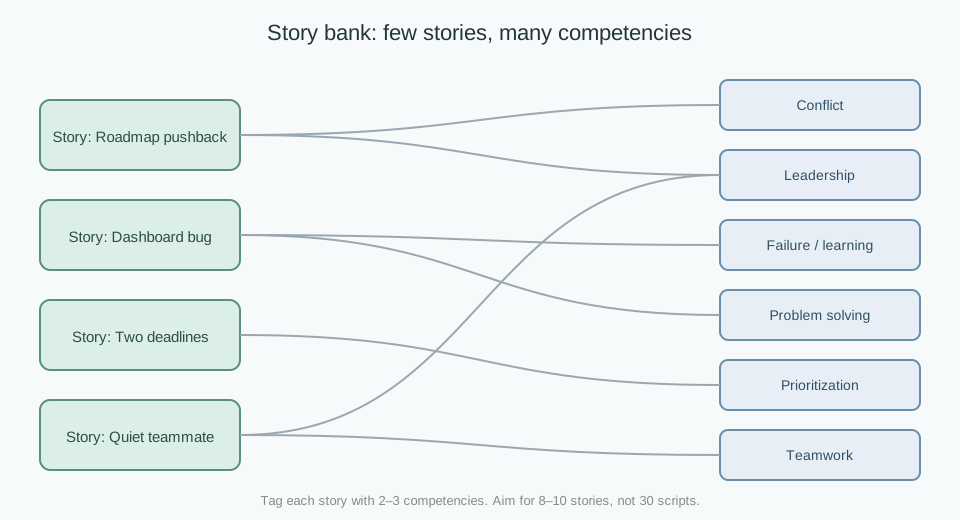 One strong story can cover two or three competencies. Tag it that way on purpose.
If you want help drafting from rough notes, try the free STAR Answer Builder. It walks you through each part and turns the bullets into something you can edit.
Mistakes that flatten a good story
Too much “we.” They’re hiring you. Say what you owned.
No result. Action with no ending is a status update. “It failed, and here’s what I changed” still counts as a result.
Wrong story for the question. Conflict needs actual disagreement. Failure needs something that went wrong. A happy deadline story covers neither.
Rambling Situation. If setup eats a full minute, you’ve lost the Action. Cut background first.
Invented metrics. Only use numbers you can defend when they ask how you measured it. Fake precision is worse than a plain qualitative result.
How to practice out loud
Say each story start to finish. Time it. Anything past two and a half minutes: trim Situation before anything else. Record one take and listen for filler and “we.”
Then practice getting interrupted. Real interviewers cut in with “why that approach?” Shuffle the question list too, so you practice picking the right story fast.
Opening softballs still matter. For the cross-role version of the opener, see sample tell-me-about-yourself answers.
Practicing with OfferBull
Notes help. Being interrupted while you talk helps more.
OfferBull is an AI mock interview app for iOS and Android. An interviewer voice asks behavioral questions out loud and you answer by speaking. Paste a job description or upload your resume and the questions follow that role. It asks follow-ups based on what you said and what’s on your resume. During practice it can show answer suggestions and STAR structures when a story starts wandering. English and Chinese.
Prep before the interview. Not during it.
FAQ
How many STAR stories do I need? Usually eight to ten flexible ones beat thirty memorized scripts.
Can I reuse a story? Yes, across different interviewers or competencies. Don’t tell the same story twice to the same person in one loop.
What if I don’t have corporate experience? School projects, internships, clinical rotations, retail, volunteering, military, caregiving logistics. Actions and results still count.
How long should each answer be? About 90 seconds to two minutes. More than half on Action.
Should I say the STAR labels out loud? No. Use STAR as scaffolding. Speak like a person.
Practice This Out Loud
Pick three questions tonight. One conflict, one failure, one prioritization. Answer each once under two minutes. Then once with a mid-answer “why did you do that?” interruption. Steady? Try a voice mock with follow-ups. → Practice Now