 OfferBull
How to Answer "Tell Me About Yourself" (Sample Answers for 8 Situations) | OfferBull

How to Answer “Tell Me About Yourself” (Sample Answers for 8 Situations)
Recruiter: “So, tell me about yourself.”
Two bad instincts show up fast. Dump the resume from high school forward. Or freeze and fill forty seconds with “uh, well.” Neither helps.
They’re not asking for a biography. They want a short pitch: who you are now, how you got here, why you’re in this room. Nail it and the rest of the call has a thread. Flub it and you spend half an hour digging out.
Here’s the present-past-future shape I’d use, how long to talk, eight sample answers across situations, the mistakes that sink the opener, and a short FAQ. Samples are illustrative. Names, employers, numbers: made up. Steal the shape. Not the words.
Software engineer or other tech specialist who wants stack-and-systems framing? Use the tech “tell me about yourself” guide. This post is the broader cross-role pillar.
The present-past-future formula
Three beats. Present first. Past second. Future last. Most people tell life stories the other way. That’s why their openers drag.
Present (20-30 seconds). Who you are right now. Current role. What you own. One win that maps to this job. Relevance first. History later.
Past (20-30 seconds). One or two beats that explain how you got here. Not every job. The transitions that make today make sense. Career changers and returning parents: do the translation work here.
Future (15-20 seconds). Why this role, this team, or this company. Specific enough that it couldn’t paste into every other application. Then stop.
No childhood. No “I’ve always been passionate about…” opener. No tool dump.
 Say it once with a timer. The version in your head is always shorter than the one that comes out.
Timing: 60 to 90 seconds
Sweet spot for most phone screens and first rounds. Under a minute sounds thin. Past two minutes and you’ve started a monologue.
Phone timer. When you run long, cut Past first. People pad the middle with every job. Keep one or two past beats. Move on.
Follow-up like “tell me more about that project”? That’s a win. You left a hook. A two-and-a-half-minute opener rarely gets that courtesy.
Sample answers for 8 situations
Illustrative. Fictional. Swap your facts. Follow-ups will catch a borrowed story by the second question.
1. New graduate
“I just finished marketing at State University. Last six months I’ve been interning on a small e-commerce content team. I own the weekly email and help with product page copy. Last spring drop campaign I drafted beat their usual open rate, mostly because we tested subject lines instead of guessing. Before that I ran the campus club newsletter. That’s how I got into writing that moves numbers. I’m looking for a junior marketing seat where I can keep shipping copy and learn paid acquisition for real. Your lifecycle email focus is why I applied.”
2. Career changer
“I’m an operations coordinator at a regional logistics company. I own the weekly capacity report and the late-shipment escalation process. Last quarter I rebuilt that report so dispatchers could see bottlenecks by lane instead of scrolling a spreadsheet. ‘Where is my truck’ pings dropped. I started on the warehouse floor five years ago, then moved into ops because I liked fixing handoffs more than driving forklifts. Next step for me is a business operations analyst role. Your posting’s cross-team process work matches what I’ve been doing without the title.”
Deeper switch plan: career switch into tech.
3. Product manager
“I’m a PM with about four years in. Most recently I own onboarding at a mid-size B2B SaaS company. One designer, three engineers, first-week experience. Last year we cut new-account support tickets by redesigning the data-source connection step after we found that’s where people abandoned. I came from customer support. Still how I decide what to build: where do users get stuck. Your activation work is the same problem at bigger scale. I’d like to own metrics end to end, not one funnel step.”
More PM loops: product manager interview questions.
4. Sales (AE)
“I’m an AE on the mid-market team at an HR software company. Patch of about 80 accounts. Usually close somewhere in the top third of the team. Last quarter I rebuilt my discovery notes so I could spot expand opportunities earlier. That turned into three upsells that weren’t on the January forecast. Before sales I spent two years in customer success, which is why I still over-index on implementation risk in demos. I’m talking to you because your average contract size and sales cycle match how I already sell. I’d like a product where the buyer and the daily user aren’t the same person.”
5. Nurse (interview prep only; not clinical advice)
Framing: pull from rotations, preceptorships, or current unit work. Keep patients anonymous. Interview prep, not clinical guidance.
“I’m an RN on med-surg, about eighteen months in. Four to five patients a shift. Charge asks me to precept new grads on nights twice a month. A few months ago afternoon handoffs were missing a consistent pain reassessment line. I brought a one-page checklist to charge. We piloted two weeks. Next audit looked cleaner. I started as a CNA in nursing school. Still how I think about patient experience. I’m interested in your step-down unit for more telemetry exposure and a team that takes precepting seriously.”
6. Data analyst
“I’m a data analyst supporting marketing at a consumer subscription company. Weekly campaign dashboard and ad-hoc pulls for budget reviews. Last month I caught a join that double-counted multi-click users, fixed it, and walked marketing through the corrected numbers before they locked next quarter’s spend. Got into analytics through a finance internship that lived in Excel until I learned SQL properly. Your growth analytics role calls out experiment readouts. That’s the work I already ask to do when there’s room.”
Related: data science interview prep.
7. Manager
“I’m an engineering manager for a payments team of eight. Delivery for checkout services plus the hiring loop for that squad. Last year we cut production incidents on our service by tightening on-call handoff and adding one boring checklist nobody wanted to write. Before management I was a senior backend engineer on the same team, so I still review design docs when the blast radius is high. Your platform manager role is hiring someone who can grow a team that’s been understaffed. That’s the problem I’ve been living.”
8. Returning parent
“I’m returning to full-time work after two years focused on family. Before that I was a project coordinator at a construction firm. Schedule updates across three active sites and the weekly owner report. In the gap I kept a small freelance bookkeeping roster for two local contractors. Stayed current with the tools and with clients under deadline pressure. Looking for a project coordinator or operations role with clear scope and a team that already figured out hybrid work. Your posting’s site-to-office coordination is the work I did before. Ready to do it again on a full-time cadence.”
 Present first. One past beat. Why this job. Then stop and let them ask.
A simple timing diagram
Keep the spoken split boring and repeatable:
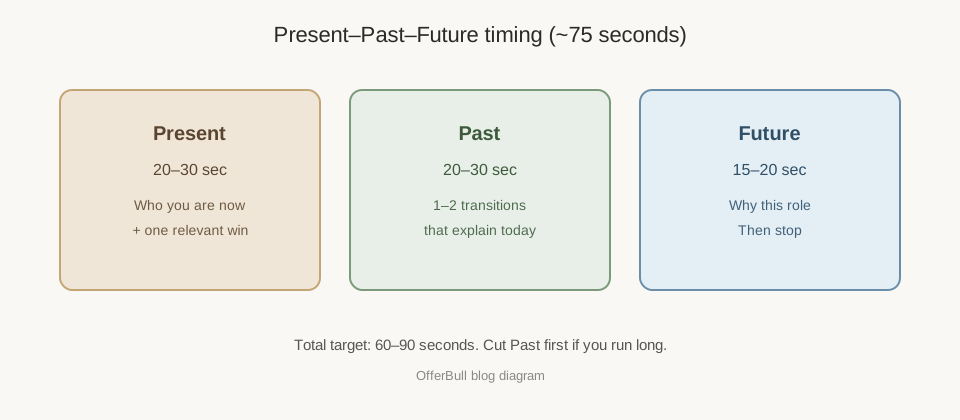 Rough spoken split for a 75-second answer. Cut Past first if you run long.
Three bullets on a sticky. Present / past / future. Practice until you can hit them without looking. Throw the sticky away before the real call so you don’t sound like you’re reading.
Mistakes that waste the opener
Starting in 2012. Chronological resumes bury the relevant part. Start with today.
Listing every tool. “Excel, Salesforce, HubSpot, SQL, Tableau, Python…” is a keyword dump. Pick one or two that matter for this job. Put them inside a result.
No “why here.” End on your last job with zero reason you’re talking to this company, and the interviewer has to invent one. They won’t.
Going past two minutes. Long openers invite the wrong kind of interruption. 60-90 seconds. Leave a hook.
Same answer for every company. Swap the future beat. If your “why you” fits any job post on earth, rewrite it.
Memorizing someone else’s sample. Including mine. Use the structure. Use your facts.
How to practice so it survives a real call
Write the three beats. Say them out loud. Time them. Record one take. Listen for filler. Then practice getting cut off after Present: “Wait, tell me more about that project.” If you can recover, you’re ready.
Engineers who want tech framing should still use the tech tell-me-about-yourself post for stack language, then come back here for the cross-role samples.
Behavioral stories that usually follow this opener: keep a short bank with the STAR method. Conflict and failure get asked a lot: conflict and failure guide.
Practicing with OfferBull
Reading samples helps a little. Saying your own answer out loud, with someone cutting in, helps more.
OfferBull is an AI mock interview app for iOS and Android. An interviewer voice asks questions out loud. You answer by speaking. Paste a job description or upload your resume and the questions follow that role. Follow-ups based on what you said and what’s on your resume. During practice it can show answer suggestions and STAR structures when a story wanders. English and Chinese.
Prep tool. Before the interview. Not during it.
FAQ
How long should “tell me about yourself” be? About 60 to 90 seconds. If they want more, they’ll ask.
Should I mention hobbies? Only if they clearly help the role or explain a gap. Most of the time, skip them in the opener.
What if I’m changing careers? Lead with transferable work you’re doing now. One past beat that explains the shift. Then why this role. Don’t apologize for the change.
Employment gap? Brief and factual in the past beat. Then what you’re ready to do now. Returning parents: see sample 8.
Same as an elevator pitch? Close. Elevator pitches run shorter and more salesy. Interview openers need a clear present, a short past, and a specific why-this-job.
Practice This Out Loud
Three bullets tonight: present, past, future. Say the whole answer once under ninety seconds. Then once with a fake interruption after the first sentence. Steady? Try a voice mock that asks follow-ups. → Practice Now