 OfferBull
MMI Interview Questions: Multiple Mini Interview Stations and How to Practice | OfferBull
MMI Interview Questions: Multiple Mini Interview Stations and How to Practice
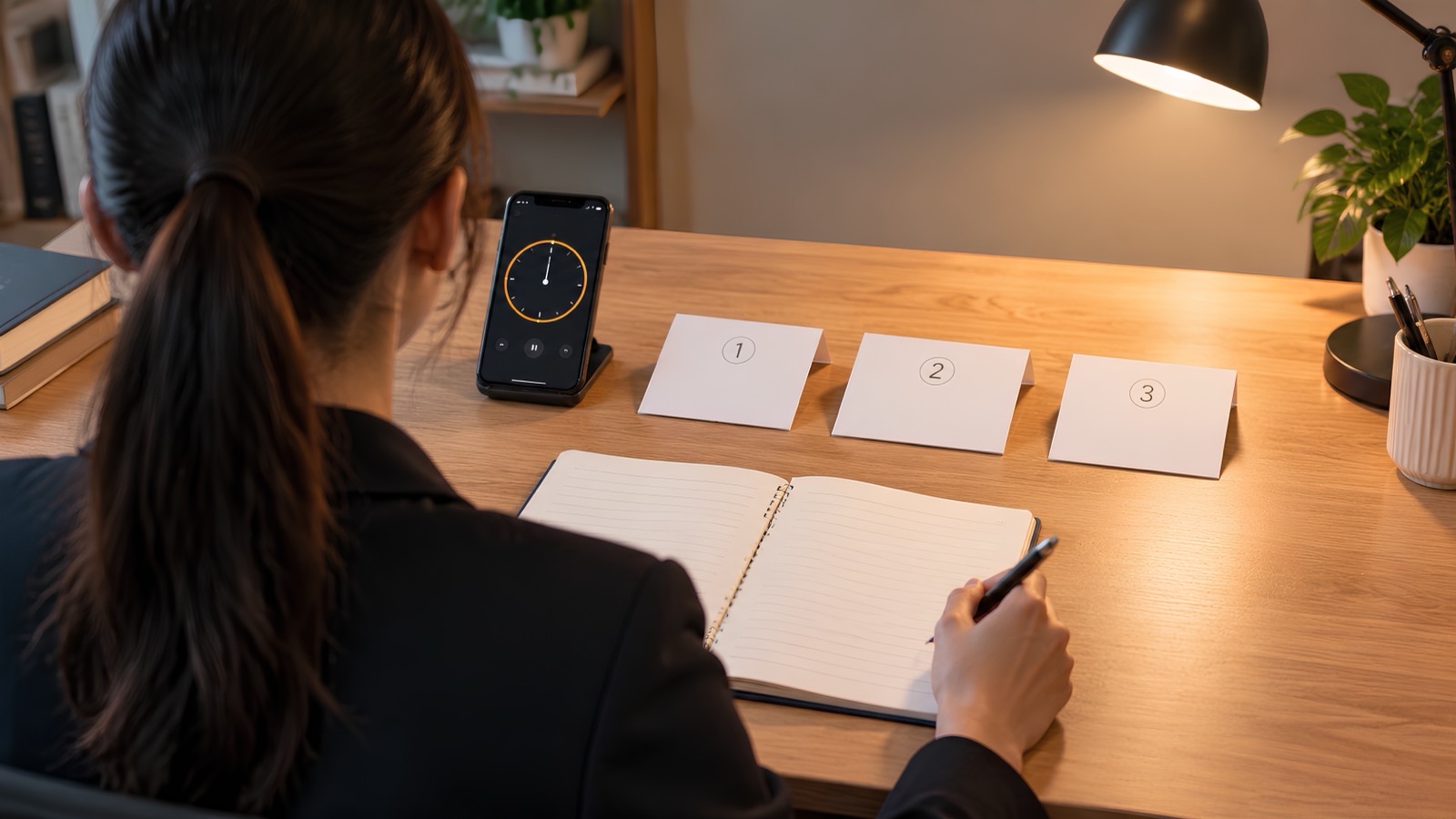
You stop at a door. Prompt on a sheet. Clock already running in your head.
Two minutes. Then you walk in. New person. They never heard whatever you said at the last door. Five or eight minutes. Bell. Next room.
That’s an MMI. Multiple Mini Interview. A circuit, not a long coffee chat. If you’ve only practiced classic one-on-ones, the format itself can throw you before the content does.
I’m writing this as interview prep for medical-school MMI days. Station shape. Types that show up a lot. How to talk through a prompt as reasoning and communication practice. A spoken timing plan. FAQ at the end.
Hard line on scope: every sample below is communication practice. Not clinical advice. Not legal advice. Not medical advice. Don’t copy a sample into a real clinical or legal mess and treat it as instruction. Schools differ. Your school’s packet wins.
I stick to public AAMC descriptions for the broad format (their students-residents pages on what an MMI is like). Station count and minutes still move around by school. When you have MSAR interview notes or an email from admissions, use those.
Story-shaped stations still like STAR. Keep a bank: STAR method, behavioral interview questions. Cold openers: tell me about yourself sample answers.
What an MMI actually is
From public AAMC guidance: usually about 6 to 10 stations. Different interviewer each time. Different prompt. They’re weighing communication, judgment under a clock, teamwork, how you sit with ambiguity. Not a trivia quiz about medicine.
A pattern they describe: roughly two minutes to read, then five to eight minutes talking. Whole thing often lands near two hours. Some schools cut or stretch those minutes. Virtual circuits are common now. Rest stations. Sometimes a writing station.
My honest take? Blog averages are orientation. The PDF they emailed you is the truth for your day.
Phone timer. Blank cards. Out loud. Silent rereading lies to you.
Station types you’ll likely meet
Names change. Buckets repeat:
Ethical / values. Short vignette. Competing goods. They want how you think out loud. What you’d ask. What you’d weigh. Not a judge’s ruling.
Teamwork. Sometimes with another applicant. Tiny task. If you steamroll, it shows. If you never speak, that shows too.
Role-play / actor. You talk with a standardized person. Conflict. Awkward ask. Bad-news framing. In person they may use actors. Still an interview skill check. You’re not diagnosing anyone.
Policy / social issue. Town, hospital, community angle. Stakeholders. Trade-offs. Admit what you don’t know.
Traditional mini. Why medicine. Team story. Resilience. Closer to normal behavioral.
Rest or writing. Some circuits give you a breather or a short essay. Take the breather. Don’t mutter the last station in the hallway.
 Curiosity beats a perfect ruling.
How I’d structure a scenario answer
You’re not handing out medical orders. You’re showing you can talk under time.
What I coach people to try:
- One sentence on the tension. Prove you read it.
- Name who is affected.
- Questions you’d ask if this were real (facts missing, urgency, whose values).
- Two or three options, upsides and downsides. Pick a priority and say why.
- Humility: escalate, consult, don’t decide alone as an applicant when you shouldn’t.
- Close on what you’d do next in the room. Skip the sermon.
Blank brain? Say the tension. Name one stakeholder. Keep moving. A clean first line you never reach is useless.
Story stations: steal STAR. Short setup. Your moves. A result. One lesson. Don’t say the letters.
Fictional prompts + rough spoken samples
I made these up. Schools write their own. Steal the shape of the talk, not the wording.
Station A: Ethical tension (fictional)
Prompt. A classmate wants you to sign that they were at a mandatory session they skipped. They’re underwater. One absence, they say, will wreck them. What do you do?
I’d talk it like this (illustrative, not advice):
“Okay. The tension is honesty versus helping someone who’s clearly struggling. People in this: them, folks who actually showed up, faculty who trust the attendance sheet, and me.
I’d ask what made the session hard and whether they’ve already talked to the course staff. I’m not signing a lie. That doesn’t fix the overload and it burns trust.
What I would do: walk them to office hours, share notes if that’s allowed, help draft a short email about makeup options. If they keep pushing the signature, I hold. Then I check in later so the ’no’ doesn’t turn into me vanishing on them.”
Notice what’s missing on purpose: no medical protocol. No legal lecture. Just how you’d talk.
Station B: Teamwork (fictional)
Prompt. Eight minutes. You and a partner. Volunteer clinic waitlist is longer than the slots. Agree on three criteria and a fair process.
I’d watch for: who talks first, who summarizes, who leaves room to disagree.
Practice the opener out loud: “Want two minutes listing criteria, then we pick three?” Then shut up and listen.
 Shared ownership is half the score.
Station C: Role-play (fictional)
Prompt. Standardized person is furious that a group-project partner went dark. You’re a peer. Not their clinician.
I’d open something like: “Thanks for talking. Sounds messy and frustrating. What have you already tried? And what do you want from me here: a project plan, or help talking to the partner?”
Role clear. Feeling mirrored. Ask before you fix. No diagnosing. No threats.
Station D: Policy (fictional)
Prompt. Town debate: expand late-night transit near a hospital. You’re a future physician-in-training. How do you approach it?
I’d sketch stakeholders (night-shift folks, patients who need the bus, budget, safety), name trade-offs, say what data I’d want, admit what I don’t know, land a provisional take. Not a campaign speech.
Station E: Motivation / traditional
“Why medicine?” Keep it specific. Skip the movie trailer. Failure story: own it, fix it, one lesson. More banks in the behavioral hub.
Schools aren’t identical (and Reddit isn’t a rubric)
Some mix old-school one-on-ones with a few MMI doors. Some run full actor circuits. Writing stations can run longer. Virtual days may drop the partner-task station.
I’d skip mining Reddit for “secret” scoring sheets. Practice the skills: timed talk, listening in a pair, resetting after a bad room. Read their packet twice.
Prompt feels clinical? Stay in communication mode. You’re showing how you think. Not doing a procedure.
Timed practice plan
Quiet room. Phone timer. No silent rereads pretending you’re ready.
Day 1–2. Six prompts. Two minutes prep. Six minutes spoken. Record one. Cringe at the filler. Good.
Day 3. Teamwork with a friend. Force yourself to invite their ideas first.
Day 4. Role-play. Friend plays the upset person. Reflect before you problem-solve.
Day 5. Five stations back to back. Two-minute transitions. Do not replay station three while reading station four.
Day 6. Virtual? Camera height, light, quiet. Still timed.
Day 7. Light pass. Sleep. Don’t invent twenty new ethics takes at midnight.
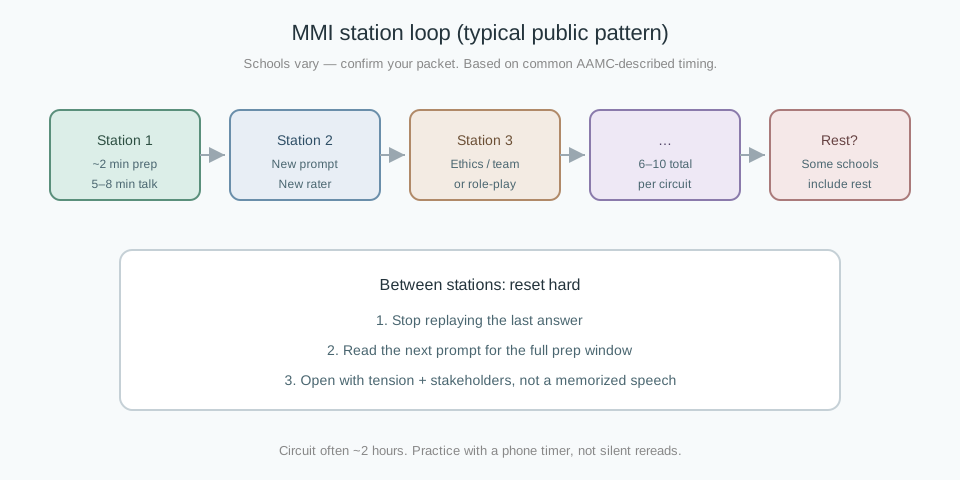 Prep. Talk. Rotate. Reset hard.
Mistakes that waste a station
Verdict first, thinking never. Lecture voice. Dominating a partner. Dragging the last room’s mood into the next. Inventing clinical protocols you don’t have. A memorized speech that ignores a changed fact in the prompt.
One rough station is normal. The circuit is built so one miss doesn’t erase you. Unless you carry it into the next five.
Practicing with OfferBull
Reading helps a little. Talking against a clock helps more.
OfferBull is an AI mock interview app for iOS and Android. Interviewer voice asks out loud. You answer by speaking. Paste a job description or upload a resume and questions follow that context. Follow-ups based on what you said. During practice it can show answer suggestions and STAR structures when a story wanders. English and Chinese.
Before interview day. Not during a real MMI.
FAQ
How many stations? AAMC publicly describes roughly 6–10. Your school may differ.
How long each? Common pattern: ~2 minutes prep, 5–8 minutes talk. Confirm yours.
Only med schools? Started at McMaster for med admissions. Widely used there. Some other health programs copy the circuit idea. This post is med-school style prep.
Right ethical answer? Structured reasoning + stakeholders + humility. Certainty without curiosity usually scores worse.
STAR in MMI? Yes on story stations. Scenario stations want tension → people → options more than a full STAR.
Virtual vs in person? Same skills. Plus connection, quiet room, camera at eye level.
Practice This Out Loud
Three prompts tonight. Two minutes prep. Six minutes spoken. One teamwork run with a friend if you can. Timer feels boring now? Try a voice mock with follow-ups. → Practice Now