 OfferBull
Nursing Interview Questions and Answers for Registered Nurses | OfferBull

Nursing Interview Questions and Answers for Registered Nurses
Charge nurse. Resume in her lap. Still not looking at you.
Then: “Three patients needed you at the same time. Walk me through it.”
You lived that shift. Lights going off. Admit rolling in. Family parked at the desk. Living it was messy and fine. Talking about it in a quiet conference room with two pens poised over clipboards? Different sport.
Most nursing interview questions live in that gap. Nobody’s grading whether you memorized a chapter. They want the judgment out loud: what went first, who you pulled in, what you said when something felt wrong.
RN and new-grad prep below. Lists. Sample answers. Panel tips. FAQ. One hard rule: every sample is fictional communication practice for interviews. Not clinical advice. Not dosing. Not a protocol for your floor. Unit policy and your license win. Same fence I put around MMI interview questions.
Prompt feels clinical? Stay in notice → escalate → handoff. Don’t invent care plans. Story prompts still like STAR — keep STAR method and the behavioral bank handy. Openers: tell me about yourself sample answers.
What nurse managers are actually listening for
The scorecard is dull on purpose.
Did you catch a change from baseline, or did you wait for drama?
Can you name what went first when three things hit, without pretending the other two vanished?
How do you talk to charge, a CNA, a provider, the next shift? Short. Useful. SBAR-shaped even when nobody says SBAR.
And please skip the hero reel. “I stayed late and fixed the unit alone” scores worse than “I flagged charge early and asked for one concrete thing.”
Honest take: one priority story and one advocacy-or-conflict story beat a binder of buzzwords.
Clinical-scenario and behavioral questions (samples)
These are RN interview questions in some form. Illustrative. Made up. Don’t memorize them as yours. Follow-ups shred borrowed stories.
1. “Tell me about a time you had to prioritize several patients.”
Situation stays tiny on purpose. Med-surg. Post-op pain climbing. Discharge teaching still undone. Family simmering about lab waits. Same ten-minute window.
My job in that minute wasn’t to be everywhere. It was to not miss the person who might be changing, and not ghost the rest.
I went to the post-op patient first. Numbers. Pain score. Morning notes. Then I told charge I needed a body for the discharge packet. Then I gave the family an actual clock time instead of “soon.” Charted what I’d seen and who already knew.
Clinical concern first. Discharge still left because charge covered teaching. Family chilled once they had a time, not a vibe.
Say it labeled. Or just talk. Either way. Don’t burn sixty seconds on the hospital founding story.
2. “Describe a time you advocated for a patient.”
“Last semester preceptorship. Older man. More confused at 1400 than he’d been at 0800. Family said he was tired. I wasn’t writing orders. I compared him to baseline, took it to my preceptor with a short SBAR, she called the provider, I updated the family and charted the timeline. Lesson I still use: small change from baseline is worth saying out loud. Structured handoff makes it easier for someone to act.”
Communication and escalation. Not a treatment plan.
3. “How do you handle a medication near-miss or a mistake?”
They want honesty and process, not a speech about perfection.
Sketch: what happened (no identifiers), who you told right away per how you were taught, how you monitored, what you changed afterward (double-check habit, ask a peer on a high-risk step). Skip the Oscar apology. Show the fix.
4. “Tell me about conflict with a coworker or a physician.”
 Panel table. Blank cards. Handoff notepad. Practice the talk, not the procedure.
Conflict needs actual disagreement. “We were busy and got along” is not a conflict story.
Spoken sample (fictional):
“Night shift. Provider wanted to send someone home. I was uneasy because their numbers had drifted from baseline and they looked worse than the note. I didn’t start it in the hallway. Asked for two minutes. Laid out the trend in plain language. Asked what would make them okay waiting for one more look. We held briefly, rechecked. Patient stayed. Day team adjusted the plan. Takeaway for me: bring the data, ask a clear question, leave the ego out.”
If your real story ended messier, say that. A clean lesson beats a fake win.
5. “Why nursing? Why this unit?”
No movie trailer. Point at something specific: acuity you like, a preceptorship on a similar floor, how this team precepts new grads. One line on how you want to grow. Two minutes is plenty. More opener shapes in tell me about yourself.
Shift stress, short staffing, “what would you do if”
New grads get a lot of situational prompts.
Hour ten. Short a CNA. Two admits incoming.
They’re not grading a perfect staffing spreadsheet. Say who you’d reassess first, that you’d tell charge early with a concrete ask, which assessments and meds can’t slip, how you’d explain delays to families without inventing promises.
Family yelling at the desk.
Your safety and the unit’s first. Lower your voice. Quieter spot if it’s safe. Name the feeling before you problem-solve. Get charge when it’s escalating. Don’t invent clinical promises.
You disagree with an order.
Clarify. Compare to what you know of scope and policy. Escalate the way you were taught. Document. Judgment and professionalism. Not a LinkedIn fight.
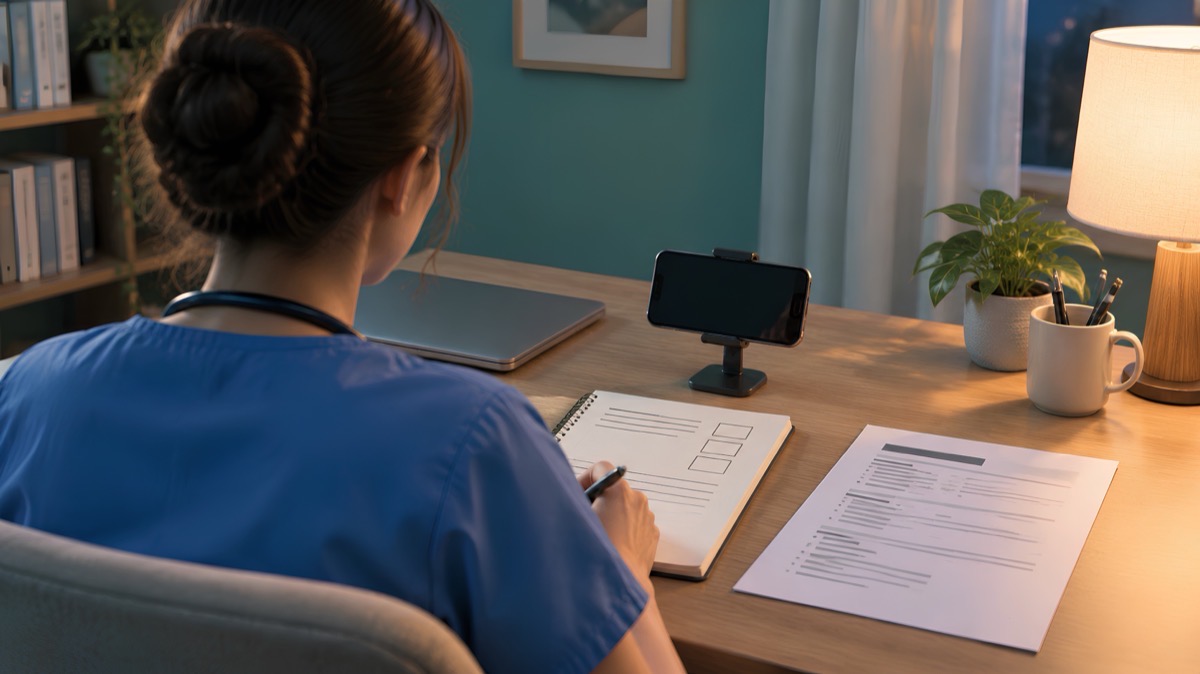 Phone on a stand. Blank handoff notes. Say the prioritization out loud before interview day.
Hospital panel tips
Often it’s manager + educator + a staff RN. Sometimes HR.
Look at whoever asked. Sweep the room when you finish a point. Bring one paper resume even if they have a tablet. Keep stories short enough that a second person can jump in.
I’d ask two of these, not eight:
- What does a strong first 90 days look like here?
- How do new grads get precepted, and how is feedback given?
- What do outsiders underestimate about this floor?
Don’t lead with vacation. Don’t trash your last unit.
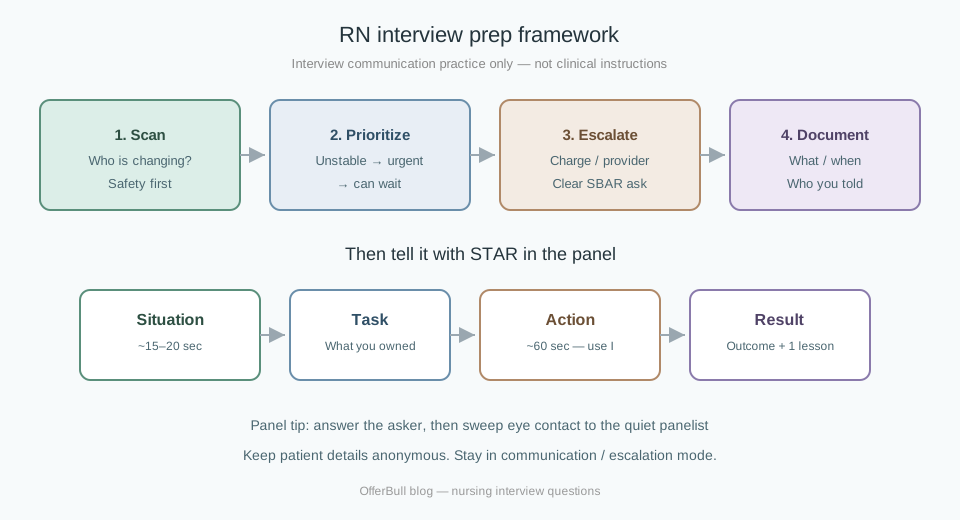 Prioritize. Escalate. Tell the story with STAR. Reset for the next question.
Question bank to drill out loud
Time yourself. Record one.
- Tell me about yourself.
- Why this unit?
- Prioritize multiple patients — tell me about a time.
- Advocated for a patient.
- Conflict with a coworker.
- Disagreed with a provider or preceptor.
- Stress on a busy shift.
- A mistake. What did you do?
- Difficult family member.
- Accurate handoff at change of shift.
- Learned something fast.
- Two to three year plan.
- Strengths and one growth area.
- Why hire you for this RN role?
- Your questions for us.
Deeper STAR practice: behavioral hub. Timed healthcare-adjacent stations: MMI.
Mistakes that sink solid nurses
Lecturing a protocol nobody asked for. Real patient names. Blaming “the doctors” as a blob. Every sentence starts with “we,” so nobody knows what you did. Five-minute Situation, ten-second Action.
Also: inventing unit process you’re guessing at. “Here’s how I’d find out and who I’d ask” beats fake certainty.
Practicing with OfferBull
Question lists help a little. Talking against a timer helps more.
OfferBull is an AI mock interview app for iOS and Android. Interviewer voice asks out loud. You answer by speaking. Paste a job description or upload a resume and questions follow that context. Follow-ups based on what you said. During practice it can show answer suggestions and STAR structures when a story wanders. English and Chinese.
Before interview day. Not during a real interview.
FAQ
What comes up most for new grads? Prioritization, advocacy, teamwork, a mistake or near-miss, why this unit. Rotation stories work if they’re anonymous and about your communication.
How long should STAR answers run? About 90 seconds to two minutes spoken. Cut background first if you overrun.
How much clinical detail? Keep it high level. They’re scoring judgment and talk, not a skills check-off. Blog samples are never clinical instructions.
Only student or CNA experience? Use it. Preceptorship. Escalation. Family teaching. Same STAR shape.
Panel vs one-on-one? Same stories. Shorter. Include the quiet panelist with your eyes.
Memorize answers? Memorize five story outlines. Not scripts. Follow-ups kill scripts.
Practice This Out Loud
Three priority or conflict prompts tonight. Ninety seconds each. Record one. Then try a voice mock with follow-ups. → Practice Now