 OfferBull
Investment Banking Interview Questions: Technical and Fit (With Answer Frameworks) | OfferBull

Investment Banking Interview Questions: Technical and Fit (With Answer Frameworks)
First question usually isn’t a DCF.
“Walk me through your resume.” Then “Why investment banking?” Then maybe someone tosses “Walk me through a DCF” and interrupts you at step two on purpose.
That’s most investment banking interview questions in the wild. Fit first. Technical as a filter. Superday as a stamina problem. The people who freeze often knew the model on paper and never practiced saying the steps out loud with a clock and a human cutting in.
This is interview prep: fit frameworks, technical answer structures (accounting, valuation, M&A), Superday notes from what big banks publish publicly about recruiting, FAQ. Samples are fictional.
Scope: interview knowledge only. Not investment advice. Not trading advice. Not a buy/sell recommendation. Don’t treat a sample structure as a live model for real capital. If your bank’s email conflicts with a blog, trust the email.
Fit still leans on STAR when they ask for stories: STAR method, behavioral interview questions, tell me about yourself sample answers. Adjacent: technical interviews at fintech companies.
Fit questions (quiet killers)
“Walk me through your resume.”
Two minutes. Present → past → why banking now. Don’t read every bullet. Pull a thread: a deal, a model, client work, a quant project, a leadership role that shows hours.
Laundry list = forgettable. Better: “Senior at X, focused on Y. Two things matter for your desk. First… Second… That’s why I’m here.”
“Why investment banking?”
“I love finance” with zero proof dies fast. Point at something you already did: club pitch, boutique internship, a transaction you followed closely, a modeling course you can actually explain. Then name the job reality you want: live deals, steep curve, client pressure. If you only want the brand, it shows.
“Why this bank? Why this group?”
One public fact (sector, a deal they announced, coverage) plus one personal hook (alum call, internship day, coverage interest). Praise that could fit every bulge bracket is free reject fuel.
“Tell me about a time you worked under intense pressure.”
STAR. Real hours stories are fine. Show prioritization and communication, not martyrdom.
Fictional sketch:
Internship week. Two models due Friday. Associate drops a third deck ask Thursday night. I listed the three by deadline and dependency, told them which one slips if all stay mandatory, offered to cut two nonessential slides, blocked two hours for the model with the earliest client use. Two landed on time. Third Monday with a green light. Lesson: surface the trade-off early.
More pressure patterns in the behavioral guide.
 Phone stand. Blank DCF boxes. Fit answers need a voice, not just a highlighter.
Technicals: learn the order, not a paragraph
They interrupt. So memorize the spine of the answer. Numbers below are made-up teaching props for structure practice. Not real recommendations.
Accounting
Three statements.
Income statement → cash flow → balance sheet, and the links. Net income to cash flow and equity. Ending cash to the balance sheet. Under 90 seconds unless they dig.
"$10 more depreciation" (illustrative).
Say the path: EBIT and net income down (tax-affected), add-back on cash flow, PP&E and retained earnings down. Blank on tax rate? State the pre-tax effect, then say you’d apply the rate they want. Don’t invent one.
Working capital. Why bankers care.
Operating current assets minus operating current liabilities, interview version. Ties to cash. Inventory or receivables climbing can eat cash while the income statement still looks fine.
Valuation
Walk me through a DCF. Classic IB technical.
Spoken order I’d use:
- Project unlevered free cash flow for a forecast window.
- Discount rate (WACC in the usual interview version). Name the pieces at a high level.
- Discount the cash flows.
- Terminal value (exit multiple or perpetuity growth). Discount that too.
- Sum to enterprise value. Bridge to equity if asked.
- Sanity-check with multiples.
They may stop you at WACC. That’s why a structure beats a monologue. You can pick up.
Main methodologies.
Comps, precedents, DCF. Sometimes LBO for sponsors. When each helps. Don’t crown one “always right.”
Enterprise vs equity value.
EV as ops value to all capital. Equity as what’s left for equity. Bridge with net debt and the usual high-level adjustments. If they want a specific list, ask which definition their group uses.
M&A
Accretion/dilution spine.
Buyer EPS after combine vs stand-alone. Moving pieces they poke: price, financing mix, synergies, amortization, share count. Say direction before you invent a model.
Why acquire?
Revenue synergies, cost synergies, product, geography, talent, defense. Cost cuts are usually clearer in interviews than fuzzy revenue stories.
Why deals fail?
Integration, overpay, culture, financing markets, antitrust. Pick one and go deep. Don’t dump eight buzzwords.
 Blank boxes for statements and a DCF flow. Interview room, not a ticker screenshot.
Superday notes (public recruiting pattern)
Banks differ. Read the invite. Public recruiting pages and large-bank internship blogs often describe a Superday as several back-to-back interviews in one day: fit + technical mix, sometimes a case or market chat, sometimes a group format. Expect fatigue. Expect “Why IB?” three times from three people who aren’t sharing notes live.
Prep that beats another silent flashcard night:
- Five fit stories at 90 seconds.
- Three-statement links and a DCF you can restart after an interrupt.
- One deal or market story you’ve followed enough to discuss without a script.
- Water, something to eat, a reset between rooms. Don’t replay room three while walking into four.
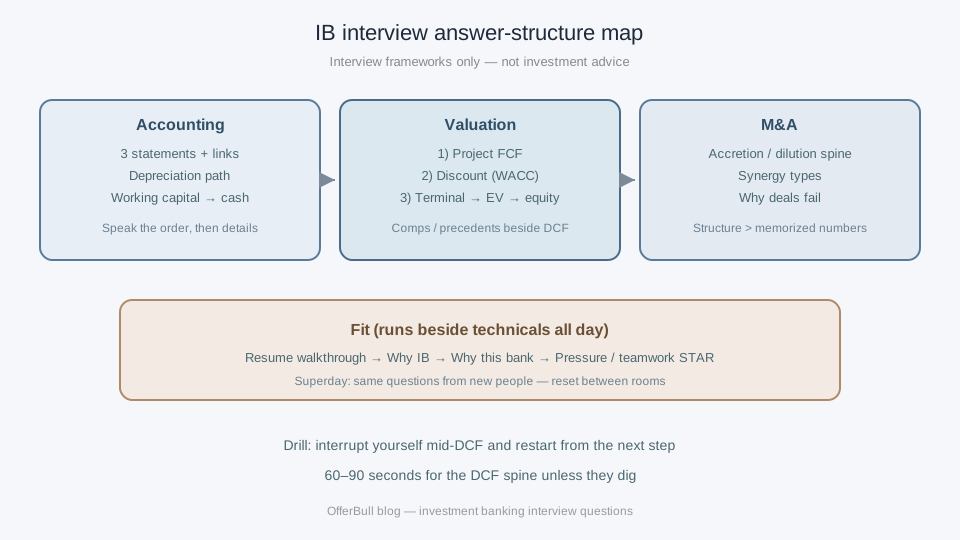 Accounting links → valuation paths → M&A. Fit sits beside the stack all day.
Drill list
Fit: resume walkthrough; why IB; why this bank/group; failure; tight deadline teamwork; strengths/weaknesses; where else interviewing; your questions.
Technical: three statements; DCF; depreciation path; EV vs equity; comps/precedents high level; accretion/dilution; FCF if inventory rises; stock pitch if your process uses it (thesis, drivers, risks — interview style, not a trade tip for readers).
Time it. Interrupt yourself mid-DCF. Restart. Closer to the room.
Mistakes on technicals
Starting a DCF in the middle. WACC as a magic number with no parts. “Synergies” with no type. Freezing when interrupted instead of “I’ll pick up from discounting.” Fake precision on a napkin question.
On fit: resume tours that never arrive at banking. “Why this bank” that works for every logo on the street.
Practicing with OfferBull
Flashcards miss filler words. Talking catches them.
OfferBull is an AI mock interview app for iOS and Android. Interviewer voice asks out loud. You answer by speaking. Paste a job description or upload a resume and questions follow that context. Follow-ups based on what you said. During practice it can show answer suggestions and STAR structures when a story wanders. English and Chinese.
Before interview day. Not during a real Superday.
FAQ
Fit vs technical? Fit = motivation, resume story, teamwork, pressure. Technical = accounting, valuation, deal mechanics. Most processes use both.
How long for a DCF walkthrough? 60–90 seconds for the spine. Longer only if they expand a step.
Do I need a perfect Excel model? Many first rounds care more about clean spoken structure. Some add a modeling test. Follow the invite.
Can I say I don’t know? Say what you do know, how you’d reason, where you’d look. Silence is worse than a partial spine.
Is this investment advice? No. Interview prep. Fictional frameworks for answering questions.
Behavioral depth? STAR method and the behavioral question bank.
Practice This Out Loud
Tonight: one resume walkthrough, one Why IB, one DCF. Interrupt yourself once mid-answer and restart. Then a voice mock with follow-ups. → Practice Now