 OfferBull
How to Answer "Why Should We Hire You?" (With Examples) | OfferBull
How to Answer “Why Should We Hire You?” (With Examples)
Last five minutes. Notebook closed. “So… why should we hire you?”
You smile. Then you list “hard-working,” “team player,” and your years on the resume. Room cools. Soft close. Hard question.
Why should we hire you is not a compliment trap. They want a short pitch. What this seat needs. Proof you’ve done something close. Why you fit this team now. Aimed at US/UK/CA/AU seekers across roles. Samples are made up. Steal the shape. Swap your receipts.
Tech loops can go deeper here: how to answer why should we hire you in tech interviews. This post stays cross-role.
The 3-part answer: needs → proof → fit
I’d keep it to about a minute. Maybe ninety seconds if they lean in.
Needs. Name two things this job must get done next quarter. Pull from the JD and what you heard in the room.
Proof. One scene. Not a trait list. A time you shipped, fixed, sold, supported, or coordinated something similar.
Fit. One line on why this team. Not “great culture.”
Out loud I’d sound like this:
“You’re hiring someone who can own the intake mess and keep ops calm when volume spikes. Last year our refund queue had three tools and no owner. I mapped the path, cut two handoffs, wrote a one-page runbook. Handle time dropped. I want that same seat here because you’re scaling support without adding chaos.”
Needs first. Proof second. Fit last. Flip it and you sound like you’re auditioning your ego.
Self-pitch cousin: tell me about yourself sample answers. Strengths cut of the same idea: what are your strengths.
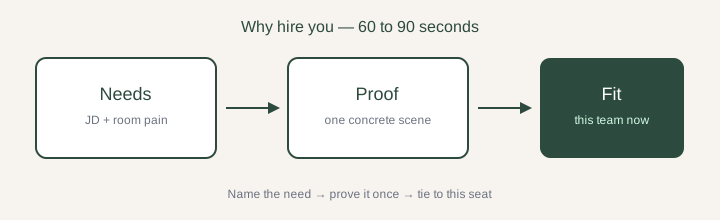 Name the need. Prove it once. Tie to this team.
How to pull “needs” from a messy JD
Open the posting. Circle verbs. Circle outcomes. Ignore fluff.
“Cross-functional,” “own,” “reduce,” “launch,” “on-call,” “close,” “coach.” Those are your needs line. If the interviewer already named a pain (“our handoff between sales and CS is broken”), use their words. Parroting the JD without listening is obvious.
Write three bullets the night before:
- Need I heard / read
- Proof story that maps
- One risk if I oversell it
Two needs is enough. Three if the role is broad. A laundry list of skills is a resume with eye contact.
Sample answers by role (fictional)
Steal the shape. Not the plot.
Software / product-adjacent
I’d say it like this, no slides:
“You’re looking for someone who digs into unclear production issues without waiting for a perfect brief. We had intermittent timeouts in one region. I sliced logs, reproduced with a small script, landed a cache TTL fix with infra. P95 came down. I’d bring that ‘prove it local first’ habit here, especially while you’re splitting the monolith.”
Data / analytics
“You need someone who checks the join before trusting the chart. A weekly board deck double-counted users after a schema change. I caught it in staging, fixed the join, and added a row-count check. The meeting used the clean number. For this seat I’d rather look slow for ten minutes than confident and wrong.”
Sales
“You’re hiring for clean pipeline, not just logos. A big account wanted a demo in week one with no problem statement. I pushed for the buying trigger first. We paused. They came back with a real pain and a budget owner. Short cycle. Cleaner forecast. I’d run the same qualify-hard habit here.”
Customer support / success
“You need someone who writes the fix so the next person doesn’t need me. Password-reset tickets were eating the queue. I rewrote the help article, tagged the top error codes, and cut that volume about a third. Strength is documentation people actually use. That’s the gap I heard on your team.”
Ops / coordinator
“You’re hiring someone who makes invisible work visible. Vendor renewals lived in five inboxes. I built a shared tracker with owners and dates. Zero surprise renewals that quarter. Boring system. Real value. I’d do the same for your vendor and contract chaos.”
Marketing / content
“You need clarity that converts, not clever copy. We had a campaign page that sounded smart and converted poorly. I rewrote to the one promise in the ad, A/B’d the hero, kept the quieter version. Clarity beat clever. I’d bring that kill-the-clever draft habit to this brand.”
People / recruiting
“You’re looking for someone who closes the loop even when the answer is no. We were losing brand on slow rejects. I set a 48-hour note rule after onsite debriefs. Candidate feedback on process ticked up. Respect is a strength you can schedule. I’d bring that here.”
More story shapes: behavioral interview questions and answers and STAR method interview questions and examples.
By experience level
Early career / career switch
You don’t need ten years. You need one honest transfer.
“You’re hiring for someone who learns systems fast and doesn’t hide gaps. In my last role I owned a messy intake spreadsheet nobody trusted. I cleaned the fields, wrote a two-page guide, and trained two teammates. Error rate dropped. I haven’t done your exact stack yet. I have done the habit you need: make the process teachable.”
Campus and first-job angles: entry-level interview questions when you have no experience.
Mid-level
Lead with ownership, not title.
“You’re looking for someone who can own a lane end to end. I ran the monthly forecast for a mid-market book. When we missed, I rebuilt the bridge same day, sat with sales ops, and we added a discount check into the weekly pack. Next quarter that segment’s error shrank. I’d take that same ownership on your reporting lane.”
Senior / lead
Show judgment and how you multiply others.
“You need someone who can set the bar and still touch the work. When our on-call noise spiked, I didn’t just page more people. I cut alert noise, wrote a triage doc, and paired juniors on the first three incidents. MTTR dropped. Mentoring without removing myself from the pager. That’s the seat I want here.”
Mistakes that kill the close
Adjective salad. “Hard-working, passionate, team player.” Wallpaper. Swap for one scene.
Resume karaoke. They already have the PDF. Pitch the match, not the chronology.
Company compliment with zero specifics. “I love your culture” without a product, customer, or team detail reads as empty.
Humble-brag dodge. “Oh I don’t know, you’d have to tell me” wastes the ask. Answer. Then invite follow-up.
Rambling past two minutes. Precision signals confidence. Cap it. Leave air for their next question.
Ignoring what they said earlier. If they spent twenty minutes on a handoff problem and you pitch “I code fast alone,” you weren’t listening.
Weakness cousin so you don’t contradict yourself later: what is your greatest weakness answers.
How I’d practice the night before
Write the three lines on paper. Needs. Proof. Fit. Say them out loud once sitting, once standing, once after a cold open like “tell me about yourself.” Record on your phone. Listen for filler and fake energy.
If the answer only works when you read it, it isn’t ready.
Full prep checklist energy: how to prepare for a job interview.
OfferBull is an AI mock interview app for iOS and Android. A voice interviewer asks questions aloud. You answer by speaking. Paste the job description or upload a resume so prompts match the seat. Follow-ups track your answers and resume. While you practice, you get answer suggestions and STAR structures. English and Chinese both work.
Practice before the interview. Not during it.
Want that drill with follow-ups? OfferBull mock interview.
Also building the growth story they ask next: where do you see yourself in 5 years.
FAQ
How long should the answer be? About 60–90 seconds. Longer only if they ask a follow-up.
What if I’m less experienced than other candidates? Sell transferable proof and learning speed. Don’t apologize for the gap in every sentence.
Should I mention salary or title ambition here? No. This is value for their seat. Save compensation for salary expectations style questions.
Is it OK to say I’m the best? Skip the superlative. Show the match. Let them decide “best.”
What if I blank? Restart with the need you heard. “You’re solving X. Here’s one time I did something close.” Then stop.
Take Control of Your Career Path:
- Official Site: www.offerbull.net/mock-interview
- iOS App: Download for iPhone/iPad
- Android App: Download for Android