 OfferBull
How to Answer "Why Are You Leaving Your Current Job?" (Without Red Flags) | OfferBull

How to Answer “Why Are You Leaving Your Current Job?” (Without Red Flags)
Minute fourteen. Notebook still open. “So… why are you leaving your current job?”
Your stomach drops. You either trash your boss for three minutes or invent a vague “new opportunities” line that sounds like a LinkedIn bot. Both hurt you.
Why are you leaving your current job is a risk filter. They want a clean reason that doesn’t scream drama, bitterness, or flightiness. Aimed at US/UK/CA/AU seekers across roles. Samples below are fictional. Steal the shape. Swap your facts.
If you were laid off or took a break, keep the framing short and forward. Deeper comeback playbooks: tech interviews after a layoff and tech interviews after a career gap. This post stays on the spoken answer itself.
What they’re actually screening for
Three checks. Fast.
Stability. Will you bolt in six months for the same vague itch.
Judgment. Can you talk about a hard exit without roasting people.
Fit. Does your reason line up with what this seat offers.
They’re not asking for therapy. They’re asking if hiring you is safe.
Safe framing: growth, scope, burnout, layoff
Pick one primary reason. One. Stacking three motives makes you sound like you’re shopping excuses.
Growth / scope. “I’ve hit the ceiling on what I can own here. Your role has the next layer of ownership I want.” Concrete. Not “I want to grow” with empty air after it.
Burnout recovery (careful). You can say the pace or scope stopped being sustainable. Then pivot hard to what you’ve reset and why this job fits the new pace. Don’t dump a medical diary.
Layoff / reorg. Name it once. No apology tour. “My team was cut in a reorg. I’m interviewing for roles where I can own X again.” Then move on. Lingering on fairness reads as stuck.
Misaligned seat. “The role drifted into pure ops and away from the customer work I’m best at. This posting is back in that lane.” Honest. Not “they didn’t get me.”
Relocation / life logistics. Fine if true. Keep it one sentence. Don’t invent it.
My honest take? Growth and scope land cleanest when they’re real. Layoff is fine when you don’t over-explain. Pure “toxic culture” stories almost never help in a first chat, even when they’re true.
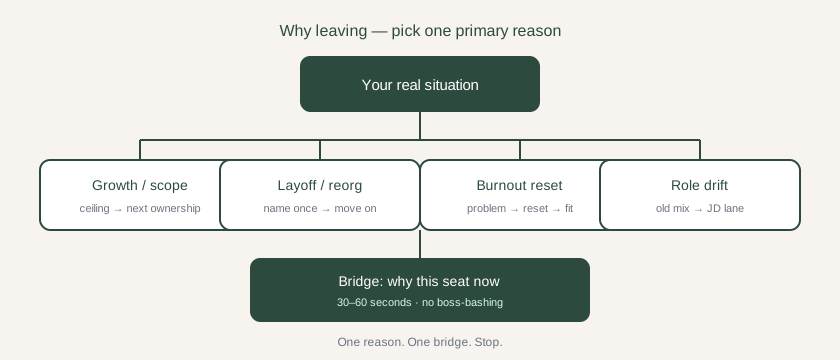 Pick one primary reason, then point forward to this seat.
Spoken sample answers (illustrative)
These are made up. Names, companies, numbers: invented. Use them as rhythm, not as your script. Interviewers ask follow-ups. A borrowed story cracks.
Growth / next ownership
“I’m leaving because I’ve maxed what I can own in my current seat. I run the weekly reporting pack end to end, but the next step — owning the forecast model and the stakeholder brief — isn’t open on my team for a while. Your role has that ownership on day one. That’s the move I want.”
After a layoff
“My role was eliminated in a March reorg. Not performance. The product line got cut. I’ve spent the last few weeks tightening my story bank and interviewing for seats where I can own customer onboarding again. This posting matches that lane. Happy to walk through a recent project if useful.”
Short. Forward. No villain.
Burnout, then reset
“I burned out on a twelve-month stretch of pure firefighting with no backlog ownership. I took two weeks, rebuilt my sleep, and I’m targeting roles with clearer priorities and a real planning cadence. From what you’ve described, this team runs that way. That’s why I’m here.”
Notice: problem, reset, why this job. Not a rant.
Role drift
“When I joined, the job was fifty-fifty customer work and internal process. Over eighteen months it became almost all tickets. I’m good at tickets. I’m better at the customer diagnosis work your JD highlights. I want back into that mix.”
Career switch (same company exit)
“I’m leaving because I’ve decided to move from ops into analytics full time. I’ve already done two internal projects with SQL and dashboards, and this analyst role is the clean next step. Staying would keep me half in, half out.”
Pair that with how you sell transferable proof: why should we hire you answers and what are your strengths.
 Rehearse the leaving answer out loud before the real room.
What never to say (even if it’s true)
Boss-bashing. “My manager is incompetent / micromanages / plays favorites.” They hear: you’ll trash us later.
Salary as the only reason. Money matters. Leading with “they won’t pay me more” without any scope story sounds transactional. Save numbers for the offer stage or a clear salary expectations question.
Gossip. “Everyone’s quitting” or named drama. You look like a liability.
Lie about being employed. If you’re out, say you’re out. Recruiters check. Getting caught is worse than a clean layoff line.
“I’m bored” with no next skill. Boredom without a destination sounds like you’ll get bored here too.
Over-sharing health or legal detail. Protect privacy. “I needed to reset after a hard year” is enough unless they ask something appropriate and you choose to share more.
Comparing companies like a Yelp review. “You’re better than them” is flattery without proof. Tie to the work, not the roast.
If you need structure for the story part of any follow-up, use STAR method interview questions and examples.
Bridging to “why us” without sounding rehearsed
After they ask why you’re leaving, the next beat is often why them. Don’t paste a separate speech. Bridge in one line.
“…and the reason your role stood out is the ownership of [X] you described on the call.”
That line is the hinge. Leaving reason → this seat. If you can’t name X, you weren’t listening. Go back to the JD and your notes.
Same honesty rule as the hire pitch: why should we hire you answers. Different question. Same no-fluff bar.
Internal transfer that fell through
“I tried for an internal move onto the analytics pod. Timing didn’t work; the headcount froze. I’m not angry about it. I am clear that analytics is the lane I want next, and your opening is the external version of that move.”
Clean. No bitterness at HR. Shows you already chose a direction.
 One reason on paper. Then the bridge to this seat.
How to practice so it doesn’t wobble
Write your one reason in one sentence. Say it out loud. Then add one bridge to this job. Record on your phone. Listen for bitterness. If you hear a sneer, cut that clause.
I’d drill it after a cold open like “tell me about yourself,” because that’s when the leaving question often lands. Full sequencing help: how to prepare for a job interview.
OfferBull is an AI mock interview app for iOS and Android. A voice interviewer asks questions aloud. You answer by speaking. Paste the job description or upload a resume so prompts match the seat. Follow-ups track your answers and resume. While you practice, you get answer suggestions and STAR structures. English and Chinese both work.
Practice before the interview. Not during it.
Want that drill with follow-ups? OfferBull mock interview.
FAQ
Should I say I’m still employed if I already resigned? If you’ve resigned and a date is set, say so. “I’ve given notice; last day is the 28th.” Clear beats coy.
What if I was fired? Don’t invent a layoff. A short honest line plus what you changed is safer than a cover story. Practice the follow-up with a trusted person first.
How long should the answer be? Thirty to sixty seconds. Then stop. Let them ask.
Can I mention pay at all? Only as a secondary point, and only if they open compensation. Lead with scope or fit.
What if I have no “good” reason and just need a job? Still pick a forward reason. “I’m looking for a more stable team with clearer ownership” beats “I just need anything.”
Take Control of Your Career Path:
- Official Site: www.offerbull.net/mock-interview
- iOS App: Download for iPhone/iPad
- Android App: Download for Android