 OfferBull
How to Answer "Where Do You See Yourself in 5 Years?" | OfferBull
How to Answer “Where Do You See Yourself in 5 Years?”
Chair scrapes. Hiring manager leans in. “Where do you see yourself in five years?”
You panic. Invent a VP title you don’t even want. Or freeze and say “wherever the company needs me.” Both land wrong.
They’re not asking for a prophecy. They’re checking if you’ll stick, grow, and stay sane.
Where do you see yourself in 5 years filters retention, ambition, and realism. Aimed at US/UK/CA/AU seekers. Samples are made up. Steal the shape. Don’t fake a five-year org chart.
Pair with your hire pitch: why should we hire you answers. Same honesty rule. Different time horizon.
What they’re actually checking
Three things. Fast.
Retention. Will you bolt in twelve months for a random title bump.
Ambition that fits the seat. Hungry is good. “I want your job in year two” is not.
Realism. Do you know how growth actually works here. IC track. Lead track. Specialist depth. Lateral moves.
They’re hiring someone who can picture a useful path inside this place. Not a motivational poster.
If you just walked through your story: tell me about yourself sample answers.
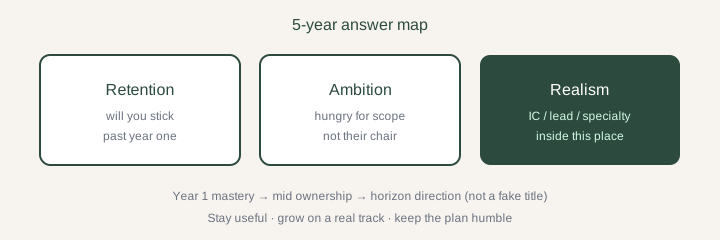 Stay useful. Grow on a real track. Keep the plan humble.
A simple shape that survives follow-ups
I’d keep it under ninety seconds. Three beats.
Near term, year one. Get strong at the core of this job.
Mid, years two and three. Own a bigger slice. Harder problems. Mentoring. A specialty. Or a cross-team lane.
Horizon, years four and five. A direction, not a fake title. Deeper IC. Lead. Domain expert. Adjacent move inside the company.
Out loud I’d say:
“In year one I want to be trusted on the messy intake work you described. By year two or three I’d like to own that lane and coach newer folks through it. Longer term I see myself as the person others pull in when handoffs break. Title is less interesting to me than that reputation.”
Notice what’s missing. “CEO.” “Your job.” “I’ll open a competing startup next door.”
Sample answers by path (fictional)
Individual contributor growth
I’d keep it plain:
“I see myself still close to the work. Year one, ship reliably on this stack and earn trust on production issues. Years two and three, take the thornier designs and leave better docs behind. In five years I’d like to be a senior IC people trust on gnarly bugs and clear tradeoffs. Management is open later. Not my first hunger.”
Lead / people path
I’d say it without the corporate shine:
“Short term I want to be excellent in this IC seat so I know what good looks like. Mid-term I’d like stretch chances. Mentoring. Interviewing. Owning a small workstream. In five years, if the team needs it and I’ve earned it, I’d hope to lead a small group. I care more about growing people than collecting a title.”
Specialist depth
Swap in the domain they care about:
“I want to go deep in the payment risk work you mentioned. Year one, nail the fundamentals of this role. Then become the person who can explain the hard edge cases without hand-waving. In five years I’d like to be the specialist others ping before a risky change. Breadth later. Depth first.”
Switch within the company
“I’m applying for this seat because it’s the right next step. In a few years, if I’ve delivered here, I’d be open to an adjacent move. Product-adjacent. Another customer segment. Same company. I don’t want to job-hop for novelty. I want to grow where the problems are real.”
Career-switch framing that still sounds grounded: career switch into tech interview guide.
Early career / first full-time seat
No fake ladder. Just this:
“Honestly, five years ago I didn’t know this field existed. So I’ll stay humble. Year one, learn the craft and be useful without constant hand-holding. Mid-term, own a small area and help the next new hire. In five years I want to be someone this team is glad they bet on. Exact title TBD. Work ethic isn’t.”
First-job nerves: entry-level interview questions when you have no experience.
Weak version vs strong version
Weak: “In five years I see myself in a leadership position where I can use my passion to drive impact and grow with the company.”
Empty. No near-term. No proof shape. Ban-list energy.
Stronger, out loud:
“Year one I want to be the person you trust on customer escalations without a script. By year three I’d like to own the playbook and train two teammates on it. In five years I hope I’m still solving harder versions of that problem here, maybe as a lead if the team needs one. I’m less attached to the title than to being useful.”
Same ambition. Actual path. You can hear the job.
If they ask how you’ll measure progress, keep it observable. Trusted on-call. Owned a doc. Shipped a lane. Coached someone through their first incident. Not “became a thought leader.”
When the interviewer pushes back
They might say: “We don’t have a manager track,” or “This role stays IC for a long time,” or “What if priorities shift?”
Good. That’s a gift.
Answer the constraint out loud.
“Then I’d double down on senior IC depth and mentoring without the formal title. The five-year picture for me is reputation and scope, not a specific box on the org chart.”
Or this version:
“If priorities shift, I’d want to stay useful on whatever problem is loudest, as long as I’m still growing craft. I’d rather adjust the path than force a title that doesn’t exist.”
Don’t argue them into inventing a promotion for you on the spot.
Mistakes that make them nervous
Instant executive fantasy. “I see myself running the org.” Reads as you already outgrew the job you’re interviewing for.
No plan at all. “I go with the flow” sounds like you’ll leave when a shiny LinkedIn message lands.
Plan that exits them. “I’ll learn here then start a competitor” is brave and dumb in the same breath.
Copy-paste ambition. Same “senior then manager then director” script for every company. They can hear it.
Contradicting your strengths pitch. If you sold “deep IC craft” and then pivot to “I only want people management,” pick a lane for this room. Strengths refresher: what are your strengths.
Treating five years as a contract. You’re sketching direction. Not signing a blood oath. Say you’re flexible when the business shifts.
Behavioral story bank for the growth receipts they’ll ask next: behavioral interview questions and answers and STAR method.
How I’d prep without sounding scripted
Write three bullets. Year-1 focus. Mid growth. Five-year direction. Say them once into your phone. Then answer a curveball out loud: “What if we don’t have a manager opening?” Your reply should still work. That means your plan isn’t title-only.
If the company publishes engineering or career ladders, skim them. Use their language lightly. Don’t recite the ladder like a brochure.
Night-before checklist energy: how to prepare for a job interview.
OfferBull is an AI mock interview app for iOS and Android. A voice interviewer asks questions aloud. You answer by speaking. Paste the job description or upload a resume so prompts match the seat. Follow-ups track your answers and resume. While you practice, you get answer suggestions and STAR structures. English and Chinese both work.
Practice before the interview. Not during it.
Want that drill with follow-ups? OfferBull mock interview.
FAQ
Do I have to want management? No. Many teams love strong ICs. Say that clearly if it’s true.
What if I genuinely don’t know? Say what you want to get good at in year one, and that you’re open on title later. Specific near-term beats fake long-term.
Can I say I might leave for grad school? Risky. If it’s real and soon, be honest with the recruiter earlier. Don’t spring a two-year exit in the final round.
Is “in your seat” a compliment? Usually no. It puts the interviewer on defense. Aim beside their path, not at their chair.
How long should I talk? About a minute. Stop. Let them poke.
Take Control of Your Career Path:
- Official Site: www.offerbull.net/mock-interview
- iOS App: Download for iPhone/iPad
- Android App: Download for Android