 OfferBull
"What Is Your Greatest Weakness?" 12 Honest Example Answers | OfferBull

“What Is Your Greatest Weakness?” 12 Honest Example Answers
They ask. Brain offers two bad gifts: “I work too hard,” or a confession that sinks the hire. Neither lands.
What is your greatest weakness is self-awareness with a trail of work. Real gap. What you did. Proof it’s shrinking. Not a humblebrag. Not a landmine.
Why they ask, a short formula, twelve fictional answers by role, what I’d skip, FAQ. Tech-shaped cousin: how to answer what’s your biggest weakness in tech interviews.
Samples are illustrative. Names, employers, numbers: made up. Steal the shape.
Why they ask
Three checks under the question.
Do you know yourself well enough to name a real gap? Do you work on it without waiting for a manager to force it? Will this gap break the job you’re applying for?
“Weakness” that’s a strength in a cheap costume? They hear spin. Core to the role and untreated? They hear risk. Aim for honest-and-managed.
The formula: real weakness → action → progress
Under ninety seconds when spoken.
1. Name a real weakness. Specific. Observable. Skip “I’m a perfectionist” unless you can show the cost.
2. Say what you changed. Process, habit, tool, feedback loop. One concrete move beats three adjectives.
3. Show progress. Before/after. A metric if you have one. A peer note if you don’t. Then stop. Don’t apologize for existing.
Already use STAR for behaviorals? This is a cousin. Old habit = Situation. Fix = Action. Progress = Result. More shapes: STAR method interview questions and examples, behavioral interview questions and answers.
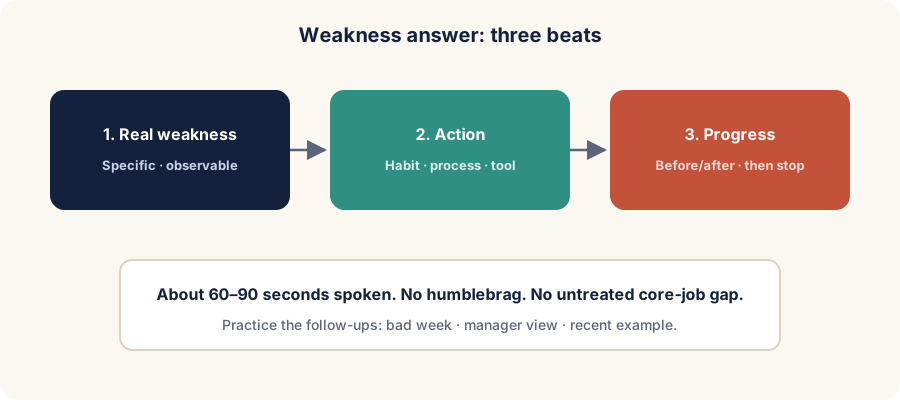 Name it. Act on it. Show progress. Then shut up.
12 honest example answers (fictional)
Say each once out loud. Then rebuild with your facts.
1) New grad: public speaking
“I used to freeze in group presentations. Last project course I volunteered for the midterm demo on purpose, recorded myself weekly, asked two classmates to cut me off when I filled silence with ‘um.’ Still not a keynote person. I can walk a room through a five-minute demo without reading slides.”
2) Career changer: domain vocabulary
“Came from teaching into customer success. Lagged on product jargon. Kept a glossary, shadowed two tenured reps, reviewed one recorded call a week. I still ask on edge cases. I don’t slow the room on basic terms anymore.”
3) Software engineer: estimating
“I under-estimated work that touched legacy billing. After a two-week slip I started writing risks into every estimate and adding a buffer when more than two systems were involved. Last three deliveries landed inside the range I gave.”
4) Product manager: saying no early
“I kept weak requests alive to avoid conflict. Stakeholders got whiplash. Now I write decision memos with a clear no and the trade-off in paragraph one. Two roadmap cuts last quarter stuck without a late thrash.”
5) Data analyst: stakeholder translation
“I defaulted to chart dumps. Partners glazed over. Switched to one-sentence finding, one chart, one recommended action. Meetings got shorter. Follow-ups got sharper.”
6) Sales: listening vs pitching
“I jumped to pitch before I understood the constraint. Lost a deal that needed a phased rollout, not the full suite. Now I ask three constraint questions before any demo and repeat the constraint back. Mid-market win rate moved after that stuck.”
7) Nurse / clinical: asking for help soon enough
“Early on I waited too long to escalate when a protocol felt unclear. One near-miss on medication timing taught me. I confirm with charge at the first doubt and document it. Safer. Faster than guessing.”
8) Designer: scope creep in polish
“I chased pixel polish past the decision deadline. Started time-boxing polish and shipping a ‘good enough for test’ build with a punch list. Tests happen earlier. Polish happens after we know what matters.”
9) Manager: delegating unfinished thinking
“I handed off tasks with half the context still in my head. People reworked. Now I write a short brief: outcome, constraints, definition of done. Rework tickets dropped once that became default.”
10) Customer support: tone under ticket load
“Queue spiked. I got clipped in chat. Feedback said so. Added a two-line empathy opener and a five-minute cool-down before hard replies. CSAT on my queue tickets recovered the next month.”
11) Returning parent: confidence after a gap
“Three years out. I undersold recent project work and over-explained the gap. Rebuilt a tight present-past-future intro and practiced it timed. I still mention the gap once if asked. I don’t lead with apology. Opener shapes: tell me about yourself sample answers.”
12) Marketing: shiny-object campaigns
“I chased new channels before the last one had a clean read. Now I require a one-metric success definition and a kill date before launch. Two campaigns got cut early last quarter instead of limping for months.”
 Say the weakness. Then the fix. Then the proof. Cut the apology tour.
Weaknesses to avoid
Fake strengths. “I care too much.” “I’m a perfectionist.” They’ve heard the costume.
Core job killers, untreated. Senior IC who hates independent work with no fix. People manager who avoids hard feedback with no system.
Wrong territory. Health details they didn’t ask for. Named ex-employer drama. Anything that turns the room into HR risk.
No progress line. Raw wound, no action. Sounds like tomorrow’s performance issue.
My honest take? Pick a real, non-central gap you’ve already started fixing. Boring honesty beats clever spin.
 Cue the three beats. Don’t script a monologue.
How to practice it
Three bullets on paper: weakness, action, progress. Speak sixty to ninety seconds. Record. Cut throat-clearing and double apologies.
Then the cousins out loud: “How do you handle that on a bad week?” “What would your manager say?” “Example from the last six months?”
Peer mock or AI voice mock both work if someone pushes the follow-up. Bank: mock interview questions. Speak/record loop: how to practice for an interview.
FAQ
Can I say I don’t have one? No. Everyone has gaps. Refusal reads as low awareness.
Is perfectionism ever okay? Only with a real cost and a real fix. Most versions sound rehearsed.
Mention a weakness from the job description? Risky. Central to the role = volunteering a misfit. Pick adjacent, not core.
How long? About a minute. Ninety seconds max. Progress line, then stop.
They ask for a second weakness? Lighter backup ready. Same formula. Don’t recycle the humblebrag.
Practice with OfferBull
Flashcards don’t train the pause after you name the gap.
OfferBull is an AI mock interview app for iOS and Android. Voice interviewer. You speak. Paste a JD or upload a resume. Follow-ups on what you said. Suggestions and STAR while you practice. English and Chinese.
Before the interview. Not during.
Practice This Out Loud
Tonight: one real weakness. Write action + progress. Record a 75-second answer. Replay once. Answer one follow-up. Then a short voice mock. → Practice Now