 OfferBull
How to Answer "What Are Your Strengths?" (Examples by Role) | OfferBull

How to Answer “What Are Your Strengths?” (Examples by Role)
Minute eight. Hiring manager smiles like this is softball. “What are your strengths?” You list five adjectives. Room goes quiet. Softballs still need a swing.
What are your strengths is a fit filter dressed as small talk. They want one or two traits that match the job, plus proof you have used them under pressure. Not a personality brand deck. Aimed at US/UK/CA/AU seekers across tech and non-tech seats. Samples are made up. Swap in your own receipts.
Pair this with the flip side: what is your greatest weakness answers. Same honesty rule. Different direction.
Choose strengths from the JD, not from a vibes list
Open the posting. Circle three verbs and two outcomes. Those are your shortlist.
If the JD screams “cross-functional,” don’t lead with “I code fast in isolation.” If it screams “on-call ownership,” don’t lead with “great at brainstorming.” Pick strengths the seat will use next quarter.
I’d keep a messy table the night before:
- Strength in plain words
- Where it showed up once (project, team, customer)
- One number or observable change
- Risk if I overplay it (so I don’t sound fake-humble later)
Two strengths is enough. Three if they ask “and another.” A laundry list sounds like you are guessing.
Good: “I turn fuzzy requests into testable criteria.” Bad: “I’m a passionate team player who thrives in fast-paced environments.” That second sentence is wallpaper.
Self-pitch still matters before they dig: tell me about yourself sample answers.
 JD verbs first. Then one proof story each.
Prove it with a mini-story (not a slogan)
Structure that survives follow-ups:
- Name the strength in one breath.
- Drop into a 45–60 second scene.
- End with a result they can picture.
- Tie it back to this role in one line.
You do not need a full laminated STAR speech every time. Mini-STAR is fine. Situation and Task can share a sentence. Action gets the airtime. Result lands.
Out loud I’d sound like this: “One strength is simplifying messy ops. Last quarter our refund queue had three tools and no owner. I mapped the path, cut two handoffs, and wrote a one-page runbook. Average handle time dropped. In this seat I’d use the same habit on your intake flow.”
If they poke “how do you know it was you,” have the second layer ready: who else was in the room, what you personally changed, what stayed broken until you moved.
More shapes live in behavioral interview questions and answers.
Strengths interview answer examples by role
Steal the shape. Not the plot. All fictional.
Software engineer
“I dig into unclear production bugs without waiting for a perfect brief. We had intermittent timeouts only for one region. I sliced logs by region, reproduced with a small script, and landed a cache TTL fix with infra. P95 came down. For this role I’d bring that same ‘prove it local first’ habit.”
Product manager / BA-adjacent
“I separate need from solution early. Stakeholders kept asking for a new portal. I asked what job failed today. We needed faster status, not a portal. I rewrote the need, eng proposed options, we shipped a status surface in two sprints. Saves rebuild theater.”
Data / analytics
“I check the join before I trust the chart. A weekly board deck double-counted users after a schema change. I caught it in the staging pull, fixed the join, and added a row-count check. The meeting used the clean number. I’d rather look slow for ten minutes than confident and wrong.”
Sales
“I qualify hard even when the pipeline looks thin. A big logo wanted a demo in week one with no problem statement. I pushed for the buying trigger first. We paused. Two weeks later they came back with a real pain and a budget owner. Short cycle. Cleaner forecast.”
Customer support / success
“I write the fix so the next person doesn’t need me. Repeat tickets on password resets were eating the queue. I rewrote the help article with screenshots, tagged the top error codes, and cut that volume about a third. Strength is documentation that people actually use.”
Marketing / content
“I kill drafts that don’t match the brief. We had a campaign page that sounded clever and converted poorly. I rewrote to the one promise in the ad, A/B’d the hero, and kept the quieter version. Clarity beat clever.”
Ops / coordinator
“I make invisible work visible. Our vendor renewals lived in five inboxes. I built a shared tracker with owners and dates. Zero surprise renewals that quarter. Boring system. Real strength.”
People / recruiting
“I close the loop with candidates even when the answer is no. We were losing employer brand on slow rejects. I set a 48-hour note rule after onsite debriefs. Candidate NPS on process ticked up. Respect is a strength you can schedule.”
Hiring pitch cousin: how to answer why should we hire you in tech interviews. Same evidence habit.
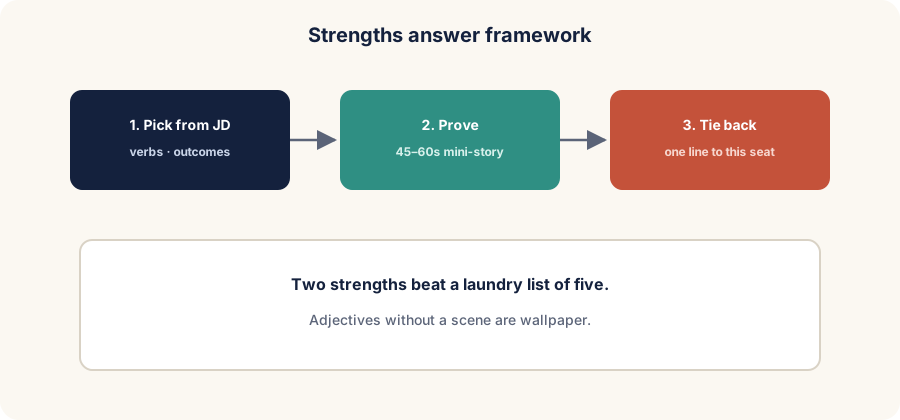 Pick from the JD · prove with a scene · tie to this seat.
How a weak version sounds vs a strong one
Weak: “My strength is communication. I communicate well with stakeholders and keep everyone aligned.”
Strong: “My strength is turning two opposing asks into one decision page. Sales wanted every field on the form. Ops wanted three. I wrote both impacts, booked fifteen minutes, and we shipped the three-field version with a monthly add window. Tickets about missing fields dropped.”
Same trait family. Only the second one is hireable evidence.
If they ask for a second strength, switch lanes. Don’t restate the first with a synonym. Example second for an eng seat after a debugging strength: “I write design notes short enough that reviewers actually finish them.” Then one scene.
Mistakes that make a good strength sound cheap
Listing six strengths. Interviewer hears zero.
Picking strengths that fight the JD. “Independent” for a heavy collaboration seat needs careful framing or a different lead.
No proof. Adjectives without a scene are wallpaper.
Humblebrag detours. “I work too hard” belongs in the weakness answer, and even there it is tired. See the weakness guide.
Reading a paragraph. Strength answers should sound like speech. Short sentences. One concrete noun per beat.
Practice the answer out loud
Sixty seconds. Phone recording. One strength. One scene. One tie-back.
Then swap the JD. Same strength, different tie-back line. If the story only works for one company name, it is too brittle.
OfferBull is an AI mock interview app for iOS and Android. A voice interviewer asks questions aloud. You answer by speaking. Paste the job description or upload a resume so prompts match the seat. Follow-ups track your answers and resume. While you practice, you get answer suggestions and STAR structures. English and Chinese both work.
Practice before the interview. Not during it.
Want that drill with follow-ups? OfferBull mock interview.
 Speak the sixty-second version. Replay. Cut one adjective.
FAQ
How many strengths should I name? One strong one with proof, or two short ones. Stop before the list feels like LinkedIn skills spam.
Is “communication” too vague? Yes, alone. Make it specific: “I write decisions so two teams stop arguing in threads.” Then prove it.
What if my best strength is not on the JD? Lead with a JD match. Offer the off-JD strength only if they ask for another. Fit first.
Can strengths be technical skills? Yes if the seat needs them. “I design APIs that stay boring under load” is a strength. Still bring a scene.
Should strengths match my resume bullets? They should not contradict them. Ideal: the story is a zoom-in on a resume line, not a brand-new claim.
Practice This Out Loud
Tonight: circle three JD verbs. Pick two strengths. Record a sixty-second answer for each. Replay once. Delete one fluffy adjective. Then a short voice mock with follow-ups. → Practice Now