 OfferBull
How to Answer "What Are Your Salary Expectations?" (Scripts) | OfferBull

How to Answer “What Are Your Salary Expectations?” (Scripts)
Required field. Cursor blinking. Or minute twelve on a screen and the recruiter drops it like weather: “What are your salary expectations?” You either whisper a low number or invent one in the parking lot.
That question is a budget filter. Not a personality test. This write-up is for general US/UK/CA/AU seats: ops, sales, marketing, support, finance, coordinator-ish roles. Not another tech-only guide. Already covered that lane: how to answer salary expectations in tech interviews. Samples here use fake $X–$Y placeholders. Not market averages. Do your own tabs.
Research before you open your mouth
Guessing is how people get screened out or leave cash on the table.
I’d make a messy one-pager the night before. Sticky note energy.
Open three recent postings for the same level and city. Pay-transparency ads help a lot in places that require them. Skim BLS wage tables for the occupation family when it fits. Levels.fyi if the seat is tech-adjacent. Glassdoor as a sniff test only. If two sources disagree by a mile, trust the live posting and one peer chat over a random crowd cell.
Read the level words again. Junior. Senior. Lead. People manager vs IC. “Analyst” in Austin is not “Analyst” in New York. Remote roles often price to a stated geo or a company band. Write that geo on the page so you don’t “forget” mid-call.
Total package, not just base. Bonus target. Shift or on-call pay if that’s real for you. Equity only if the role has it. For a lot of non-tech seats, base plus bonus is the whole movie. Say that out loud once so you don’t freeze when they ask about “comp.”
Then your floor. The walk-away number. Quiet. Not the number you lead with.
Bad sentence: “The market average is $87,400.” Good sentence: “Based on postings for this level here and two peer checks, I’m targeting $X–$Y base.” That one survives a follow-up.
 Research first. Blank boxes on paper beat a lobby guess.
What to type on the application form
Forms hate nuance. They want a box.
If text is allowed, I’d paste something like: “Open based on scope and total package. Similar roles in this market sit around $X–$Y base for me.”
Forced single number? Midpoint of your researched range. Or the lowest you’d still sign after you learn the seat. Not your dream top. Not “whatever you pay now” if the market moved up.
Current-salary field where the law limits that ask: follow local rules. Where you can push back: “Prefer to discuss expectations for this role rather than history.”
Blank required field? ATS may just drop you. Painful. Still true.
Scripts for the recruiter call
They ask early so they don’t burn a hiring manager. Treat it like logistics on a phone screen. Short. Clean. Not a speech about your rent.
Soft deflect (no leveling yet):
“I’d like the level and full package first. For similar roles in this market I’m generally in the $X–$Y base range. Flexible for the right scope.”
They need a number today:
“For this level and location I’m targeting $X–$Y base. Open on bonus and the rest once I understand the seat.”
They dig for current pay:
“I go off market for the role, not history. Expectation band is $X–$Y. Happy to align when we confirm level.”
Band sits under your floor:
“Thanks for being straight. That sits under what I need to move. If scope or total package can stretch it, I’m open to keep talking. If not, I appreciate the clarity.”
Say the range once. Don’t apologize. Don’t slash the bottom “to be likable” thirty seconds later.
Sixty seconds max out loud. If you wander into benefits philosophy, you sound unsure. You are unsure. The recording will show it.
When the hiring manager asks
Managers care more about whether you know your level than the exact dollar on day one. Some still ask.
I’d keep it tighter than with the recruiter:
“I’ve looked at postings for this level here. I’m in the $X–$Y base range if the scope matches what we covered. How do you think about leveling for this seat?”
If they already floated a band that fits: “That range works pending full offer details.” Don’t claw the ceiling in the same breath. Save the longer dance for the offer. Process-wise, how to negotiate your tech job offer salary still maps even when equity is thin.
Range strategy: deflect once, then land
Range beats a lonely number. Bottom must be a number you’d sign. Top must be believable for the level.
Width matters. Roughly a 10–15% span in speech. “$80k to $120k” for a mid coordinator often reads as “I didn’t look.” “$92k–$105k” sounds like tabs were opened.
Deflect when the screen is early, level is foggy, or the post had zero pay data. Once. Ask again and they get tired. Give the range.
Give the number when the form requires it, the recruiter cannot advance without a band, the band is already posted and you fit, or you’re in late-stage offer talk.
Fictional only: posting shows $88k–$102k for a coordinator in a mid-cost city. Peers sit near there. You might say “$95k–$105k base depending on bonus and scope.” Floor at $98k? Don’t announce “$90k–$100k” just to sound humble. That humility gets expensive.
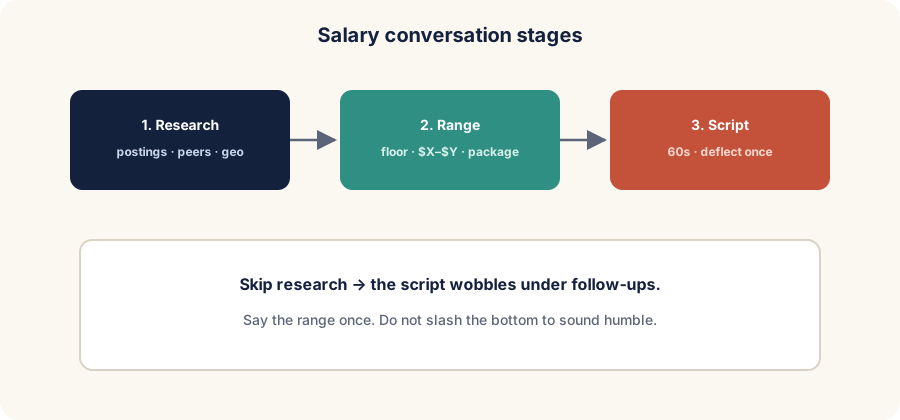 Research → range → short script. Skip step one and the script wobbles.
Mistakes that show up on replay
Anchoring on old pay when the market moved. Sharing a number with zero research. One low number “to get in the door.” Narrating your bills. Asking the recruiter what you should say. Changing your range every round with no new facts.
Salary chat is not the whole negotiation either. Start date. Title. Bonus. Remote days. Learning budget. Get the verbal offer shape before you spend every chip on base.
Week-of prep beyond money: how to prepare for a job interview. The self-pitch still comes first on most screens: tell me about yourself sample answers.
How I’d practice tonight
Phone flat on the desk. Timer ugly and loud.
- Sixty-second researched range. Record. Kill the filler.
- Soft deflect. Then give the range when they push.
- “Band under my floor” exit. Calm. No monologue.
Want a voice interviewer that asks follow-ups from a job description while you speak? OfferBull’s mock interview practice is built for that rehearsal before the real call. Practice only. Not during the recruiter screen.
 Say the range once. Record it. Fix one stumble. Stop rewriting at midnight.
FAQ
Single number or a range? Range. Bottom acceptable. Top realistic for the level.
No idea what to ask? Don’t guess on the live call. Thirty minutes on postings plus one peer check. “I’ll send a range tomorrow morning” beats a panic figure.
Can I ask their budget first? Yes. “Happy to share expectations. Do you have a posted band for this level?” Fits? Say so. They refuse? Give yours.
They lowball after I shared a range? Ask what drove it. Restate your researched band once. See if package or scope closes the gap. Walking is allowed.
Different for tech? Same bones. Equity and ladder names change the vocabulary. Use the tech salary expectations guide when RSUs dominate.
Practice This Out Loud
Tonight: write your floor and a $X–$Y range from real postings. Record a 60-second delivery. One deflect. One “band too low” exit. Replay once. Fix one thing. Then a short voice mock with follow-ups. → Practice Now