 OfferBull
40 Smart Questions to Ask at the End of an Interview | OfferBull
40 Smart Questions to Ask at the End of an Interview
The folder closes with that cheap plastic snap. 4:10pm, if the wall clock is honest. “That’s all from my side. Do you have any questions for me?”
Your brain does a lazy thing here. It wants to say “No, I think you covered everything” because talking feels finished and their chair is already half turned toward the door. I’ve heard that line a lot. It sounds polite. It also tells them your curiosity died the second they stopped pitching you.
I treat questions to ask at the end of an interview as a real part of the hour, not a handshake. You still need to decide if you want the seat. They’re watching how you think when nobody is feeding you a prompt.
Software loops have a narrower list: best questions to ask your interviewer in tech. Three people staring at you at once? Use this page with panel interview questions. Everyone else can stay here. Ops, sales, marketing, support, finance, coordinators, the admin seats, healthcare hiring that isn’t a clinical exam. US, UK, Canada, Australia. Same idea.
The questions and the spoken versions below are made up. Teams, names, the reporting-pack example. Don’t walk in reciting them like a script. Write ones that fit the job you actually want.
Start with who is sitting there
Ask a recruiter how your future boss likes feedback and you’ll get a guess dressed up as insight. Ask a peer to lock your start date and they’ll shrug. Ask an exec about your commute stipend and the air gets weird.
Put the question in front of the person who can actually answer it.
I’d bring eight or ten written down and use three. Live. If they already burned twenty minutes on the first 90 days, asking “so what would the first 90 days look like?” makes you sound like you weren’t in the room. Ask the gap instead. Timeline. Who’s missing on the team. What blew up the last time they hired for this seat.
I write mine in a notebook in the lobby, even if the boxes stay blank until I hear what they skip. Pulse is a bad editor. The week-before work sits in how to prepare for a job interview. Still on that first recruiter call? Phone screen interview questions is the other half of this: they ask, you answer. This post is you asking.
My honest take? Two questions you actually care about beat a printed sheet of six that could fit any company on the block. Depth. Not a performance.
Watch the clock and their shoulders. If they look at the door, ask one and sit back. A good question delivered while they’re late for the next candidate just makes everyone twitch.
Questions for recruiters and hiring managers
Recruiter (process, timing, the edges of compensation)
Recruiters run the process. Steps, dates, who else you’ll sit with, whether the range from the screen still holds. I would not ask them to decode the hiring manager’s personality. They’ll fill the silence with something that sounds official, and you’ll treat it as fact.
How I’d actually say it:
“Thanks. Two things I don’t want to guess about. What does the rest of the process look like from here? And is the range we talked about on the screen still right for this level in [city]?”
Then I shut up. Both answers matter. Talking over the second one wastes the first.
Smart recruiter questions you can pick from:
- What does the rest of the process look like from here?
- What’s the timeline for a decision, and is that date real or a hope?
- How many more conversations should I expect?
- Who else will I meet, and what’s each person evaluating?
- Is there anything in my background you’d like me to clarify before I meet the team?
- Is the salary range we discussed still accurate for this level and location?
- How is this role being measured in the first 90 days, from your side of the process?
- What would make a candidate stand out in the next round?
- If this role isn’t the right level for me, are there other openings I should know about?
- Who should I send a thank-you note to, and is email okay?
Question 6 belongs here if pay hasn’t been named yet and you’re past the first screen. Asking only about money, and asking it first, still lands badly. Pair it with a process question so you don’t sound like a calculator.
Hiring manager (the work, the gaps, the mess)
This is the person who will live with your output. Ask about the problem this hire is supposed to solve, not about free snacks.
Spoken version I’d actually use:
“You mentioned the reporting pack earlier. What’s the hardest problem on your desk that this hire is meant to take off you in the first quarter?”
That’s specific. It proves you listened. Compare that with “So, what are the challenges?” which could apply to any job on earth.
Hiring manager questions:
- What would a strong first 90 days look like in this seat?
- What’s the hardest problem on your desk that this hire is meant to help with?
- How is success measured at the six-month mark? What would “this is working” look like?
- How does this role work with [adjacent team you actually named]?
- What does the team look like today, and what’s missing?
- What’s something about this job that never shows up in the posting?
- How do you like to give feedback, and how often?
- When this role has gone wrong in the past, what happened?
- What’s the biggest change the team went through in the last year?
- How do priorities get set when everything feels urgent?
- What would you want me to own that nobody owns cleanly right now?
- How hands-on are you day to day versus your own manager?
Question 8 is my favorite when the conversation already feels honest. People reveal more when you ask about a past miss than when you ask “What’s the culture like?” Culture answers come out pre-washed.
Questions for peers and executives
Peer (the Tuesday test)
Peers tell you the truth about the work. Not the career-site version. Ask about a normal Tuesday, about disagreement, about who actually helps when the calendar explodes.
How I’d ask it:
“If I sat next to you for a week, what would surprise me? The thing that isn’t in the job post.”
Then wait. The pause matters. People fill silence with the useful stuff.
Peer questions:
- What does a normal Tuesday look like in this role?
- How does the team handle disagreement when two people want different paths?
- What’s something you wish you’d known in week one?
- When you’re slammed, who actually helps?
- How realistic are the deadlines, most months?
- What’s the best part of working with [hiring manager] that they wouldn’t say themselves?
- Where do people get stuck after the first month?
- Do people grab lunch together, or is everyone on their own island?
- What tool or process slows you down the most right now?
- Knowing what you know, would you take this job again?
That last one is sharp. Ask it only if the peer already seems comfortable. If they hesitate, don’t push. The hesitation is data too.
Executive (direction, not your PTO)
An exec conversation is short. They think in bets, trade-offs, and whether this function matters next year. Don’t walk them through your commute. Don’t ask them to explain the product like a tour guide. You should already know the basics.
Spoken line:
“From your seat, how does this team fit the company’s priorities for the next year? I want to understand what ‘good’ looks like above the hiring manager.”
Executive questions:
- How does this team fit the company’s priorities for the next year?
- What does good look like for this function from your seat?
- Where is the company placing bets, and where is it pulling back?
- How do you want this role to communicate upward?
- What’s a recent decision that changed how this team works?
- How do you think about headcount versus output in this function?
- What should I understand about the culture that isn’t on the careers page?
- If this hire is successful a year from now, what actually changed?
That’s forty questions across the four seats. You will not ask forty. You will pick. If the loop turns into a panel, the same lists still work: aim each question at the person who can answer it, then glance at the others. More on that in panel interview questions.
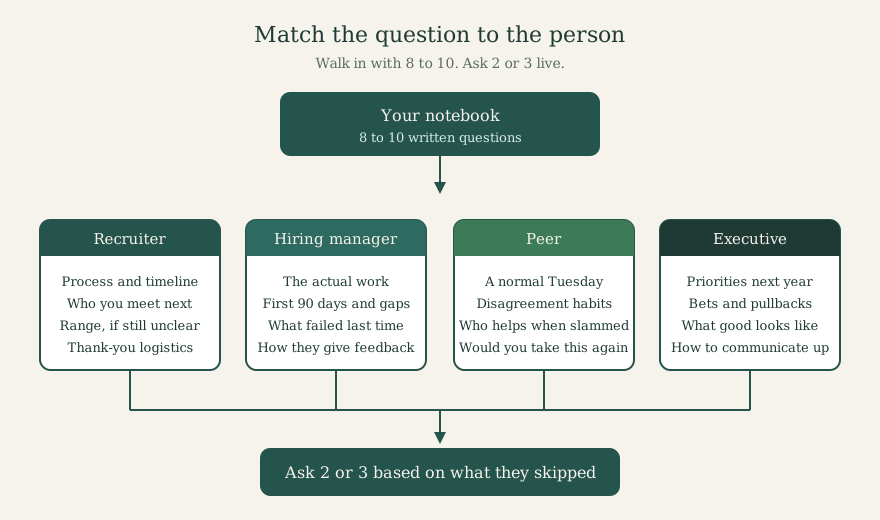 Match the question to the person who can actually answer it.
What I’d never ask in the last five minutes
Some questions aren’t evil. They’re just timed wrong, or they tell on you.
“What does this company do?” You had the website, the posting, and a phone screen. Asking this at the end says you didn’t prepare. For sequencing help before the day, see how to prepare for a job interview.
“How quickly can I get promoted?” Ambition is fine. Leading with the exit from a job you don’t have yet sounds like you’ll be restless in nine months. Ask how people have grown on the team instead.
“Did I get the job?” They can’t answer, and now the air is weird. Ask about timeline instead.
Salary as the only question, asked first, in a final round. Money matters. Opening with it and nothing else, after they just spent an hour on the work, makes the work sound secondary. If pay is still foggy, pair it with a process question and ask the recruiter.
Vacation, remote days, or “what’s the work-life balance?” as your first and only question. Those are legitimate later, especially with a recruiter or after an offer. As your one question to a hiring manager, they can sound like the job is an inconvenience.
Questions about other candidates. “Who else are you interviewing?” puts them in an awkward box and gives you almost nothing useful.
Anything you could have googled in thirty seconds. Office locations, public product lines, last year’s press release. Use your minutes on things that aren’t on the internet.
Gossip bait. “I heard people have been quitting” or named drama. You look like a liability, even if the rumor is true.
I’d also skip the compliment that isn’t a question: “I don’t have any questions. This has been great.” It feels polite. It reads as empty. If they truly covered your list, say so and ask one follow-up on something they already mentioned. “You talked about the Q1 cleanup. What would ‘done’ look like on that by March?” That counts.
How I’d practice the last five minutes
Write your eight-to-ten questions by interviewer type. Say the opener out loud. Record it on your phone. Listen for two failure modes: a stiff recitation, and a ramble that never lands the actual question.
Then run a short mock where someone says “Do you have any questions for me?” and you pick three based on a fake conversation you just had. That’s harder than reading a list, which is the point. A longer bank of practice prompts lives in mock interview questions.
OfferBull is an AI mock interview app for iOS and Android. A voice interviewer asks questions aloud. You answer by speaking. Paste the job description or upload a resume so prompts match the seat. Follow-ups track your answers and resume. While you practice, you get answer suggestions and STAR structures. English and Chinese both work.
Practice before the interview. Not during it. The closing questions deserve the same drill as “tell me about yourself.” You can even practice asking your questions out loud after a mock round ends.
Want that drill with follow-ups? OfferBull mock interview.
FAQ
How many questions should I ask? Two or three, plus one backup if they give short answers. More than that and you start running the meeting.
What if they already answered everything I prepared? Say that, briefly, then ask a follow-up on something they mentioned. Repeating a covered question to prove you have a list is worse than adapting.
Should I ask about salary at the end of every interview? No. Ask a recruiter if the range is still unclear. Don’t make it your only question to a hiring manager in a late round.
Is it okay to take notes while they answer? Yes, if you’re quick and you still look up. Writing shows you care. Staring at the page the whole time does not.
What if I go blank? Keep two all-purpose questions in your pocket: “What would a strong first 90 days look like?” and “What’s something about this job that never shows up in the posting?” They work in almost any general role.
Take Control of Your Career Path:
- Official Site: www.offerbull.net/mock-interview
- iOS App: Download for iPhone/iPad
- Android App: Download for Android