 OfferBull
Phone Screen Interview Questions: What Recruiters Ask and How to Answer | OfferBull

Phone Screen Interview Questions: What Recruiters Ask and How to Answer
Unknown number. Recruiter first name. “Got 20 minutes?” Your intro still lives in a Notes draft under the milk list. That call is the gate. Not a warm-up chat.
Phone screen interview questions sound easy until you try them on a live line. Recruiters are asking: can I put you in front of a hiring manager without wasting their hour? Fit. Clarity. Timeline. Tone. Not your deepest craft demo.
This write-up is for general US/UK/CA/AU roles. Not another tech-only screen guide. Already have those: how to ace the recruiter phone screen in tech hiring and how to prepare for technical phone screens. Samples are made up. Steal the shape.
What a phone screen actually filters for
Four checks. Fast.
Clean self-pitch. Sixty to ninety seconds: present seat, one win with a number, why this job. Stall here and the rest of the call limps.
Resume match while you talk. They scroll as you speak. Title stretch, fuzzy dates, every sentence starting with “we”, those get poked.
Logistics that won’t explode later. Notice period. Hybrid vs onsite. Travel. Auth if it matters. Soft questions. Hard consequences.
Someone a manager would want on a Zoom. Specific. Not a TED talk. Two decent questions that prove you opened the posting.
They are not grading poetry. Yes, maybe, or quiet no. Half an hour.
 Phone screens reward spoken clarity. Reading notes silently does not.
~15 common phone screen interview questions (with sample answers)
Say these out loud once. Time them. If any answer blows past two minutes, cut.
1. “Tell me about yourself.”
Trailer. Not autobiography. If you hear yourself listing every job since college, stop.
I’d say it like this: “I’m an ops coordinator at a mid-size retailer. Last year I owned weekly inventory exceptions across twelve stores. Stockout tickets dropped about 18% after I rebuilt the escalation sheet with the warehouse lead. I’m talking to you because this seat sits closer to process design, and that’s already the work I raise my hand for.”
Shapes and more situations: tell me about yourself sample answers.
2. “Why are you interested in this role?”
One problem from the posting. One proof you’ve touched it. That’s the whole answer.
Out loud: “Your posting keeps mentioning vendor onboarding speed. I own the first two weeks of new supplier setup today. Built a checklist the team still uses. Time-to-first-PO went from nine days to five. I want that cleanup to be the job, not a side quest.”
3. “Why are you leaving / looking?”
Forward. Not bitter. Never trash the boss on a first call.
I’d keep it short: “I’ve learned a lot in a high-volume store ops seat. Next step I want is broader process ownership across sites. Your posting lists that explicitly. Not running from my team. Aiming at wider scope.”
4. “Walk me through your resume.”
Do not narrate every line. Hit present role, one prior chapter, then the bridge to this job. Ninety seconds.
5. “What are you looking for in your next role?”
Mirror two real requirements from the posting. Add one preference that is not a dealbreaker.
6. “Tell me about a recent win.”
Result first. Action second. Context last. Under two minutes or you’ve lost them.
Try: “We were missing SLA on refunds. I mapped where tickets sat overnight, pulled three agents into a 15-minute morning huddle, cleared the backlog in eight business days. Manager kept the huddle. That’s the one I’d point to.”
More behavioral shapes: behavioral interview questions and answers.
7. “Tell me about a conflict at work.”
Adult communication. Not a villain story. My honest take? Skip the coworker you still resent.
Spoken version: “Store manager and I disagreed on returns priority in a holiday rush. I asked for fifteen minutes with the data open. We agreed anything over two weeks old went first. I owned the floor message. Tension dropped because the rule was on paper.”
8. “What’s a weakness you’re working on?”
Real. Work-related. Fix in progress. “I care too much” gets an eye roll you can hear through the phone.
I’d go: “I used to over-explain status updates. Manager flagged it. Now I lead with the decision and the risk, detail only if someone asks. Still catch myself on Slack. Weekly notes are shorter.”
More examples: what is your greatest weakness answers.
9. “Where do you see yourself in a few years?”
Credible next step. Not “your job.” Not “CEO.”
Plain: “In a few years I want a fuller ops lane end to end, vendor side included. Roles like this are how I get those reps.”
10. “What are your salary expectations?”
Have a researched range. In many places they should not dig into current pay. Keep it brief: range based on market for the level and location, open to total package. For a tech-framed version of this question, see how to answer salary expectations in tech interviews. For general roles, market data plus “happy to align once I understand leveling” is enough on a screen.
11. “What’s your notice period / when can you start?”
Exact weeks. Mention any pre-booked time off now, not after an offer.
12. “Are you open to hybrid / onsite / travel?”
Answer the real constraint. Soft yes with a hard limit beats a vague yes that collapses later.
13. “Do you have any other processes ongoing?”
Honest without games. “I have two other early conversations” is fine. Inventing fake urgency is not.
14. “What questions do you have for me?”
Ask two that a recruiter can answer: team size, next steps and timing, what “good” looked like for the last person in the seat. Skip anything Google already answered.
15. “Anything else we should know?”
Only if it removes friction: work authorization nuance, relocation timing, a name pronunciation. Otherwise: “I think we’re covered. I’m interested and ready for the next step.”
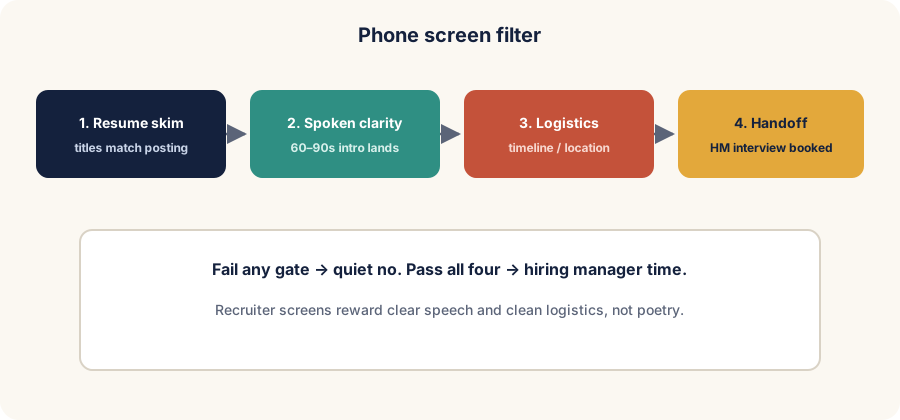 Resume skim → clarity → logistics → handoff. Fail any gate and the call ends quietly.
Setup checklist (do this the night before)
Phone screens die on logistics more often than people admit.
- Charged phone. Headphones that actually work. Charger within reach.
- Quiet room. Door closed. Pets and roommates briefed.
- Job post + your five bullets on one screen. Resume PDF open.
- Water. Notepad for names and next steps.
- Calendar invite triple-checked for time zone.
- Backup: laptop dial-in if they sent a Zoom/Teams link instead of a pure phone call.
Stand or sit upright. Smile once before you answer. It changes your voice even when they cannot see you.
Fuller sequencing for the week around any interview: how to prepare for a job interview.
 Quiet room, charged phone, five bullets. Fancy scripts optional.
How I’d practice the night before
Not a full mock loop. Three passes. Phone on the desk. Timer up.
- Intro. Seventy-five seconds. Stop even if you feel unfinished.
- “Why this role?” Sixty seconds. One posting problem. One proof.
- One conflict or win. Ninety seconds. Result first.
Record. Replay once. Change one thing: length, filler, or a missing number. Then leave it alone. Rewriting at midnight makes you flatter in the morning.
If you want a voice interviewer that asks follow-ups from a job description while you speak answers out loud, OfferBull’s mock interview practice is built for that kind of rehearsal before the real call. Practice only. Not during the recruiter call.
FAQ
How long is a phone screen? Fifteen to thirty minutes most days. Sometimes forty-five if the recruiter is also doing light hiring-manager screening.
Is a phone screen the same as a technical screen? No. Recruiter screen = fit and logistics. Technical screen = skills with an engineer. Different prep. Don’t bring a coding editor to a salary chat.
Should I take the call on speaker? Only if the room is private and audio stays clear. Headphones are safer. Pets walking by mid-answer is a real failure mode.
What if I blank? Say “Give me two seconds to pull the right example,” then answer. Silence with a signal beats filler soup.
Can I reschedule? Yes if you truly cannot hear or think. Reschedule once, early. Ghosting ends you faster than a clumsy answer.
Practice This Out Loud
Tonight: 75-second intro. 60-second “why this role.” One 90-second win story. Record. Replay once. Fix one thing. Then a short voice mock with follow-ups. → Practice Now