 OfferBull
Panel Interview Questions and Tips: How to Win Over the Whole Room | OfferBull
Panel Interview Questions and Tips: How to Win Over the Whole Room
The door is already open and three people are seated. Packet. Half-open laptop. The smile that points you to the lonely chair facing the row.
Someone forgot to say it was a panel. Or they said it, and your stomach still dropped.
Panel interview questions are usually the same stories you’d tell one-on-one. What changes is the audience. Three people, three reasons for being there, and you have to talk to all of them without picking a favorite. The friendly nodder is a trap. The quiet one with the score sheet often owns the hire.
I wrote this for ordinary hiring rooms in the US, UK, Canada, and Australia. A structured corporate panel. A mixed table with a manager, HR, and a future teammate. A hospital or school board where the work, for this page, is how you speak and share the air. I will not tell you how to treat a patient or how to run a class. Nurses who need the actual question bank should use nursing interview questions. People in software loops can jump to panel interviews in tech.
When they turn it around and ask what you want to know, grab two from 40 smart questions to ask at the end of an interview and aim each one at the person who can answer it. Don’t dump the whole list on the manager and ignore HR.
The names and numbers below are invented. Priya, Dan, the store reset, the twelve late orders. Use the shape. Please don’t memorize the paragraphs and hope nobody asks a follow-up.
What the room actually is
A panel is two or more interviewers in the same conversation, in person or on a video grid. That’s it.
You’ll see a few common shapes.
Structured corporate panel. Everyone has the same question list. They score you against a rubric. One person asks, the others write. These show up in government, large companies, and anywhere HR has standardized the loop so every candidate gets a fair shot. Your job is to answer the question that was asked, not to freestyle a more interesting one.
Mixed panel. Hiring manager, a peer, maybe someone from HR or a partner team. Questions bounce. One person cares about how you handle conflict. Another wants to know if you’ll answer emails. Treat each question as coming from that person’s world, then include the rest of the table in your eye line.
Hospital or school boards. A nurse manager, a charge nurse, and someone from HR. Or a principal and a department lead. Same communication rules as any other panel. Look at the person who asked. Share the answer with the group. I will not give clinical advice or tell you how to teach. If the questions themselves are nursing-specific, go to nursing interview questions. This post stays on how you sit in the chair and share the air.
Video panels. Three boxes on a laptop. The delay is worse, the eye-contact math is weirder, and it’s easy to talk only to the largest tile. Same rule: answer the asker, then glance across the grid.
My honest take? Panels feel scarier than they are because you can’t read one person’s face and relax. That’s the point of the format. They want to see if you can talk to a group without performing or shrinking.
If you know it’s a panel in advance, ask the recruiter who will be there and what each person owns. Write the names down. Walking in knowing “Priya is the hiring manager, Dan is a peer, Morgan is HR” changes how you aim answers. Those names are made up, same as the samples below. For the rest of the week’s prep, how to prepare for a job interview still applies.
Who to look at, and in what order
This is the skill most people skip, then regret.
Start with the person who asked the question. Hold there for the first sentence so they know you heard them. As you hit the middle of the answer, glance at the others. One beat each. Not a windshield-wiper sweep. Then land the last line back on the person who asked, so they can follow up.
If someone on the panel hasn’t spoken in a while, a short look their way during a result or a takeaway says you know they’re in the room. Don’t force a “and I’d love your take on that” at every person. That’s theater.
When two people talk at once, pause. Smile at both. “I want to catch both of those. Can I start with yours?” Point lightly toward the person who started first, or toward the chair of the panel if it’s a formal board and that’s the local custom. Then go to the second question. Don’t pretend you can answer two things in one breath.
Names help. Use them once, not as a tic. “Dan, on the handoff piece…” is better than repeating everyone’s name like a toast.
On video, look near the camera when you start and finish. In the middle you can look at the tile of the person who asked. If your notes are on a second screen, don’t disappear sideways for thirty seconds. They’ll think you checked out.
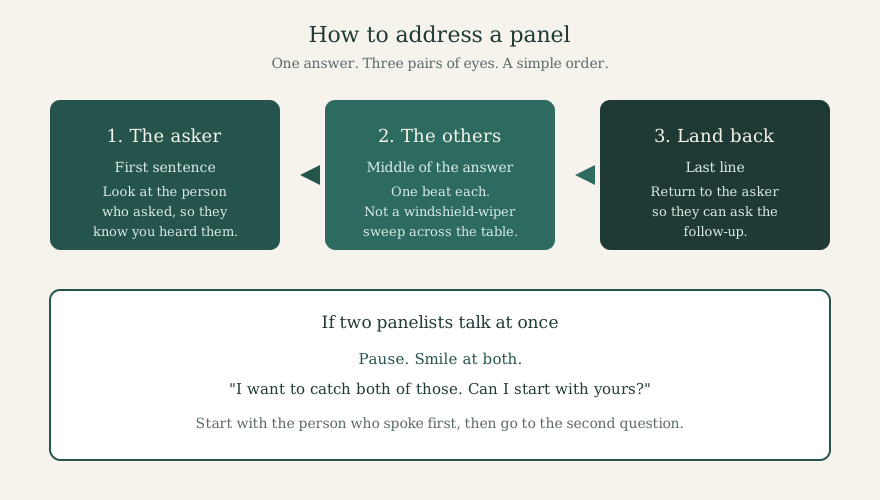 Asker first. Glance across. Land back on the person who asked.
One more unglamorous tip. Bring extra copies of your resume if it’s in person. Somebody on a panel always forgot theirs. Handing one over without fuss makes you look prepared, not eager.
Common panel interview questions (with sample answers)
Panels recycle the same prompts you’d get one-on-one. The difference is the audience. Keep answers in the 90-second to two-minute range unless they ask for more. A long story that thrilled a single hiring manager will lose the peer who wanted a shorter version.
The sample answers below are made up. Don’t deliver them as your own. Interviewers ask follow-ups, and a borrowed story falls apart.
“Tell us about yourself”
Talk to the group, not to one friendly face. I keep a simple arc: what I do now, what I did before, why I’m here. One hook the manager can use. One messy detail a peer would recognize as real work.
“I’m an operations coordinator. Last three years I’ve been the person who owns Friday’s fulfillment scramble at a mid-size retailer. Exception queue, carrier escalations, that weekly delay report the warehouse lead actually reads. Before that I worked the floor in store ops, which is probably why I still plan backward from 4pm instead of from a slide. I’m looking for a seat with a real planning cadence, not just another fire. Your posting read like that mix: daily exceptions plus somebody finally cleaning up the process. That’s the work I already like. I want more of it.”
No childhood origin story. HR hears that you have a lane. A peer hears the queue. Good enough.
“Tell us about a time you worked with several stakeholders who wanted different things”
A panel asks this because they are several stakeholders. They want to know if you’ll pick a favorite in the room.
No labels this time. Just how I’d tell it:
“Last spring I got stuck coordinating a store reset. Regional merchandiser, store manager, vendor rep. Three calendars, two days that actually smashed into each other. I put the dates on one sheet and asked each of them a boring question: what breaks if we slide your piece by a day? Merchandiser could move. Vendor could not. So I proposed vendor work Tuesday, merch overlays Wednesday morning, and I sent a six-line email so nobody had to replay the meeting in Slack later. We hit the Thursday open. The store manager reused the one-sheet for the next reset, which is how I knew it wasn’t just politeness in the room.”
Situation, what I owned, what I did, what happened. I just didn’t announce the letters.
“Tell me about a time you disagreed with someone”
Use STAR here if you want the scaffolding visible. Keep “I” for your part.
Situation. “On my last team, a peer wanted to send an apology email to thirty customers after a delayed shipment, before we’d confirmed which orders were actually late.”
Task. “I was responsible for the delay list, so I was the one who’d look careless if we apologized to people who weren’t affected, or missed the ones who were.”
Action. “I asked if we could wait two hours while I matched tracking to the order export. I showed him the twelve rows that were truly late and offered a targeted note plus a call list for the four largest accounts. He still wanted speed. I suggested we send the twelve immediately and hold the rest until noon, which gave him movement without a blanket apology.”
Result. “We sent twelve notes the same morning. Two of the large accounts stayed. The blanket email never went out, and we didn’t have to unwind a fake apology. He and I used the same match-first step the next time something slipped.”
Notice: a real disagreement, not a story where everyone secretly agreed.
“Why this role? Why us?”
Aim this at the hiring manager, then include the peer with one concrete detail from the conversation.
“I want this role because the posting is honest about the exception volume, and that’s the work I’ve already been doing without the title. On the call last week you mentioned the Q1 cleanup of the returns process. That’s the kind of mess I like to own. And if the team’s Tuesday is as full as Dan described, I’d rather walk in with my eyes open than be surprised in week two.”
Using a name you heard is allowed. Inventing a name in a real interview is not. The sample name is fictional.
“How would you handle it if two of us gave you conflicting priorities?”
Hypothetical. Lead with your approach, then a short real example if you have one.
“I’d name the conflict out loud instead of guessing. ‘You both asked for Friday. I can do one fully or both halfway. Which matters more this week?’ If you two disagree, I’d ask you to decide rather than pick a favorite. Last winter I had a similar split between a regional request and a store-level fire. I wrote both deadlines on one line, asked my manager to choose, and then told the other person the same day so nobody found out by silence.”
A panel loves this question because they are testing whether you’ll triangulate them against each other.
A few more they often throw in
- Walk us through a time you made a mistake and how you cleaned it up.
- How do you organize a messy week?
- Describe a time you had to explain something complicated to someone outside your function.
- What would your last manager say you still need to get better at?
- Where do you want to be in a few years? Stay grounded; a longer treatment is here: where do you see yourself in 5 years.
- Do you have any questions for us?
For that last one, pick two questions from different people in the room. Don’t fire all of them at the hiring manager and ignore HR. The end-of-interview questions list is organized by interviewer type for exactly this reason.
Mistakes that lose the room
Playing to the friendly face. There’s always one nodder. If you lock onto them, the quiet scorer writes “poor group awareness.”
Answering only the most senior person. Rank matters less than the question that was asked. The peer’s question is still the question.
Cross-talk and jokes that leave someone out. A little warmth is good. An inside-joke energy with one panelist makes the others feel like an audience.
Talking over a panelist. Stop mid-sentence. “Sorry, go ahead.” Then finish your point in one line.
Identical energy for every question. A culture question from HR and a process question from a peer shouldn’t get the same two-minute epic.
Ignoring the note-taker. They’re not furniture. Include them in the glance pattern.
Filling every silence. After you finish, stop. Someone is writing. Let them write.
If the format still makes you freeze, run a mock with two friends on a video grid. It’s closer than practicing at a mirror. Extra prompts: mock interview questions.
How I’d practice for a panel
Set up two or three people, even if one of them is just a phone on a book and a laptop with a colleague. Ask them to interrupt you once. Ask them to talk over each other once. Practice the line: “I want to catch both of those.”
Record from behind the “panel” if you can. Watch where your face points. If you never look at person three, you’ll do the same in the real room.
OfferBull is an AI mock interview app for iOS and Android. A voice interviewer asks questions aloud. You answer by speaking. Paste the job description or upload a resume so prompts match the seat. Follow-ups track your answers and resume. While you practice, you get answer suggestions and STAR structures. English and Chinese both work.
Practice before the interview. Not during it. You can paste the job description so the spoken prompts match the seat, then practice answering as if more than one person is listening: shorter setup, clearer result, less wandering.
Want that drill with follow-ups? OfferBull mock interview.
FAQ
How is a panel different from a series of one-on-ones? Same questions, shared room. You have to manage attention and follow-ups in public, and you can’t fully reset your story between people.
Should I greet everyone individually? A short hello and name, yes. A two-minute personal chat with each person before you sit will eat the clock and make the quiet ones restless.
What if I don’t know who is who? Ask at the start. “Could I quickly hear names and roles?” Write them down. Nobody minds.
Do I need different answers for a hospital or school panel? Different content, same room skills. Keep clinical or classroom substance out of a communication guide like this. Use a field-specific question list for the content, and use this post for eye contact, turn-taking, and follow-ups.
How long should my answers be? Aim for under two minutes unless they invite more. Watch the note-takers. If they stop writing and look up, land the plane.
Take Control of Your Career Path:
- Official Site: www.offerbull.net/mock-interview
- iOS App: Download for iPhone/iPad
- Android App: Download for Android