 OfferBull
NVIDIA Software Engineer Interview Questions (Systems, C++, CUDA, Behavioral) | OfferBull
NVIDIA Software Engineer Interview Questions (Systems, C++, CUDA, Behavioral)
You need a physical government ID. Not a photo of it on your phone. NVIDIA’s How We Hire page is unusually direct about the end of the process: for a full-time role, you complete an onsite, in-person interview at an NVIDIA office before you can be considered for an offer. They point to an Onsite Policy. Interns typically complete phone interviews only. That already tells you more than a forum thread about “five rounds” and a bar raiser, neither of which NVIDIA publishes as official fact.
The posting may put C++ and CUDA in the same bullet, and your first honest question in an NVIDIA software engineer interview is how deep they mean it. A GPU driver, compiler, or kernel-library team will mean it. An applications role might stay closer to the programming model. Public job posts will show families like systems software, deep learning, and hardware-adjacent work. That is not a secret org chart. Read the posting, then ask the recruiter which loop you’re in.
OfferBull is not affiliated with NVIDIA. Recruiter instructions beat this blog post.
The official NVIDIA software engineer interview process
You’ll meet the hiring manager, team members, and employees from other groups by phone, video, and in person. Depending on the role, you may have several interviews. If your skills match a different role, or a new opening appears, you may be invited to interview for that too. For full-time roles, the typical shape is phone interviews, then virtual or in-person interviews. Some teams may run a slightly different process. I will not upgrade that into a guaranteed template.
Interviews are described as one-on-one, small group, or panel, usually 30 to 60 minutes each. Prospects for technical roles may be asked to complete a coding exercise, usually using HackerRank on a whiteboard or on a laptop NVIDIA provides. That is their wording. Confirm the setup. Don’t assume a language policy NVIDIA never published. If the posting is C++-heavy, prep in C++. If they tell you another language is fine, use the one you can write cleanly under time.
During the final-stage interview, NVIDIA offers an Insider Chat with a community resource group member. Their FAQ describes it as an optional 15-minute meeting that does not influence hiring decisions. I’d take it for culture questions you don’t want to spend a technical hour on.
Most candidates, NVIDIA says, will have a decision within a matter of weeks from the first interview. Tell recruiting if you have a deadline. Dress tip from the same page: NVIDIANs tend toward business casual, but wear what’s comfortable.
And this policy is not a rumor. NVIDIA states it on the same page: the use of unapproved outside tools, such as ChatGPT, during the interview will result in the disqualification of candidacy. The short version is: don’t.
The onsite has security rules because NVIDIA is a CTPAT-certified facility. Bring a physical, valid government-issued photo ID; digital copies and phone photos are not accepted. You sign in, print a visitor badge, and stay with your host. None of that is interview content, but it is a stupid way to start the day late.
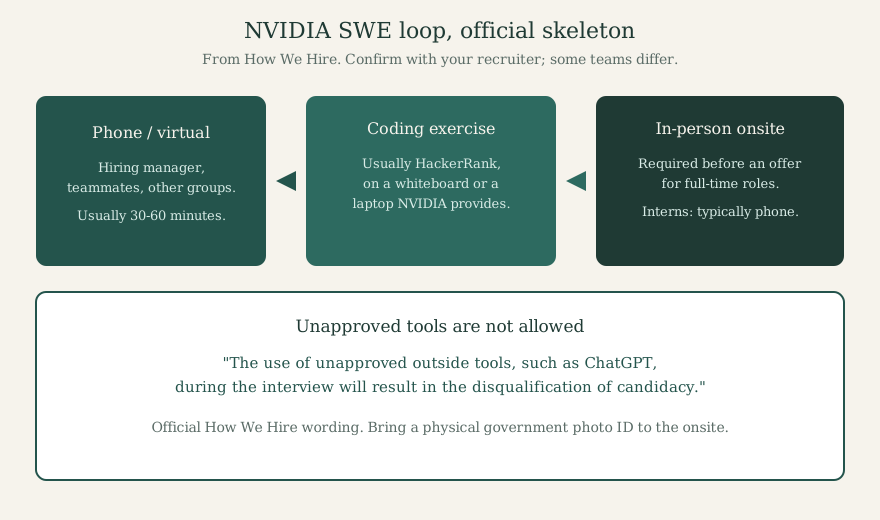 A skeleton from NVIDIA’s How We Hire page. Confirm with your recruiter; some teams differ. Interns typically interview by phone only.
If you’re also looping elsewhere in the same season, keep the shapes separate. Google, Meta, Microsoft, Amazon SDE, Apple, and the Uber software engineer interview each have their own habits. Don’t drag a marketplace dispatch prompt into a CUDA loop just because a blog bundled them.
C++, systems, and the NVIDIA coding interview
Candidate reports vary. Unofficial prep sites love a fixed round count and a C++-only rule. NVIDIA’s own page does not give you those. My honest take? I’d prep as if the coding hour is systems-flavored, not only a pattern drill, and I’d still practice talking through algorithms clearly. A clean walk through memory, ownership, and a tight loop often beats a clever trick you can’t explain when they change a constraint.
For systems, driver, compiler, or CUDA-heavy seats, I’d spend real time on C++ that shows up in code review. Ownership: who frees this, and what happens if a caller holds a pointer after you return. RAII: resources tied to object lifetime, so a mid-function return doesn’t leak a lock or a file. Undefined behavior: dangling references, data races, using a moved-from object and hoping. References versus pointers: what can’t be null, what can be reseated. Concurrency you can defend: mutexes, atomics, and why you’d pick a boring lock over a lock-free design you can’t prove.
I’d also rehearse operating-systems and memory topics at a conceptual level: virtual memory, cache-aware layout, when false sharing looks like a slow lock, and when a coarser lock is fine because the critical section is short. The concurrency and multithreading interview questions and operating systems and memory management interview questions posts are useful drills. They are not official NVIDIA questions.
Fictional prompt:
Interviewer: implement a thread-safe bounded buffer. Produce and consume, block when full or empty, no lost wakeups.
I’d say: “I’d start with a mutex, a queue or a ring buffer, and two condition variables, one for not-empty and one for not-full. I assume a single process, in-memory, and that a destructor should not leave waiters hanging. I am not starting with a lock-free ring. If I mess up the wakeup, we hang in a lab, not in a blog comment.” Then I’d talk through the wait predicate, notify_one versus notify_all, and what happens if a consumer throws after pop. Then I’d write it. Then I’d try the nasty case: two consumers, one item. Correct and a bit plain beats a race you narrate after the fact.
If they stay on algorithms, same mouth, different problem. Clarify. Work an example. Give complexity. Test the empty case. Don’t apologize for writing a correct n log n before you hunt a linear pass.
If a design conversation appears, it should sound like the team’s work, not a generic unique-ID service. Use the system design interview template and throw away the parts that don’t fit the posting.
CUDA interview questions, grounded in NVIDIA’s own docs
Depth depends on the team. GPU, driver, compiler, and kernel-library roles will go further. App-layer roles may stay conceptual. Don’t bluff PTX you skimmed on a train.
For the programming-model facts below, I’m sticking to NVIDIA’s CUDA Programming Guide.
CUDA assumes a heterogeneous system: a host CPU and host memory, a device GPU and device memory. Your program starts on the host. Device code runs in kernels, which you launch with many threads. Those threads are grouped into thread blocks, and blocks into a grid. A thread can find its place in the block and the block’s place in the grid, which is usually how you decide which data it owns.
All threads of a thread block run on a single streaming multiprocessor. They can synchronize with each other and use on-chip shared memory to exchange data. There is no guarantee of scheduling between thread blocks. A block should not wait on results from another block of the same grid, because that other block may not run until yours has finished. The programming model requires that blocks can execute in any order, in parallel or one after another. That one idea catches people who try to invent a global barrier.
Inside a block, threads are grouped into warps of 32, executing in a SIMT style: same instruction, each thread with its own data and, if you’re unlucky, its own branch. When threads in a warp take different paths, some lanes are masked off. Utilization is better when the warp stays together. A block size that isn’t a multiple of 32 leaves a tail warp half empty.
Memory, at a high level, is a hierarchy. Each thread has private registers and local memory. Each block has shared memory, close to the SM, as a programmer-managed scratchpad. All threads can reach global memory, the device DRAM, at much higher latency. Copying between host and device is a real cost, and “just use unified memory” is not a substitute for knowing where the data lives.
Occupancy is the usual interview word for how fully an SM is kept busy with active warps. Official docs tie that to finite resources: registers and shared memory, among other limits. I’d still get the kernel correct first. A wrong reduction with beautiful occupancy is still wrong. Once the answer is right, then talk about occupancy and whether shared memory is helping. “I haven’t shipped that optimization, here’s how I’d profile it” beats a fake war story.
Behavioral questions and spoken answers
They still want to know whether they can work with you. For these seats, useful stories often involve an adjacent team (hardware, compiler, research, or a driver group), a painful performance bug, a disagreement about an approach, and a clear reason you want this team rather than any company with a GPU in the building.
Samples are illustrative. The names, chips, and numbers are made up. Don’t recite them. Use the STAR method if you need a spine.
“Why this team? Why GPU computing?”
For a library performance seat (fictional):
“I spent two years making a computer-vision pipeline fast enough to run on a mid-range laptop without melting the fan. The part I liked wasn’t the last one percent of SIMD. It was finding that we were launching too many tiny kernels, batching the work, and watching a 40-millisecond step become something a product could actually ship. Your posting is about kernel libraries and performance budgets, which is already the argument I have in code review. I want to be closer to the machine that work runs on, not one layer further from it.”
“I’ve always been interested in GPUs” is not a reason. A constraint you already chose is.
“Tell me about a hard performance bug.”
Spoken:
“We had a training step that was fine on one GPU and awful on two. People wanted to blame the network. I instrumented copies and found we were synchronizing on every batch because a debug flag had been left on in a wrapper someone copied into the production path. I removed the flag, added a test that fails if a host-device sync shows up in that path, and wrote a two-line runbook note so the next person doesn’t ‘just enable it to be safe.’ The two-GPU run went back to looking like a machine with two GPUs. The bug was embarrassing. The process change was the actual result.”
“Tell me about a disagreement with a hardware or partner team.”
Situation. We wanted to ship a kernel that assumed a newer memory feature. The hardware partner said the board we actually had to support for two more quarters wouldn’t get that feature.
Task. I needed a path that didn’t strand the current fleet or blow the launch.
Action. I asked for the exact boards and dates, then split the work: a correct fallback path on the current hardware, and the faster path behind a capability check. I also cut one ambitious layout change that only paid off on the new boards.
Result. We shipped on the old hardware without pretending we had the new one. When the later boards arrived, the fast path was already there. I didn’t win a debate about who was being conservative. We just stopped tying the launch to a feature we didn’t have.
Other questions worth a two-minute pass:
- Walk me through a systems project on your resume until I run out of “why.”
- How do you review a performance change you don’t fully trust?
- What would you do in your first 90 days on this team?
That last one should sound like reading the code and finding one small reliable win, not a fantasy reorg of the CUDA stack. More prompts sit in software engineer behavioral interview questions and behavioral interview questions and answers. Save a few real questions for them: questions to ask at the end of an interview.
How I’d practice, and what not to do in the room
You cannot prep every NVIDIA loop. You can get fluent at the transferable parts.
One coding session a day out loud, preferably in the language on the posting, with tests you say before you type them. A short C++ inventory: ownership, a race you actually understand, one undefined-behavior example you can explain without a meme. If the team is GPU-facing, a clean recitation of threads, blocks, grids, and the memory hierarchy, plus one kernel you’d refuse to optimize until it was correct. Two projects you can defend for twenty minutes. Two behavioral stories, then interrupt yourself. A general plan: how to practice for an interview.
About tools. This one is already decided for you on NVIDIA’s page. Unapproved outside tools, such as ChatGPT, during the interview will get your candidacy disqualified. OfferBull is for the weeks before the loop. Not for the meeting window, not for a second monitor, not for answers in your ear, and not for a take-home unless they have explicitly allowed tools. Do not assume they have.
OfferBull is an AI mock interview app for iOS and Android. A voice interviewer asks questions aloud. You answer by speaking. Paste the job description or upload a resume for tailored questions. Follow-ups based on what you said and what’s on the resume. While you practice, you get answer suggestions and STAR structures. English and Chinese. Close it before the real call starts.
FAQ
Is there a fixed number of NVIDIA interview rounds? No official fixed count on the How We Hire page. NVIDIA says you may have several interviews, usually 30 to 60 minutes each, and that some teams differ. Ask your recruiter.
Do I have to interview in person? For full-time roles, NVIDIA says you complete an onsite, in-person interview at an NVIDIA office before you can be considered for an offer. Interns typically complete phone interviews only. Confirm the Onsite Policy with recruiting.
Can I use ChatGPT or another AI tool during the interview? No, not unless NVIDIA has approved that tool. Their published rule is that unapproved outside tools, such as ChatGPT, during the interview will result in disqualification.
Do I have to code in C++? NVIDIA does not publish an official C++-only language policy on How We Hire. The posting and the recruiter win. If the role is systems or CUDA-heavy, I’d prep in C++ anyway. They say wear what’s comfortable, and bring a physical government photo ID to the onsite.
Practice This Out Loud
Tonight: a thread-safe bounded buffer spoken as you type, a two-minute explanation of threads, blocks, and shared memory, and a “why this team” answer that names a constraint from the posting. Interrupt yourself once. Then a voice mock with follow-ups. → Practice Now
Take Control of Your Career Path:
- Official Site: www.offerbull.net/mock-interview
- iOS App: Download for iPhone/iPad
- Android App: Download for Android