 OfferBull
Microsoft Software Engineer Interview Questions and Loop Guide | OfferBull
Microsoft Software Engineer Interview Questions and Loop Guide
Teams invite lands. Thursday, 45 minutes. Shared editor. First thing they say is usually “walk me through how you’d clarify this” before you’ve typed anything.
You probably already know mergesort. That isn’t the hard part. The hard part is talking while the solution is still ugly, then testing it before you announce you’re done.
That’s a Microsoft software engineer interview stripped of forum folklore. Problem solving. Design. Coding. Testing. Plus a story about being wrong that doesn’t sound rehearsed.
I’ll stick to Microsoft Careers — How we hire and the technical interviewing page for process facts. Candidate reports and old slang get labeled. No invented hire rates.
Also looping elsewhere? Google, Amazon SDE, Meta.
What Careers actually publishes
Lifecycle on the hire page: explore jobs → apply → review → interview → offer → pre-onboard → hired.
Interviews: most loops are 2–4 conversations, each up to an hour, with teammates and cross-functional people. Phone, Teams, or in person. Recruiter owns the “what next” email.
Values they name out loud: respect, integrity, accountability, growth mindset. That last one isn’t decoration. Expect “when were you wrong” and “how did you learn a stack under pressure.”
Technical page is blunter. They evaluate:
- Problem solving
- Design
- Coding
- Testing
Algorithms, data structures, system design / distributed systems show up under technical excellence. Role-specific piles (AI/ML, data science, networking) if the JD says so.
Coding notes I wouldn’t skip: use a language you’re strong in. No pseudocode. Third-party tool where you can run and compile. About 45 minutes a round. Clarify. Plan. Then type. Test before you say done. They even call out security, stress, boundaries, error conditions.
Virtual: Careers has a virtual interviewing checklist. Install Teams. Test join/leave. Prefer Edge or Chrome if you’re stuck in the browser.
Code of Conduct (Careers): honest resume. AI for prep that still reflects your skills is fine. During assessments and interviews, show your own work unless the invite explicitly allows help. Practice apps stay in the weeks before. Not in the Meet.
Recruiter screen
Short call after resume review. Careers says some teams use a brief screen before the full set. Still a real interview.
Usual mix:
- Resume in two minutes (present → past → why this role)
- Why Microsoft / why this org
- One project: what you owned, what broke, what you’d redo
- Level, location, timeline, other processes
I’d rather hear one messy bug you can explain without slides than ten buzzwords. Rambling dies here faster than a missing keyword.
Technical rounds (practical coding)
Careers wants clarifying questions and a plan before implementation. Microsoft Life pieces and candidate reports push the same: talk while you code, take feedback mid-problem. Matches the official brief.
How I’d spend 45 minutes
- Restate the problem. Inputs, outputs, constraints.
- Brute force first, then the target complexity. Say big-O out loud. They ask for it.
- Pick structures before typing. Arrays, maps, trees, graphs: know the trade.
- Real code in your strong language. Small helpers. Readable over clever.
- Tests: happy path, empty, overflow, weird concurrency if it fits.
Style that tends to land: practical, a bit of OOP where ownership is clearer. One interface you can defend beats five abstract classes you can’t.
Practice prompts (not leaked questions)
A. Stream of (userId, timestamp, action). Top K users by count in the last N minutes. Talk windowing, map + heap, what breaks when N is huge.
B. Rate limiter for an API gateway. Token bucket vs sliding window. Code the core. Then clock skew, burst, multi-instance.
C. Merge overlapping calendar intervals, then free slots of length L. Interval basics; they poke sorted-input assumptions.
Silent perfect code still loses half the score. Narrate.
Senior design depth: system design template and FAANG system design questions.
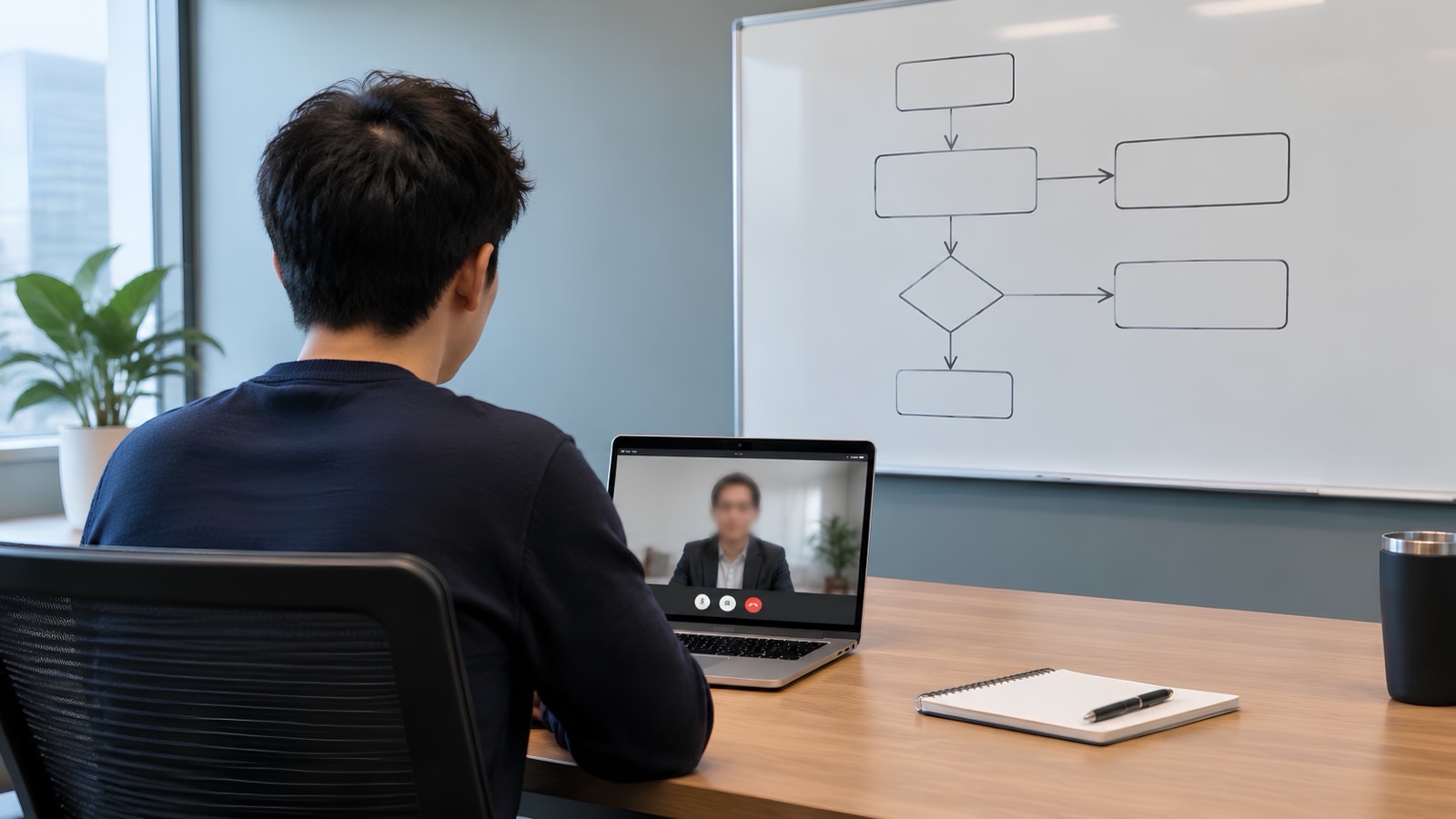
 Coding round energy: laptop plus whiteboard boxes, no faces, interview room.
As-appropriate (AA): the nickname
Forums love “AA” / “as-appropriate.” It is not a current Careers label.
Raymond Chen’s Old New Thing note covers the history. Older loops sent you through several interviews, then a more senior person only if earlier feedback made it worth it. Nickname stuck. Packaging changed.
What I’d do:
- Ask the recruiter what’s on your day. Invite text beats Reddit.
- Later rounds may be more senior. Candidate reports still say that.
- Don’t “save” your best story for a mythical final boss. Round two counts.
If an email literally says AA, prep like a senior hiring-manager round: depth plus judgment. Not a secret rubric.
Growth-mindset behavioral
Careers lists growth mindset with the other values. Microsoft news / Life pieces talk curiosity, learning under uncertainty, recovering from mistakes. You need scars, not slogans.
STAR helps. Scaffolding: STAR method. Broader bank: behavioral interview questions. Engineer-shaped: software engineer behavioral.
Prompts worth drilling
- Wrong in a design review
- New stack, hard deadline
- Approach conflict with a teammate
- Production incident you owned
- Feedback that stung — next week
- Mentoring someone stuck
- Fuzzy requirements, how you cut scope
Sample answer (illustrative / fictional)
Q: Feedback that changed how you work?
A: “Payments service. I owned retries. Sev2 retro: manager said I’d optimized for never losing a message and ignored what customers felt on latency. True. No jitter. Dependency blinked, we stampeded it. I added jitter, put a breaker in, wrote a load test that replayed that window, sat with their on-call on a shared SLO. Next release p99 was under budget. Now my design docs open with the failure I’m trading off. Old policy felt safer for my ego. Worse for users.”
Long Action. Short apology. That’s the point.
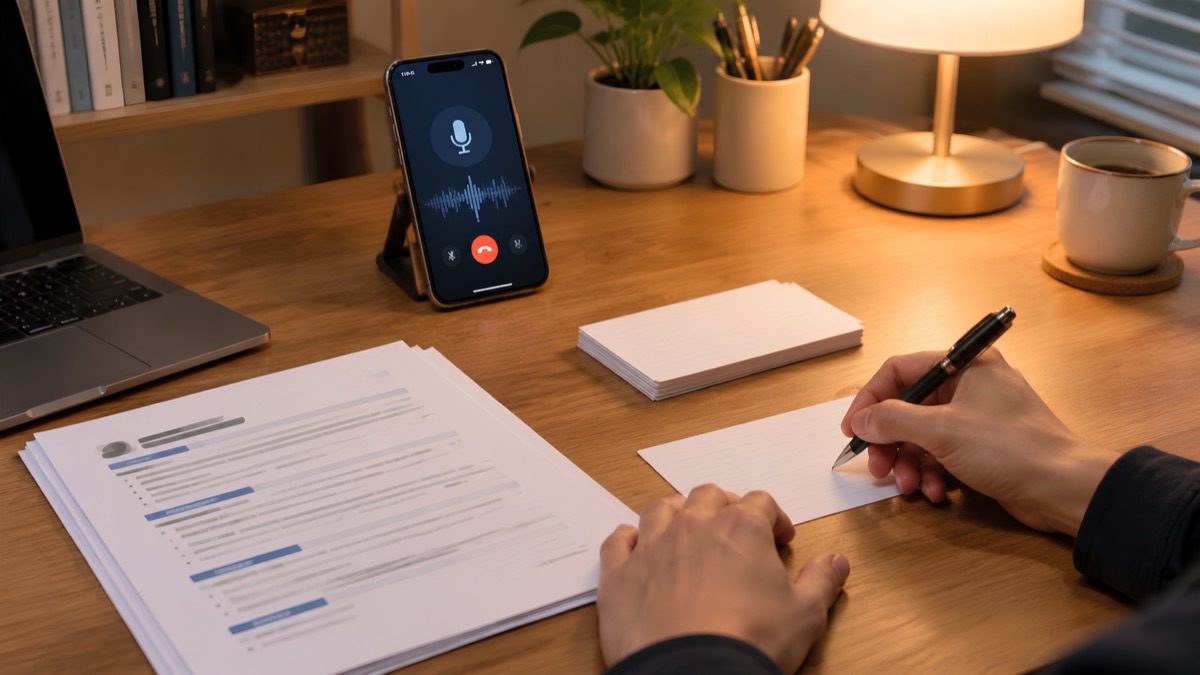 Practice desk: phone mock, resume, STAR notes. Prep before the loop, not during it.
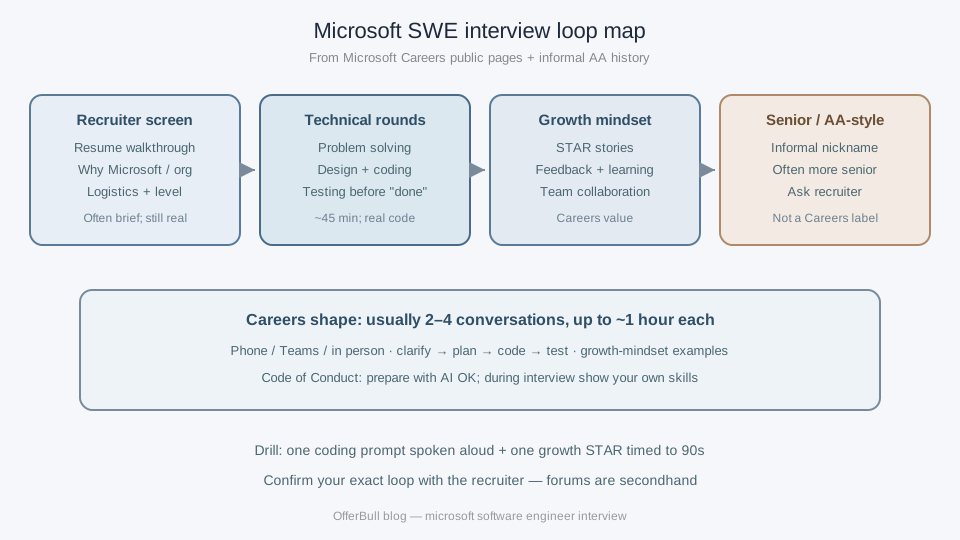 Public Careers shape: 2–4 conversations, technical lifecycle, growth-mindset stories. AA is informal history.
Level folklore (not Careers policy)
Careers doesn’t publish an L3/L4/L5 cheat sheet. Secondhand patterns candidates report:
- Early career: coding + fundamentals; lighter design
- Mid: coding + design; ownership stories
- Senior: design, trade-offs, mentoring, cross-team
Ask your recruiter. Folklore is a bad substitute for the invite.
Mistakes I see a lot
- Code before clarifying (Careers warns on this)
- Pseudocode when they asked for runnable
- “Done” with zero tests
- Growth answers that are only vibes (“I love learning”)
- Saving energy for rumored AA, mailing round two
- AI or second screens in the real Teams interview against the Code of Conduct
Practicing with OfferBull
Reading Careers is step one. Talking under a clock is step two.
OfferBull is an AI mock interview app for iOS and Android. Interviewer speaks. You answer out loud. Paste a Microsoft-style JD or upload a resume for tailored questions. Follow-ups based on what you said. During practice it can show suggestions and STAR when a story wanders. English and Chinese.
Weeks before the loop. Not during a Microsoft interview.
FAQ
How many interviews? Careers: usually 2–4 conversations, up to an hour each. Recruiter confirms yours.
Which language? One you’re strong in. Confirm team preference if they have one.
Is AA still official? Informal / historical slang. Not a Careers label. Prep for a possible senior round anyway.
AI during the interview? Prep responsibly. In the room, your own skills unless explicitly allowed.
Growth mindset prep? Three STAR stories: wrong, new tool, process change after feedback. Specifics beat slogans.
System design? Common mid/senior. Use a template. Talk trade-offs out loud.
Practice This Out Loud
Tonight: resume walkthrough, one coding prompt with spoken big-O and tests, one growth STAR at 90 seconds. Interrupt yourself once. Restart. Then a voice mock with follow-ups. → Practice Now