 OfferBull
Medical School Interview Questions and Sample Answers | OfferBull

Medical School Interview Questions and Sample Answers
Two faculty. One folder. Water still in your hand. “Why medicine?”
You’ve written the essay. Out loud it still wants to become a movie trailer. That’s what medical school interview questions actually test. Not a biochem pop quiz. Whether you sound like someone they could train: clear, specific, calm when the follow-up gets sharp.
Interview prep only. Communication and reasoning. Not clinical advice. Not legal advice. Not a script for a real consult. Your school’s invite packet wins. Station day? Pair this with MMI interview questions. Story shape still helps: STAR method, tell me about yourself samples.
Samples are fictional. Steal the skeleton. Use your hours.
Traditional rooms and panels
One-on-one feels like a long talk. Panels put three to five people in chairs. Same themes. Faster follow-ups from odd angles.
Motivation shows up. Teamwork. Conflict. Ethics framed as how you think. Situational judgment. And the last five minutes: any questions for us?
MMI flips the clock: short doors, new examiner, timed. Don’t jam a twenty-minute “why medicine” into an eight-minute ethics station.
My honest take? Panels punish rambling faster than one-on-ones. Point first. One concrete detail. Then stop talking.
“Why medicine?” without the trailer
“I want to help people” is true. It’s also what every other applicant says. The version that lands names a moment, a skill you actually liked using, and a hard part you’ve already bumped into.
How I’d stack it:
- One scene in two sentences (shadowing, volunteering, caregiving, research contact).
- What stuck (listening under fatigue, explaining a plan someone already gave, sitting with “I don’t know yet”).
- Why school is the next step, not a vague calling speech.
- One hard part (hours, hierarchy, emotional load) and how you cope in plain terms.
Spoken (made up): “Okay. Sophomore year. Long clinic day. I sat with someone while the team wrapped notes. He asked the same thing three different ways. I wasn’t giving medical advice. I just said back what the resident had already told him, slower, and asked which part still felt fuzzy. Boring hour. Stuck with me anyway. That’s the work I want more training for. The science too. I’m not pretending nights and charting aren’t part of it. Lab group fell behind last spring. I asked for help early instead of white-knuckling. Same muscle.”
“Why our school?” needs two concrete things from their site or visit. Prestige talk is empty calories.
Teamwork and conflict
They want shared credit, feedback that didn’t wreck you, process fixes over blame.
Prompts you’ll hear: struggling team, conflict with a classmate, teammate not pulling weight, feedback that stung.
Flowing sample (fictional): “Anatomy group. Someone kept missing dissection. I was annoyed. Almost dumped it in the group chat. Didn’t. Pulled them aside. Night-shift job. We shifted their piece to quiz decks they could knock out at 6 a.m. I covered an extra lab slot that week. Grade came back. We still talk. I’d set the ground rules in week one next time. Week four was late.”
More shapes in behavioral interview questions. Small and repair-focused beats cinematic.
 Record once. Cut the trailer. Keep one scene.
Ethics prompts (reasoning only)
Nobody wants an order set from you. They’re watching how you frame the mess, whose interests you name, what you admit you don’t know, and when you’d loop someone in.
Shapes: peer cheating, privacy vs safety in a vague story, resource limits, social media and professionalism, disagreement with a supervisor in school or volunteer work.
Safe prep skeleton:
- Clarify what’s asked (thirty seconds).
- Name stakeholders and values in tension.
- First process move: listen, gather, use the proper channel.
- Admit uncertainty. Name who you’d ask (advisor, course director, written policy).
- Don’t diagnose strangers. Don’t invent treatment.
Peer honesty sketch (fictional): Clarify rumor vs what I saw. Stakeholders: peer, other students, faculty trust, my integrity. Private ask to correct if safe. Graded breach I witnessed goes through the school’s academic integrity path, not group-chat pile-on. I’m not the judicial board.
MMI ethics doors: shorten every step. Timing lives in the MMI guide.
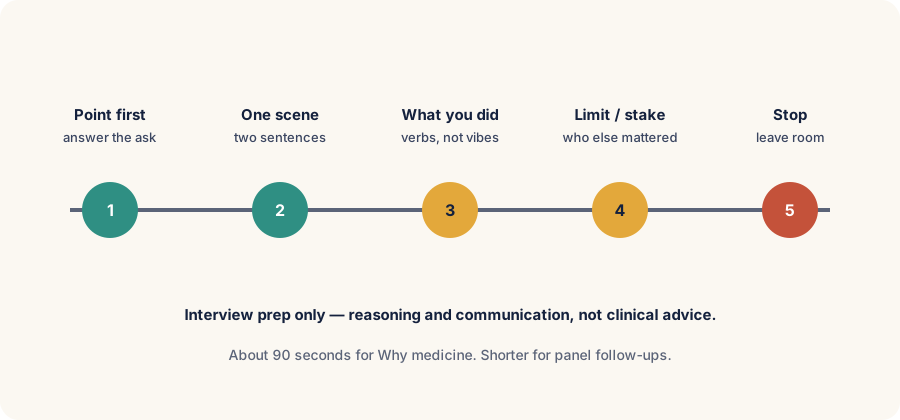 Point first. One scene. Stakeholder. Limit. Stop.
Habits that survive follow-ups
Memorized paragraphs crack the second someone asks “What would you do differently?” Put a timer on. Speak. Wince. Cut. Speak again.
First sentence answers the question. One concrete noun. A limit you respect. A short lesson that isn’t a TED closer.
If English isn’t first language, clarity still beats fancy words. Pacing ideas: tips for non-native English speakers.
Questions you ask them
End of the hour. “Do you have questions for us?” Empty hands look worse than a simple one.
I’d skip culture vibes and Googleable stats. Ask about how feedback works in the first year, how students find research or service mentors, what a typical Tuesday looks like in their curriculum model. One question tied to something you actually read on their site beats three generic ones.
If they already answered it, say so and pivot. Don’t force a rehearsed line into a closed door.
FAQ
Hard science trivia? Some schools sprinkle a light article chat. Most traditional rooms stay motivation, judgment, communication. Read your notes.
How long for Why medicine? About 90 seconds spoken. Then let them dig. Panels may cut sooner.
No hospital shadowing? Use real care-adjacent or service work you did. Don’t invent clinical authority. Skills: listening, reliability, teamwork under load.
MMI or this guide? Both if schools mix. Station timing in the MMI post. Long-form “why us” here.
Mental health or family illness? Only with boundaries. Insight and support systems. Not graphic detail. Don’t turn the room into therapy.
Night-before spoken drill
I’d run these with a phone timer, standing up if you fidget sitting:
- Why medicine, 90 seconds, one scene only
- Why this school, 60 seconds, two concrete facts
- Teamwork repair story, 90 seconds
- Ethics outline: clarify → stakeholders → first channel → limit, under 2 minutes
- One question you’d actually ask them that isn’t “what’s the culture like?”
If tomorrow is MMI-heavy, swap the long why-medicine for two short station drills from the MMI guide. Don’t arrive with one speech and force it into every room.
Tired voice is fine. Trailer voice is not. Record once, wince, cut the adjectives, record again.
 Outline beats. Not a memorized speech.
Practicing with OfferBull
Reading feels polished. Speaking exposes the trailer voice.
OfferBull is an AI mock interview app for iOS and Android. Voice interviewer. You answer out loud. Paste a school prompt list or upload notes shaped like a resume. Follow-ups on what you said. Suggestions and STAR while you practice. English and Chinese.
Practice before interview day. Not during a real interview.
Practice This Out Loud
Tonight: Why medicine in 90 seconds. One teamwork repair in 90. One ethics outline in 2 minutes. Record. Cut fluff. Timed voice mock. → Practice Now