 OfferBull
How to Negotiate Salary After a Job Offer (Scripts and Email Templates) | OfferBull

How to Negotiate Salary After a Job Offer (Scripts and Email Templates)
Offer email lands at 4:12pm. Heart rate up. “We’re excited to offer you…” and a base that sits a notch under what you hoped. Thumb hovers on Reply. Half of you wants to say yes in twelve minutes so nobody changes their mind.
Don’t hit send yet.
How to negotiate salary after a job offer is a short, calm talk after they already picked you. Not a hostage scene. For general US/UK/CA/AU seats: ops, sales, marketing, support, finance, coordinators, analysts. Not a tech-comp deep dive. Equity, RSU, levels.fyi math lives here: how to negotiate your tech job offer salary. The interview question about expectations is a different post: what are your salary expectations. This one starts after the letter arrives.
Dollar figures below are made up. Run your own tabs.
When to negotiate (and when to skip)
I’d negotiate when the base sits under your researched range, when a peer posting pays more for the same level and city, or when you’ve got a real competing offer you can name cleanly.
I’d skip the big ask when the number already hugs the top of the posted band, when it’s a tiny nonprofit on a fixed grant, or when you truly need any start date this month and can’t risk delay. Skipping is a choice. Not a personality flaw.
My honest take? Most people under-ask once. Not because hiring teams are saints. Fear fills the gap where a script should sit.
Before you open your mouth: re-check two live postings, one peer chat if you have it, and the pay note from the ad if it had one. Scribble your walk-away number on paper. No number on paper and you’ll fold at the first “budget is tight.”
The phone script (calm, short)
Recruiter calls to “walk through the offer.” Smile in your voice. Don’t apologize.
“Thanks for putting this together. I’m excited about the team and the work. On base, I was targeting closer to $X based on the range for this level in [city] and the scope we discussed. Is there room to move the base to $X, or meet in the middle at $Y?”
Then stop talking. Silence is not rudeness. It’s space for them to answer.
If they say they’ll check: “Appreciate it. Happy to stay flexible on start date if that helps the package.” One trade, not five.
If they say no on base: pivot to a lever (below). Don’t stack three new asks in the same breath like a shopping list.
Competing offer variant
“I want to be transparent. I have another offer at $A base. I’d rather join you because of [one specific reason about the work]. If you can get to $B base, I’m ready to sign.”
Only say this if the other offer is real. Bluffing dies fast.
 Keep the counter short. Then leave silence.
Email templates you can send
Keep email when you need a paper trail, when the recruiter prefers async, or when you’re negotiating across time zones.
Template: first counter on base
Subject: Offer – [Your Name] – quick question on base
Hi [Name],
Thank you again for the offer for the [Role] role. I’m excited about [one concrete thing: team, product, problem].
Based on the market for this level in [city/region] and the scope we covered in the loop, I was hoping we could move the base from $Offer to $Ask. If $Ask isn’t possible, I’d be glad to discuss $Middle or another lever that gets total cash closer.
Happy to hop on a quick call tomorrow if easier.
Best, [Name]
Template: after they say base is firm
Hi [Name],
Thanks for checking on base. Understood that $Offer is the ceiling there.
Would the team consider a sign-on of $Z, or an earlier performance review at six months with a documented raise path? Either would help me say yes with confidence.
Thanks, [Name]
Template: accept after a partial win
Hi [Name],
Confirming I accept the updated offer at $NewBase / [other terms]. Looking forward to starting on [date]. Please send the revised letter when ready.
Thanks again, [Name]
Always confirm the final numbers in writing before you celebrate on Slack.
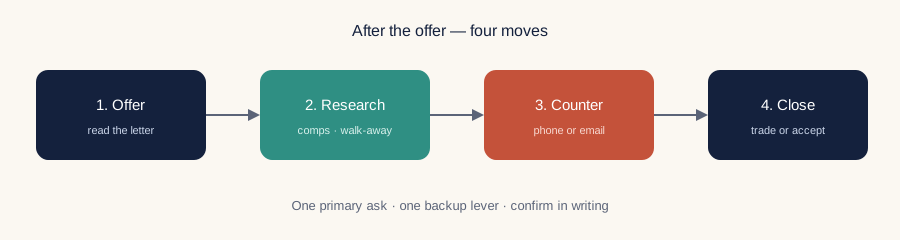 Offer → research → counter → trade or close.
Non-salary levers that still move the package
Base won’t always budge. Other dials often will.
Sign-on bonus. One-time cash. Easier for many budgets than a permanent raise.
Start date. Sometimes a two-week delay unlocks a better band in the next fiscal window. Sometimes starting sooner is the trade they want.
Title / level. A clearer title can matter for your next jump even if cash is flat this round.
Review timing. “Six-month review with a documented raise conversation” beats a vague “we’ll see.”
Remote / hybrid days. Real money in commute and childcare for a lot of people.
PTO / flexible hours. Especially if cash is stuck and your life needs the buffer.
Learning budget or conference stipend. Smaller, but useful for specialists.
I’d pick one primary ask and one backup lever. Not a catalog. Recruiters freeze when you send a twelve-item wishlist.
Tech folks with equity questions: bounce to how to negotiate your tech job offer salary for RSU and refreshers. This post stays on cash and practical levers for general seats.
Mistakes that shrink the deal
Accepting in the same hour. Excitement is not a strategy. Sleep on it unless the deadline is real and short.
Apologizing for asking. “Sorry to bother you with this…” trains them to treat your ask as a nuisance.
Ultimatums you won’t keep. “Match or I walk” only works if you’ll walk.
Lying about another offer. Don’t. Recruiters compare notes more than you think.
Negotiating forever. Two rounds is plenty for most general roles. Endless counters look flaky.
Ignoring the written letter. Verbal “we’ll bump you later” is not an offer. Get the PDF.
If the loop is still ahead and you’re still practicing answers, not negotiating yet: how to prepare for a job interview and spoken drills on why should we hire you answers. Close the interview first. Then open the money talk.
 Read the letter again. Then write the ask.
How I’d practice the call
Write your $Ask and $Walk numbers. Say the phone script once sitting, once standing, once while slightly distracted (dishwasher on). Record it. Cut filler. You want calm, not courtroom energy.
OfferBull is an AI mock interview app for iOS and Android. A voice interviewer asks questions aloud. You answer by speaking. Paste the job description or upload a resume so prompts match the seat. Follow-ups track your answers and resume. While you practice, you get answer suggestions and STAR structures. English and Chinese both work.
Practice before the interview. Not during it. Negotiation scripts you can rehearse out loud the same way you rehearse behavioral answers.
Want that drill with follow-ups? OfferBull mock interview.
FAQ
Will they rescind the offer if I negotiate? Rare for a polite, researched ask. A company that pulls an offer for a calm counter was a bad bet anyway. Still: be respectful and specific.
How much should I counter? Often 5–15% above the offered base if your research supports it. Don’t invent a fantasy number with no comps.
Should I negotiate by email or phone? Phone for speed and tone. Email for clarity and a record. Many people do a short call, then confirm by email.
What if they ask for my current salary? In many US places you can decline or redirect to your range. Give a researched target, not a confession. See also salary expectations.
Can I negotiate after I already said yes? Sometimes on small items before you start. Harder on base. Best window is before you accept.
Take Control of Your Career Path:
- Official Site: www.offerbull.net/mock-interview
- iOS App: Download for iPhone/iPad
- Android App: Download for Android