 OfferBull
HireVue & One-Way Video Interview Questions: How to Prepare | OfferBull

HireVue & One-Way Video Interview Questions: How to Prepare
Link opens. Webcam light. Question on screen. Timer already chewing your thinking time. Nobody nods. Nobody says “take your time.” Just you, a lens, a bar sliding to zero.
That is a one-way video interview. HireVue is one vendor name you will see. Employers also use tools in the same family (Modern Hire, Spark Hire, others). Timers, retakes, and question banks differ by employer config. Do not treat one product page as gospel. Pattern to prep for: recorded answers, a clock, limited or no retakes, mostly competency and behavioral prompts.
HireVue interview questions (and the same prompts on other one-way tools) punish silent reading. Structure under a clock wins. A STAR essay in a doc does not.
Samples are made up. Steal the structure.
Also useful: how to practice for an interview, mock interview questions, behavioral interview questions and answers.
How one-way interviews usually work
Some mix of these. Not always all of them.
Think window. Short. Sometimes thirty seconds. Use it to pick one story. Not three.
Talk window. Often one to three minutes. When the bar hits zero, you are done mid-sentence if you were still talking. Painful. Practice that cut once on purpose.
Retakes. Maybe one or two. Maybe zero. Assume zero until the screen says otherwise.
Prompt type. Leadership, teamwork, conflict, failure, customer focus. “Tell me about a time…” more than trivia.
Someone watches later. Recruiter or hiring manager on replay. Rubrics may sit behind the scenes. I am not claiming how any vendor scores video, and this is not legal or clinical advice. Prep for a human who hits play once: can they follow you?
If they cannot, you will not get a chance to clarify.
 One-way means the clock is the interviewer. Practice against a timer, not a mirror pep talk.
Common prompts and how to structure answers
Keep a simple spoken skeleton: hook → action → result → one line of learning. If you like labels, map that to STAR. On camera, labels are optional. Timing is not.
“Tell me about yourself.”
Sixty to ninety. Present role. One win with a number. Why this company. Then stop.
I’d hit record with: “I’m a customer support lead at a SaaS company. Pod of six. Last quarter first-response went from eleven hours to under four after I rewrote triage tags and staffed the morning spike. Your posting wants someone who already owned that kind of queue change. That’s why I’m here.”
More shapes: tell me about yourself sample answers.
“Tell me about a time you handled a conflict.”
Peer or stakeholder fight. Not a villain monologue. Camera makes melodrama worse.
Spoken: “Sales promised a feature we could not ship that month. I asked for fifteen minutes with the account open. We agreed a workaround the customer could use in two days. I sent written scope the same afternoon. Deal stayed. Limit was visible. That helped more than a long argument.”
“Describe a failure and what you learned.”
Own the miss. Show the fix. Skip the growth-mindset speech. It reads fake on replay.
Try: “I shipped a help-center article without a second reviewer. Wrong refund window. Two customers followed it. Pulled the article in an hour, posted a correction, added a two-person check for policy pages. That class of miss has not come back.”
“Give an example of leadership without authority.”
Influence. Not title. Keep it boring and real.
Out loud: “Weekend coverage kept slipping. I was not the manager. I drafted a rotation sheet, asked two senior agents to pilot three weekends, showed the manager the missed-chat drop. She made it official. My part was the draft and the pilot. Not the org chart.”
“Why do you want this role / this company?”
One company-specific detail. One skill match. No flattery paragraph.
“How do you prioritize when everything is urgent?”
Name a rule you actually use: customer impact, deadline risk, effort. Give one messy week as proof.
“Tell me about a time you received tough feedback.”
What they said. What you changed. One proof it stuck.
“Describe a time you improved a process.”
Before metric → change you owned → after metric. Under two minutes.
If the prompt is weird or hypothetical, still pick one concrete past moment when you can. Hypothetical-only answers sound thin on replay.
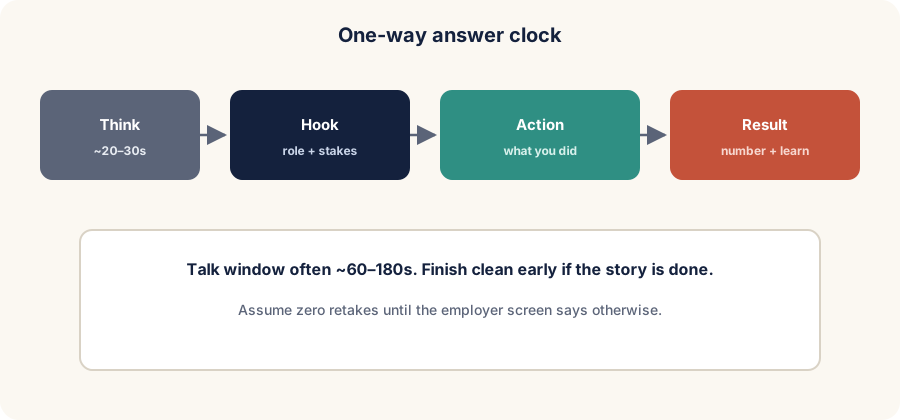 Think window → hook → action → result. Cut the throat-clearing.
Practice timed spoken answers (the part people skip)
Reading answers in a doc trains reading. One-way interviews grade talking into a dead lens under a clock. Different sport.
Tonight drill. No fancy setup.
- Five prompts from the list above.
- Phone timer: ninety seconds of talk.
- Twenty seconds to think. Then front camera. Record.
- When the timer ends, stop. Once, stop mid-sentence on purpose so you feel the cut.
- Replay once. Only three scores: Did you answer the actual question? Was there a result? Were your eyes mostly on the lens?
Do not rewrite a novel between takes. Change one lever. Shorter setup. Louder ending. Fewer “um.” Then move to the next prompt.
Remote video habits (lighting, eye line, backup link) also show up in live loops: how to ace remote technical interviews. One-way twist: no human rescues you mid-answer.
Want a voice interviewer that asks follow-ups while you speak, with STAR-style suggestions during practice? OfferBull mock interview is for rehearsal before you open the employer link. Practice only. Never during the recorded session.
 Twenty seconds to think. Ninety to talk. Replay once.
Setup and lighting checklist
Treat the room like a tiny studio. Boring is good.
- Laptop at eye level. Books under it if needed. Looking down reads as disengaged on replay.
- Face a window or a lamp in front of you. Harsh overhead alone digs shadows.
- Plain background. No laundry pile. No readable posters.
- Wired or solid Wi-Fi. Close bandwidth hogs.
- Headphones only if echo is bad; otherwise clean mic on the laptop is fine.
- Quiet house. Put a note on the door.
- Dress like the job’s first live round. They will see shoulders up.
- Close Slack. Kill notifications. Do not keep a script on a second monitor if your eyes drift.
Test the employer link early if they allow a practice question. Read the on-screen rules for retakes before you start the scored set.
FAQ
Is HireVue the only one-way tool? No. It’s a common vendor name. Employers also run other one-way platforms with the same timed recorded vibe.
How many questions will I get? Often three to eight. Read the invite. Guessing wrong wastes prep.
Can I use notes? Maybe, if they stay off camera and you are not reading lines. Eyes glued to a side monitor looks obvious on replay. Three memorized bullets beat a script.
What if I freeze? One beat. Restate the question in your own words. Pick one example. Short and finished beats a polished stall that never lands.
Do I need to fill the whole timer? No. Finish clean early if the story is done. Dead air is fine. Rambling to “use the time” is how good answers get worse.
Practice This Out Loud
Tonight: five one-way prompts. Twenty seconds think. Ninety seconds talk on camera. Replay each once. Fix one lever. Then a short voice mock with follow-ups. → Practice Now