 OfferBull
Google Behavioral Interview Questions and "Googleyness" Explained | OfferBull

Google Behavioral Interview Questions and “Googleyness” Explained
Whiteboard marker still wet. Interviewer leans back. “Tell me about a time you worked through ambiguity.” Your brain offers three stories and none of them have an ending. Clock keeps moving.
Google behavioral interview questions are not a personality quiz. Google’s public hiring material says every candidate is assessed on four attributes: general cognitive ability, role-related knowledge, leadership, and Googleyness. Behavioral and hypothetical prompts are how interviewers collect evidence for those. Aimed at US/UK/CA/AU candidates across eng, PM-adjacent, ops, sales, and support. Samples here are fictional. Steal the shape. Use your own facts.
OfferBull is not affiliated with Google. Process details below come from Google Careers and Google’s public candidate guidance as of late 2026 and can vary by role and location.
What Google says it assesses
Stick to the company pages. Forums invent rubrics.
Google’s How we hire overview lists four attributes for every role:
General cognitive ability (GCA). How you learn and solve hard problems in real life. Not GPA theater. Not a puzzle dump. Google has also said it does not use brainteasers because research showed they were not useful.
Role-related knowledge (RRK). Do you have the skills and background for this seat. For eng that often means coding and design. For non-eng it means the craft of the job.
Leadership. Not job titles. Influence when the brief is messy. Being a teammate who still moves work forward.
Googleyness. Public material frames this as comfort with ambiguity, bias to action, and a collaborative nature. Humility shows up in older re:Work write-ups too. Treat those as story prompts, not magic words to sprinkle.
Google re:Work also splits structured interview questions into two flavors. Behavioral: “Tell me about a time…” Hypothetical: “What would you do if…” One checks past patterns. The other checks how you reason in a new situation.
For coding-heavy loops, start with Google software engineer interview. For STAR mechanics, keep STAR method interview questions and examples open while you draft bullets.
 Blank boxes on paper beat a memorized speech.
Behavioral questions with STAR sample answers
Say “I,” not “we.” Leave room for follow-ups. Numbers help when they are real.
1. “Tell me about a time you faced ambiguity.”
Googleyness bait. Don’t say the word. Show the move.
Fictional spoken take: “Our launch brief said ‘improve onboarding’ with no metric. I pulled the last two weeks of drop-off data, booked twenty minutes with support and one PM, and wrote three possible definitions of success. We picked day-seven activation. I owned a one-page plan and a weekly check. Activation moved about eight points in a month. Now I refuse a fuzzy brief until one metric is named.”
Shape: Situation → Task → Action → Result. Longer Action. Same structure as software engineer behavioral interview questions.
2. “Tell me about a conflict with a teammate.”
They want repair, not a villain reel.
“Design and I disagreed on whether a feature needed a full rewrite. I scheduled thirty minutes with both sketches on one page. Listed cost, risk, and user impact. We shipped a thinner change that week and parked the rewrite behind a measured pain signal. Relationship stayed fine because the trade-off was written down.”
3. “Describe a time you failed.”
Own the miss. Show the scar.
“I shipped a config change without a rollback note. Support got a spike. I reverted in twenty minutes, wrote the postmortem the same day, and added a checklist to the deploy template. We have not repeated that class of miss. I still over-index on rollback text.”
4. “Tell me about a time you helped someone else succeed.”
Leadership without a title.
“A new hire was stuck on a flaky test suite. I sat for an hour, showed how I isolate flakes, and left a short doc. Their first green week landed faster. I still keep a ‘first week traps’ note for anyone joining the lane.”
5. “Give an example of solving a hard problem.”
GCA signal. Show how you learned, not how clever you are.
“Latency spiked only for one region. Metrics looked fine globally. I sliced by region, found a cache miss pattern, reproduced it with a tiny script, and partnered with infra on a TTL fix. P95 dropped. Lesson I kept: start local before you redesign the world.”
More bank coverage: behavioral interview questions and answers. Amazon’s LP flavor is different: Amazon behavioral interview questions.
Hypothetical questions (same attributes, future tense)
These feel like design lite. Talk out loud. Name assumptions.
6. “A key metric drops 20% overnight. What do you do?”
I’d open with: “Confirm the data is not broken. Check logging, time zones, and whether a release shipped. Segment by platform and region. If real, list top three causes ranked by likelihood and blast radius. Pick one experiment or rollback I can do today. Write what I’d tell the team in one paragraph.”
7. “You join a team with unclear ownership. First two weeks?”
“Map who thinks they own what. Read the last month of incidents and roadmap notes. Ask three people the same question: what breaks if you disappear next week. Propose a thin RACI for the messiest surface. Bias to a written draft over a kickoff speech.”
8. “Your manager asks for a feature that looks wrong for users. What do you do?”
“Ask what success looks like in ninety days. Bring one page with user cost, eng cost, and an alternative. Escalate only with options, not a vibe. If we still ship, I document the revisit date.”
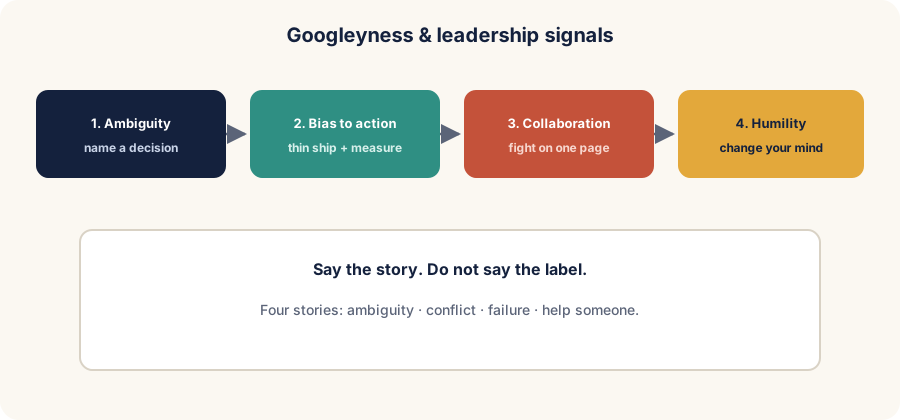 Ambiguity · action · collaboration · humility. Stories beat slogans.
Googleyness and leadership signals (without the buzzwords)
Interviewers do not need you to say “Googleyness.” They need evidence.
Ambiguity. You named a decision when the brief was mush.
Bias to action. You shipped a thin version and measured.
Collaboration. You made the fight visible on one page instead of Slack lobbying.
Humility. You changed your mind when the data said so. You credit others without vanishing from the “I.”
Leadership. You moved a stuck group without waiting for a title.
Prep four stories that cover: ambiguity, conflict, failure, helping someone. Two minutes each. Then be ready for “What would you do differently?” That follow-up is where thin stories die.
Night-before checklist
Four stories on sticky notes. Not essays.
- Ambiguity with a named metric at the end.
- Conflict with a written trade-off.
- Failure with the scar you still carry.
- Helping someone without making yourself the hero of their career.
One hypothetical. Metric drop or unclear ownership. Talk for ninety seconds while you sketch blank boxes on paper.
Record one story. Replay. If you hear “we” five times, fix the “I” lines. If the ending is a feeling with no change, add the change.
Compare your conflict story to the Amazon LP tone if you are looping both companies: Amazon behavioral interview questions. Different vocabulary. Same need for receipts.
AI tools: practice only, never in the real interview
Google’s candidate guide for virtual interviews is blunt. Do not use AI during the interview to help answer questions. Doing so can disqualify you. Same idea for submitting work you did not produce.
So frame practice tools the honest way. Use them in the weeks before. Not inside the Meet. Not as a copilot on interview day.
OfferBull is an AI mock interview app for iOS and Android. A voice interviewer asks questions out loud. You answer by speaking. Paste a job description or upload a resume for tailored prompts. Follow-ups track what you said and what’s on the resume. While you practice, you can see answer suggestions and STAR structures. English and Chinese practice both work.
That is rehearsal before Google. Not assistance during Google. If a recruiter later invites AI for a specific assessed exercise, follow that email. Default rule when nobody said otherwise: off.
Want that rehearsal loop? OfferBull mock interview is built for speaking out loud before the panel.
 Phone on a stand. Speak. Replay. Fix one thing.
FAQ
Is there a separate Googleyness interview? Often yes for some loops. Sometimes behavioral questions are mixed into other rounds. Ask your recruiter what your packet includes.
How is GCA different from coding? Coding is mostly RRK for eng seats. GCA shows up in how you reason, learn, and structure a messy problem. Hypotheticals and deep follow-ups on past work both probe it.
Should I mention Googleyness by name? I’d skip the label. Tell the story. Let them map it.
Can I use notes in a virtual behavioral round? Ask your recruiter. Even if notes are allowed, reading a script sounds like reading a script. Bullets only.
How long should a STAR answer be? About ninety seconds to two minutes before follow-ups. Leave air for “what did you do next.”
Practice This Out Loud
Tonight: four stories. Ambiguity, conflict, failure, help. Two minutes each on a timer. One hypothetical metric-drop answer. Record. Replay once. Fix one limp ending. Then a short voice mock with follow-ups. → Practice Now