 OfferBull
Financial Analyst Interview Questions and Answers (Technical + Behavioral) | OfferBull
Financial Analyst Interview Questions and Answers (Technical + Behavioral)
Whiteboard marker squeaks. Interviewer draws three blank boxes and an arrow. “Walk me through how these connect.” You blank on the labels you crammed. Labels aren’t the point. How the pieces talk to each other is.
Financial analyst interview questions check whether you can talk statements, variance, and a model without turning into a textbook. Aimed at FP&A, corporate finance, and financial analyst seats in US/UK/CA/AU. Samples are made up. Steal the shape. Not the numbers. Interview prep only. Not investment advice. No stock picks. No “you should buy.”
Also looking at IB-style screens? Peek at investment banking interview questions. Same neighborhood. Different intensity.
What they’re actually grading
Four lanes. Fast.
Statement fluency. P&L, balance sheet, cash flow. Can you say how they connect without a script.
Judgment under variance. Why actual missed forecast. What you’d do next week.
Modeling hygiene. Excel another analyst can audit. Assumptions you can defend out loud.
Behavioral spine. Forecasting miss. Tight close. Stakeholder who wants a prettier number.
They’re hiring the person who keeps the story honest when the dashboard looks ugly. Not a walking formula sheet.
Fintech loops sometimes add a light technical screen. If that’s you: how to prepare for technical interviews at fintech companies.
Three statements and valuation. Say them out loud.
Over two minutes on “walk me through the three statements”? Cut background.
Q: Walk me through the three financial statements and how they link.
“I’d start with the income statement. Revenue minus costs gets you net income. That net income flows into retained earnings on the balance sheet, and it’s the starting point for cash flow under the indirect method. Balance sheet is a snapshot. Assets equal liabilities plus equity. Cash flow explains why the cash line moved. Capex and working capital sit on cash flow, then update the balance sheet. If net income is up but cash is down, I’m hunting inventory, receivables, or debt paydown before I celebrate.”
Q: EBITDA versus free cash flow?
“EBITDA is a proxy for operating profit before interest, tax, depreciation, and amortization. Handy for comparing operating performance across capital structures. Free cash flow is what I’d actually care about for cash left after the business reinvests. Rough cut: cash from operations minus capex. In the room I’d ask which FCF definition they use before I invent one.”
Q: How would you value a company in a first-pass answer?
“Three families. Comps: similar publics, multiples like EV/EBITDA, check comparability. Precedent deals: what buyers paid, usually a control premium. DCF: project free cash flows, discount at WACC, terminal value. I’d say which one I’d trust more for the business in front of me, and name one risk for each. DCF is sensitive to terminal growth. Comps get noisy if the peer set is wrong.”
Keep valuation talk interview-shaped. You’re showing how you’d reason in the room. Not pitching a security.
Variance and FP&A
This is where FP&A seats lean hard.
Q: Revenue missed forecast by 8%. How do you dig in?
“I’d split volume versus price versus mix before I invent a narrative. Then I’d check whether the miss sat in one product, region, or channel. Compare against pipeline or bookings if we have them. Next I’d ask what we already knew mid-month. If the miss was visible two weeks ago and nobody reforecast, that’s process as much as demand. I’d bring one recommended action. Not just a chart.”
Q: A favorable expense variance that still worries you?
“Hiring freeze that under-ran payroll looks great on the P&L and terrible if delivery slips. Same for cutting maintenance. I’d flag the operating risk next to the dollar variance so leadership doesn’t treat every green cell as a win.”
Q: How do you build a driver-based forecast?
“Start with the two or three drivers that actually move the number. Units, price, conversion, headcount, utilization. Write assumptions in plain language next to the cells. Keep a version finance owns and a light view ops can challenge. Revisit drivers when the business changes. Not only when the month closes.”
Excel and modeling tests
Many loops drop a timed Excel case. My honest take: structure beats fancy formulas.
Inputs, calculations, outputs. Clear. Color inputs if that’s house style. Name the key assumptions. No buried hardcodes. Leave a short note on what you’d check with another hour.
Messy tab? Clean the logic before you decorate charts. Ask one clarifying question early. “Is the target contribution margin or gross margin?” saves twenty minutes of wrong work.
Practice saying your steps while you click. Silence plus frantic scrolling reads as panic even when you’re fine.
Behavioral: forecasting miss and tight close
Analyst behavioral rounds still want STAR method stories. Broader bank: behavioral interview questions and answers.
Tell me about a time a forecast missed.
“I owned the monthly revenue forecast for a mid-market SaaS book. March we missed by about six percent. Volume held. Discounting in one segment spiked after a sales contest nobody flagged to FP&A. I rebuilt the bridge that afternoon, sat with sales ops, and we added a discount-rate check into the weekly pack. Next quarter that segment’s forecast error shrank. Lesson I keep: contests and pricing experiments need a finance ping before they go live.”
Tell me about a tight close.
“Month-end. Two analysts out sick. Controller needed flash by noon. I cut scope to cash, revenue, and the three accruals that usually move. Built a one-page checklist. Paired with AP on the sticky invoices. Sent a 10 a.m. status with what was still open. Flash out at 11:40. Full close next morning. I’d rather send a labeled partial early than a silent scramble.”
Self-pitch before they dig technical: tell me about yourself sample answers. Comp talk later: what are your salary expectations.
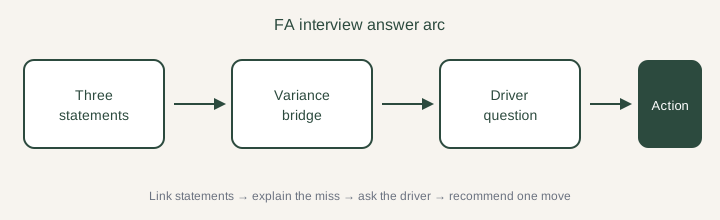 Link the statements. Bridge the miss. End on one move.
How I’d prep the week before
Read the latest public filings or a recent earnings note if they have one. Sketch the three-statement links once on paper from memory. Two STAR stories: a miss, and a close or stakeholder pushback. One timed Excel drill with a messy sheet. Then speak the answers out loud. A written cheat sheet you never say aloud is theater.
Full checklist energy: how to prepare for a job interview.
OfferBull is an AI mock interview app for iOS and Android. A voice interviewer asks questions aloud. You answer by speaking. Paste the job description or upload a resume so prompts match the seat. Follow-ups track your answers and resume. While you practice, you get answer suggestions and STAR structures. English and Chinese both work.
Practice before the interview. Not during it.
Want that drill with follow-ups? OfferBull mock interview.
FAQ
Do I need a CFA to pass? No. Helpful signal for some teams. Not a gate for most corporate FA or FP&A seats. Clear statement links and one honest variance story usually matter more.
Will there be a live Excel test? Often yes for FP&A. Sometimes a take-home. Ask the recruiter. Prep structure and auditability either way.
How technical is valuation for a corporate FA role? Usually lighter than IB. Know comps, DCF shape, and when each breaks. Don’t fake a full LBO walkthrough unless the JD asks.
What if I blank on a formula? Say what you’re trying to measure and how you’d look it up. Then reconnect to the business question. Silence plus panic scrolling is worse than an honest gap.
Bring a model to the interview? Only if they asked. Otherwise bring clean stories and a willingness to sketch on a whiteboard.
Practice This Out Loud
Tonight: sketch the three-statement links from memory. Record a ninety-second variance answer. Replay once. Cut one jargon word. Then a short voice mock with follow-ups. → Practice Now