 OfferBull
Entry-Level Interview Questions: How to Answer When You Have No Experience | OfferBull
Entry-Level Interview Questions: How to Answer When You Have No Experience
Waiting room. Folder on your lap. You keep rehearsing the same line: “I don’t have real experience.” Then the door opens. You don’t owe them that apology. A campus project, a weekend shift, a volunteer morning. Those still count if you tell them like work.
Entry-level interview questions hit new grads, career switchers, and international students across US/UK/CA/AU. Cross-role on purpose. Not a tech-only guide. What they want is simple: can you own a story, learn fast, and show up prepared. Samples below are fictional. Steal the shape. Use your own scenes.
Aiming at a big-tech new-grad loop after this? Then read how to crack your first big tech interview as a new graduate.
School, shifts, and volunteering still count
They already saw the short resume. They’re listening for Situation, Task, Action, Result. Same bones as any STAR method answer.
I’d map it messy on one page:
Group project that almost blew a deadline. That’s conflict plus delivery. Cafe rush on Saturday. Prioritization under noise. Tutoring or club officer work. Teaching and follow-through. Volunteer event with broken logistics. Asking for help without melting down. Capstone with a fuzzy brief. Research, then a clear finding.
Four bullets per story. One line each. Say “I.” End with what changed. No metric? Fine. Say what a professor, shift lead, or teammate did differently after.
My honest take: the candidates who sink entry-level screens aren’t the ones with thin resumes. They’re the ones who open with an apology and never land a concrete scene.
15 questions. Say the answers out loud.
Aim for about ninety seconds on behavioral ones. Shorter on “why us.”
1. Tell me about yourself.
“I’m wrapping a marketing degree. Last year I ran social for a student club, about two thousand followers, and I worked bookstore weekends through the rush. I’m looking for a coordinator seat where I own campaigns end to end. Your retail internship posting is why I applied.”
More shapes live in tell me about yourself sample answers.
2. Why this role?
“Two things. The posting wants clear briefs and follow-through. That’s what I did on our club’s sponsor deck. And I’ve followed your product since a class project last spring. I want those two to meet. Not just any first job.”
3. Why hire you with so little experience?
“Because I already practice the habits the seat needs. I show up early for shifts. I write down what I did so the next person isn’t guessing. In my capstone the team stalled on the survey. I owned the design and we still hit the presentation date. I’ll need coaching on your tools. I won’t need coaching on finishing.”
4. Tell me about a time you worked on a team.
“Four of us building a booking app for a final-year class. Week four, one teammate hadn’t pushed code. I almost vented in the group chat. Didn’t. Messaged him privately. He was stuck on setup and working late shifts. We paired for an hour. Broke his work into weekly chunks. He delivered. We demoed on time.”
5. Tell me about a conflict.
“Research class. Teammate wanted a new topic three days before the outline. I wanted to keep ours. I asked for fifteen minutes, listed what we’d lose if we switched, and offered a middle path: keep the topic, add one section for her angle. She agreed. Outline in on time. Naming the cost early beat a polite standoff.”
6. Tell me about a failure.
“I led a campus fundraiser and under-counted volunteers. Day-of, check-in table was short. I apologized to the advisor, called two friends who could spare an hour, and wrote a staffing checklist for next time. We still hit the donation goal. I don’t skip the volunteer math anymore.”
7. Greatest strength?
“I turn fuzzy instructions into a checklist other people can follow. Tutoring: students kept missing the same homework step. I rewrote the sheet with three examples and a stop-and-check box. Missed problems dropped the next week. I’d rather leave a trail than look busy.”
More framing: what are your strengths.
8. Greatest weakness?
“I used to over-build slides and under-rehearse the talk. Club pitch. Twenty slides. I stumbled on the ask. Now I cap at ten and practice the open twice out loud. Still not perfect. Better than winging the close.”
See also what is your greatest weakness answers.
9. Learned something fast?
“Bookstore POS changed overnight. Watched the trainer once. Wrote my own cheat sheet at lunch. Ran evening rush without calling a manager. Two coworkers borrowed the sheet next day. Writing it down beat relearning under pressure.”
10. How do you prioritize when everything feels urgent?
“External deadlines first. Customer in front of me beats restocking. Professor deadline beats slide colors. On a group project I pushed the shared draft early so others weren’t blocked. Then I say what I moved. Silent reordering creates drama.”
11. Tell me about feedback you got.
“Professor said my lab write-ups buried the result. I started putting the finding in the first paragraph. Method detail lower. Clarity grades went up. Now I ask one person to read the first five lines before I submit anything long.”
12. Where do you see yourself in five years?
“Honest version. I want to own a small lane end to end. Maybe help a newer hire. I’m not claiming a VP title in this room. Get good at this craft first.”
13. How do you handle stress?
“I shrink it to the next physical step. Before exams I timed one practice set, not the whole syllabus. Before interviews I rehearse two stories out loud, then stop. Panic wants a marathon. I give it ten minutes.”
14. Questions for us?
“What does success look like in the first ninety days here? And what’s one thing new hires usually underestimate about this team?”
15. A project you’re proud of.
“Orientation volunteer lead. Three hundred new students. Rainy backup plan nobody loved. I built a room sheet the night before, briefed volunteers in ten minutes, parked myself at the confusing hallway. Lines moved. Advisor reused the sheet next year. Proud of the boring system. Not the title.”
Mistakes that sink these interviews
Opening with “I know I don’t have experience.” They read the resume. Lead with a scene.
Soft skills with zero proof. “Hard worker” without a shift or deadline is wallpaper.
Only “we.” Credit the team. Then say what you owned.
A script so rigid you can’t take a follow-up. People interrupt. Practice the interrupt.
Zero questions at the end. Looks like you’ll take anything. Ask about ninety days.
Broader prep: how to prepare for a job interview and how to practice for an interview. More behavioral bank: behavioral interview questions and answers.
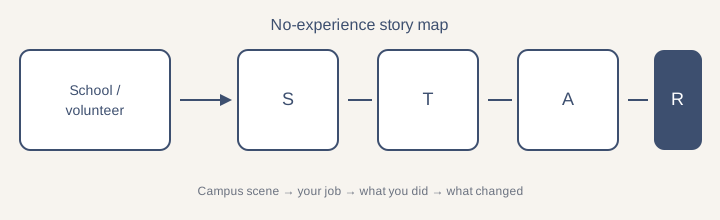 Campus scene in. Clear result out.
Practice before the room
Eight messy bullets tonight. Pick five. Speak each once into your phone. Delete the apology opener. Then a short mock with follow-ups so you practice getting cut off.
OfferBull is an AI mock interview app for iOS and Android. A voice interviewer asks questions aloud. You answer by speaking. Paste the job description or upload a resume so prompts match the seat. Follow-ups track your answers and resume. While you practice, you get answer suggestions and STAR structures. English and Chinese both work.
Practice before the interview. Not during it.
Want that drill with follow-ups? OfferBull mock interview.
FAQ
Can I use class projects? Yes. Name your role, the deadline, what you did, what happened.
Only retail or cafe experience? Use it. Customer pressure and reliability transfer. Don’t hide the title. Frame the skill.
How long should answers be? About ninety seconds for behavioral. Shorter for “why us.” They’ll ask if they want more.
Mention GPA? Only if it’s strong and they care, or if they ask. A story usually beats a number.
Okay to say I don’t know? Yes on a tool you’ve never touched. Then say how you’d learn it week one. Don’t bluff a system you’ve never opened.
Practice This Out Loud
Tonight: map three campus or shift stories into STAR. Record one. Cut the apology. Then a short voice mock with follow-ups. → Practice Now