 OfferBull
CodeSignal General Coding Assessment (GCA): Format, Scoring and Prep Plan | OfferBull

CodeSignal General Coding Assessment (GCA): Format, Scoring and Prep Plan
You have reread the invite twice and still have not clicked Take Assessment. It names the CodeSignal General Coding Assessment. A teammate already decided the clock started when the email landed. It did not. CodeSignal’s setup page says the timer starts after you finish setup, and there is a Practice button you can use first.
A lot of the prep I see is built from forum folklore: a fixed easy-medium-hard-very-hard stack, a magic cutoff, a leaked bank. CodeSignal publishes the structure, the rules, and how the score is built. Use those pages. Then read the invitation your recruiter sent. A company can change the duration, and that invitation beats this blog. OfferBull is not affiliated with CodeSignal.
This post is the platform-specific complement to our guide to online coding assessments. That one covers take-homes and timed tests in general. This one stays on the GCA.
What the CodeSignal General Coding Assessment actually is
The format source I am using is CodeSignal’s support article What should I expect when I take the General Coding Assessment (GCA) and how is it structured (updated October 13, 2026).
You get four questions of varying difficulty. The default window is 70 minutes, unless a company configured a different duration. When the timer starts, all four questions are accessible. You can split the time however you want and work in any order. The focus is implementation and problem-solving ability. You write code in the assessment IDE. Outside IDEs are not permitted.
“Varying difficulty” is the official phrase. That is all I will claim. I am not going to label them question 1 easy, question 2 medium, question 3 hard, and question 4 very hard, because CodeSignal’s own article does not. Forum posts do that constantly. Treat those labels as rumor.
The same article says the GCA is scored on correctness, speed, implementation, and problem-solving ability. The score is reviewed and certified if no unusual activity is found. That score is part of the Coding Report, which also includes other scores plus coding speed, problem-solving, and implementation.
On the certified assessments page (updated April 14, 2026), CodeSignal describes the GCA as the industry standard for evaluating core programming skills at scale, and as a fit for early-career and new-grad screening. They say it includes over 628,000 variations, and that candidates can take it in any of CodeSignal’s 45 supported programming languages. That is their wording, not a ranking I am inventing.
One mix-up I want to kill early. The GCA is not the Industry Coding Assessment, sometimes discussed under the Industry Coding Framework. The ICA is a different certified assessment, aimed at mid- to senior-level engineers. Official ICA rules describe one project-based question with four progressive levels, a maximum of 90 minutes, and a different cooldown: two attempts in 180 days. Details live in What are the Industry Coding Assessment (ICA) rules (updated September 14, 2026). If your invite says ICA, stop reading this as a checklist and go to that page instead.
How GCA scoring works, and what I will not invent
CodeSignal’s Assessment Score, also called the Coding Score in some of their articles, ranges from 200 to 600. Higher generally means more questions completed successfully. That comes from Understanding Assessment Score (updated November 3, 2026) and What is an Assessment Score and how do I interpret a test taker’s GCA Assessment Score (updated April 16, 2026).
Scoring is two-tier. You earn base points for completing questions in a module. Bonus points are added only if you complete 100% of a module. Those bonuses weigh harder, more discriminating modules more heavily. So a half-finished hard prompt is not a clever substitute for finishing a module you can actually complete.
You may also see skill-area labels. On the November 3 scoring page, CodeSignal names the GCA skill areas as Basic Coding, Data Manipulation, Ease of Implementation, and Problem-Solving. The April interpretation article still defines the labels against the possible points in that skill area: Expert is 1.0 or above, Advanced is 0.67 to 0.99, Intermediate is 0.34 to 0.66, and Developing is 0.00 to 0.33. Both pages say these labels are directional and are not meant for hiring decisions. Do not treat an Intermediate label as a formal reject reason.
Here is what I will not invent, because I do not have it from CodeSignal:
A company-by-company cutoff such as “you need 300 out of 600.” Companies set their own bars, and they do not all publish them.
A leaked or official question bank. The certified-assessments page talks about hundreds of thousands of variations. Studying a screenshot from a stranger is a bad plan and a rules risk.
A universal expiry date for a certified score. CodeSignal says companies configure an acceptable score-age limit. There is not one public date that applies to every employer.
If someone quotes a cutoff in a forum, treat it as that person’s rumor about one team, not a rule.
A time plan that is advice, not a CodeSignal rule
Nothing in this section is an official requirement. It is how I would use the facts above.
Because completing more questions generally raises the score, I would try to land working solutions on the earlier or easier tasks first. I would not sink the whole 70 minutes into one hard prompt and leave three files empty. You can open all four from the start, so glance at them, pick a first target you can actually finish, and come back.
Submit often. CodeSignal says you may submit as many times as you need, and the highest-scoring submission is kept even if a later one has a syntax error. That is official, and it is a gift if you use it. A last-minute edit that breaks compilation should not erase a passing submission if you already sent a good one.
Use the official practice assessment and the in-browser IDE before test day. The rules article flags a Practice button before a real attempt, and the format article says outside IDEs are not permitted. The night before is a bad time to meet the editor.
A fictional practice prompt, not a GCA question and not something to touch during a real attempt:
You are given a list of login times for one user and a window of k seconds. Return whether any two logins fall at most k seconds apart. I would say this out loud at my desk, with the phone face down.
“I’d start with the empty list and with a single login, both of which should be false, and I’d ask whether the times are already sorted. If they aren’t, I sort a copy. Then I walk adjacent pairs and stop at the first gap that is less than or equal to k. I’d trace [1, 8, 10] with k=2 by hand before I trust the loop. Sorting makes it n log n, then a linear scan.”
That is interview-style talking, and it is prep. It is not a script for the proctored session.
 A study setup, not the live assessment. Four questions are official; the cards and timer are just a way to practice choosing an order.
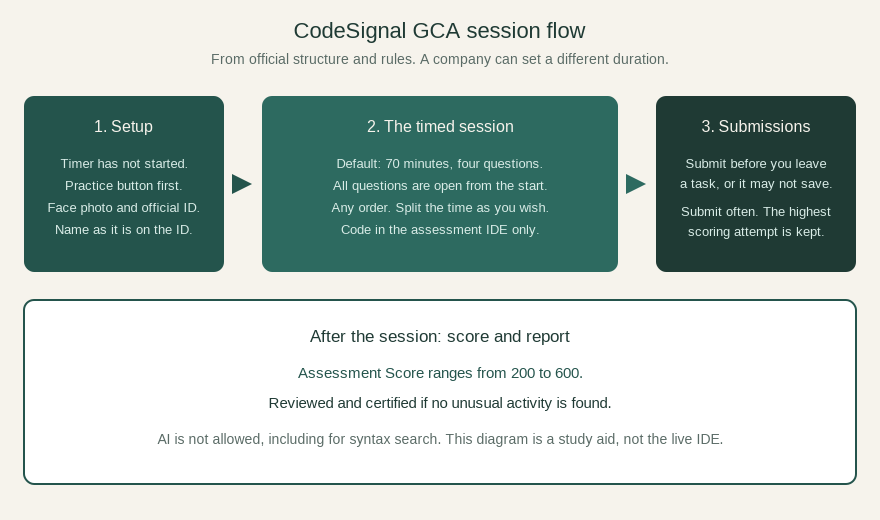 From CodeSignal’s GCA structure and rules articles. A company can set a different duration. This diagram is a study aid, not the live IDE.
Setup, proctoring, and what you can look up
The rules live in General Coding Assessment (GCA) Rules and Setup (updated October 26, 2026). Read that page in full before you start. I am summarizing, not replacing it.
The timer does not start until setup is complete. Use that. There is a Practice button before you start a real attempt. Use that too.
 Practice the setup on your own time. During the real GCA, follow CodeSignal’s rules and your invitation, not a photo from a blog.
Proctoring setup includes a face photo and a photo of official ID. If the photo is unclear, an upload is allowed. Submit your name as it appears on the ID, not a preferred nickname that does not match the document.
Syntax-only web searches are allowed. CodeSignal’s example is a C++ queue method reference. Pages that help you implement the solution are not allowed. And this part is easy to miss if you only remember the old “Google is fine for syntax” advice: use of AI is not allowed, including for syntax search. So a docs query for a standard-library method may be fine. Pasting a prompt into a chatbot, even “what’s the method name,” is not.
You must submit your work before leaving a task, or the code may not save. That is official, and it is one of those rules people learn the hard way. Submit, then switch.
I will say this once, clearly. Practice on your own, or in a mock interview app, before the GCA. Do not use OfferBull, a chatbot, a second screen, or a notes overlay during the assessment. There is no stealth mode, and I will not hint at one.
Cooldown, retakes, and sharing a score
CodeSignal states the GCA cooldown plainly in Why is the Take Now button disabled (updated April 15, 2026): two attempts within 30 days, and three attempts within 180 days. More detail and examples are in What is a cooldown period and how does it impact my ability to take an assessment (updated September 24, 2026).
You cannot make multiple attempts on a single invitation. A retake happens only on a new request, and only when you are not in cooldown. During cooldown, share a past score instead of hunting for a loophole. Do not use a different account to bypass cooldown. That is not a clever workaround. It is against the rules.
CodeSignal does list exceptions that can grant a new attempt: an incomplete attempt where they identified technical issues or extenuating circumstances; previous attempts that were all non-proctored when the new invite is proctored; and previous scores that are older than the hiring company’s configured acceptable score-age limit. If you think one of those applies, follow CodeSignal’s process. Don’t invent a fourth exception in an email to a recruiter.
Sharing has a consequence people skip. How do I share my assessment results with potential employers (updated October 2, 2026) says that if you retake, the requesting company receives the new result, even if it is lower. A company that already received a prior result still has that prior result too. So a retake is not a clean overwrite everywhere, and it is not free. If your current certified score is solid and you are inside cooldown, sharing is the path CodeSignal points you to.
A practice plan that stays outside the proctored test
The GCA is a silent, timed IDE session. A later onsite or video coding interview is often not. Prep for both, and keep them in different rooms.
I’d spend a couple of weeks on patterns, not on trying to memorize 628,000 variations. The coding interview patterns post is the map I would actually use: arrays and hashing, two pointers, sliding windows, trees, graphs, heaps, recursion, and the usual dynamic programming shapes. If you want a finite list rather than an open tab of “all problems,” the companion post on Blind 75 vs NeetCode 150 is the next decision, not a second question bank to finish in a panic.
Then put a timer on, in an in-browser editor, and practice submitting. The official practice assessment is the closest dress rehearsal I know of, because the real test does not let you bring your usual IDE. Get used to reading a prompt, writing a first working version, submitting, then tightening.
And practice explaining the solution out loud, on a different day, as interview prep. Walk the brute force, the why, one edge case, and the complexity, the way you would in how to communicate your thought process during technical interviews. That skill will not be graded by the GCA IDE. It will show up later, when a person is on the call. A broader rehearsal plan is in how to practice for an interview.
 Do this after you close the practice editor. It is for a later interview, not for the proctored test.
OfferBull is an AI mock interview app for iOS and Android. A voice interviewer asks questions aloud. You answer by speaking. Paste the job description or upload a resume for tailored questions. Follow-ups based on what you said and what’s on the resume. While you practice, you get answer suggestions and STAR structures. English and Chinese. Close it before you open the real GCA. It is practice, not a tool for the assessment.
FAQ
How long is the CodeSignal General Coding Assessment, and how many questions are there? The official default is four questions in 70 minutes, unless the company configured a different duration. All questions are available when the timer starts, and you may work in any order.
What score do I need? CodeSignal does not publish a single passing cutoff for every employer. The Assessment Score ranges from 200 to 600, and a higher score generally means more questions completed successfully. Ask the recruiter whether their team uses a threshold, and do not treat a forum number as official.
Can I use Google or an AI assistant during the GCA? Syntax-only web searches are allowed, such as looking up a C++ queue method. Pages that help you implement the solution are not allowed, and use of AI is not allowed, including for syntax search. When in doubt, stay in the assessment IDE.
How often can I retake it? The GCA allows two attempts within 30 days and three attempts within 180 days. You cannot take it again on the same invitation. If you are in cooldown, share a past score rather than opening a second account.
Is the GCA the same as the Industry Coding Assessment? No. The ICA is a separate certified assessment for mid- to senior-level engineers: one project-based question with four progressive levels, and a maximum of 90 minutes. Check the name on your invite.
Practice This Out Loud
Tonight: open the official practice path, or an in-browser editor if you cannot start practice yet, and finish two timed prompts with several submissions each. Then, after you close that tab, explain one solution out loud in two minutes, including an edge case you almost missed. A voice mock is for the later interview, not for the proctored test. → Practice Now
Take Control of Your Career Path:
- Official Site: www.offerbull.net/mock-interview
- iOS App: Download for iPhone/iPad
- Android App: Download for Android