 OfferBull
Business Analyst Interview Questions and Answers | OfferBull

Business Analyst Interview Questions and Answers
Marker half-dry. Hiring manager points at a messy intake nobody owns. “How would you gather requirements?” You start listing Jira. Eyes glaze. Wrong sport.
Business analyst interview questions check whether you can pull a sharp need out of fuzzy people, write something a tester can fail on purpose, and stay calm when two directors want opposite things by Friday. Aimed at IT BA, business systems analyst, and product-adjacent BA seats in US/UK/CA/AU. Samples are made up. Steal the shape.
What these interviews are actually grading
Four lanes. Fast.
Requirements craft. “Make it better” turned into criteria QA can break.
Process thinking. As-is vs to-be. Where tickets sleep overnight. What you’d measure after a change.
Stakeholder spine. Conflict without a villain monologue. Trade-offs in plain words.
Delivery habits. How you sit with eng and QA. UAT that is not theater.
They are not hiring a human ticket router. They want the person who asks the second question when the first answer is mush.
Near product or program? Peek at product manager interview questions and how to prepare for technical program manager interviews.
 Blank boxes and arrows beat a tool name-drop.
Requirements and process (say these out loud)
Time yourself. Over two minutes? Cut.
1. “How do you gather requirements?”
They want a loop. Not a chapter.
I’d say it like this: “I start with the decision this change is supposed to make possible. Then who touches the work today. Short interviews. One shadowing pass if I can get it. Rough as-is sketch I correct live with them. Draft requirements in their words first. Tighten into acceptance criteria. Walkthrough before eng picks them up. Docs are the output. Talk is the work.”
2. “Business requirement vs solution?”
Need: “Agents resolve billing mismatches in one screen without a side spreadsheet.” Solution: “Ship widget X in the CRM.” Separate them so eng can propose options.
Out loud: “If someone says ‘we need a new portal,’ I ask what job fails today. Often they need faster status visibility. Not a portal. I write the need. Options come after.”
3. “Walk me through mapping a process.”
Keep dirt under the nails.
“I’d pick one case type. Follow a real ticket from intake to close. Note handoffs and wait states. Sketch swimlanes on a whiteboard. Validate with two people who do the job. Metrics I care about: cycle time, rework, where work sits overnight. Fancy notation later. Shared picture first.”
4. “How do you write acceptance criteria?”
Given / when / then is fine. Clear fail conditions matter more than the template brand.
Shape I’d use: “Given a refund under $50, when the agent submits with reason code R2, then the case auto-closes and the customer email sends within five minutes. Fail if the email never leaves or status stays open.”
5. “Requirements changed mid-build. Tell me about it.”
Behavioral. Use STAR without sounding like a laminated card.
Fictional spoken take: “Mid-sprint, compliance wanted an extra approval over a refund threshold. I split must-have vs later. Rewrote two criteria. Twenty minutes with eng on a scope cut. Updated the UAT script same day. We shipped Friday with the high-tier approval path. Lower tier stayed as designed. Now I ask compliance for thresholds in week one.”
More shapes: behavioral interview questions and answers.
Stakeholders and conflict
6. “Two stakeholders. Opposite priorities. What do you do?”
Make the fight visible. Don’t lobby in Slack DMs.
I’d go: “One page. Option A impact. Option B impact. Cost of delay. Ask each what ‘good’ means in ninety days. Still stuck? Fifteen-minute call with the decision maker named up front. Write the choice and the revisit date. Quiet private lobbying burns trust.”
7. “Describe a difficult stakeholder.”
No villain reel.
“Ops lead kept tossing ‘quick’ fields into every stand-up. I booked thirty minutes. Showed how each field moved UAT and training. We set a monthly change window. Ad-hoc noise dropped. Easier relationship because the rule was on paper.”
8. “When are requirements done enough to build?”
“When two practitioners and one owner can walk the criteria without inventing a new edge case every other line, and eng can estimate without a dozen clarifications. Perfect docs don’t exist. Stable questions do.”
Mini case they’ll throw at you
Prompt flavor: “Gather requirements for a new employee laptop request flow.”
How I’d burn five minutes:
- Clarify success. Time-to-laptop? Fewer wrong configs? Audit trail?
- Actors. Employee, manager, IT asset, finance if cost codes matter.
- As-is pain. Email threads. Missing cost center. Wrong tier.
- Must-haves for v1. Authenticated request. Manager approve/deny. IT sees tier and site. Status the employee can check.
- Park for later. International shipping exceptions. BYOD.
- Open questions list. Say what you’d validate next.
Say the structure even while you invent details. Silence while you hunt for tool names is worse.
Self-pitch still matters before the case: tell me about yourself sample answers.
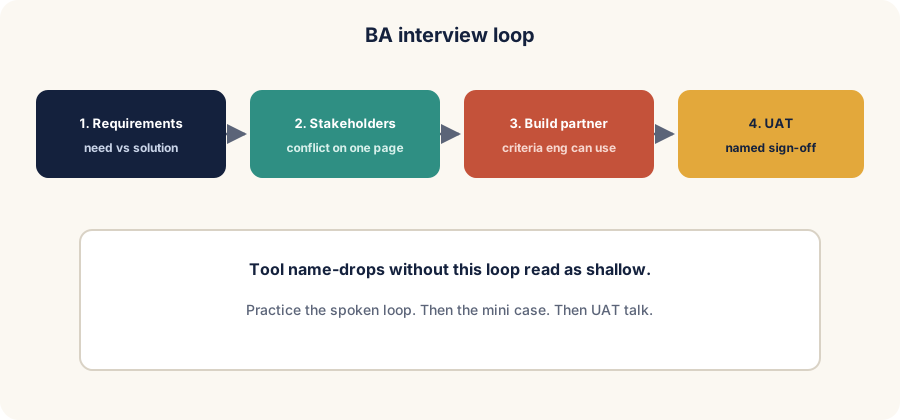 Requirements → stakeholders → build partner → UAT. Skip UAT and they’ll notice.
Tools questions without a feature tour
9. “What tools do you use?”
Name what you’ve touched. Tie each to a job.
“Sheets or Excel for quick reconciliations. SQL for pulls when warehouse access exists: joins, filters, spotting duplicate keys. Jira for backlog and acceptance notes. Miro or a whiteboard for maps. Visio or Lucid when audit wants a formal diagram. Tool isn’t the skill. Getting a shared picture is.”
10. “How’s your SQL?”
Honest level. Tiny example.
“I write selects with joins and basic aggregates. Example: orders with two shipping addresses in seven days. I’m not a data engineer. I partner when the query gets heavy.”
11. “How do you run UAT?”
“Scenarios from the criteria. Real users. Timeboxed cycle. Defects with repro steps. Must-fix vs cosmetic. Sign-off is a named owner, not a vibe. Hole in the requirements? I own the rewrite. Blaming QA is a bad look.”
 UAT scripts from criteria. Named sign-off. Blank checklist on the desk.
Night-before drill
Three passes. Timer up.
- Sixty-second “how I gather requirements” loop.
- One conflict story. Result first.
- Five-minute laptop-request case out loud. Record. Catch where you named tools instead of decisions.
Want a voice interviewer that asks follow-ups from a BA job description while you speak? OfferBull mock interview is for rehearsal before the panel. Practice only. Not during the real interview.
FAQ
Do BA loops include cases? Often. Process redesign, small feature requirements, or “why did this metric drop.” Practice talking while you sketch.
How technical? Read the posting. Many IT BA seats want SQL literacy and systems curiosity. Not production engineering. Don’t bluff.
Bring diagrams? A clean one-pager of a past as-is/to-be can help later if they allow materials. Don’t dump a portfolio in a screen.
BA vs PM interviews? BA leans requirements, process, UAT, translation. PM leans roadmap, prioritization, product sense. Overlap is real. Prep the lane on the JD.
How long is the loop? Screen plus one or two panels is common. Some add take-home or live case. Ask the recruiter early.
Practice This Out Loud
Tonight: 60-second requirements loop. One stakeholder conflict story. One five-minute mini case. Record. Replay once. Fix one thing. Then a short voice mock with follow-ups. → Practice Now