 OfferBull
Blind 75 vs NeetCode 150: Which LeetCode List to Use (and How to Practice It) | OfferBull

Blind 75 vs NeetCode 150: Which LeetCode List to Use (and How to Practice It)
Two tabs, one calendar. One tab is Blind 75. The other is NeetCode 150. A friend insists the longer list is what serious people finish. Another friend rushed the short one and still went quiet when they had to explain a sliding window out loud. That’s the actual fork. Not a branding war.
I am going to use NeetCode’s own wording and the difficulty totals shown on their practice pages, fetched for this article on November 17, 2026. I am not going to paste a third-party per-category count table as if it were official. Those tables disagree with each other, and lists get reorganized over time, so I will stay conservative. OfferBull is not affiliated with NeetCode or LeetCode.
What each list actually is
On the Blind 75 practice page, NeetCode writes: “The Blind 75 is a popular list of algorithm practice problems.” The difficulty totals on that page are Easy 19, Medium 49, and Hard 7. The topic-family headings include Arrays & Hashing, Two Pointers, Sliding Window, Stack, Trees, Heap / Priority Queue, Graphs, Advanced Graphs, 1-D Dynamic Programming, 2-D Dynamic Programming, Greedy, Intervals, Bit Manipulation, and Math & Geometry.
On the NeetCode 150 practice page, the wording is just as plain: “The Neetcode 150 is the Blind 75 plus 75 more problems. It’s the ideal list for people already familiar with basic algorithms & data structures.” Difficulty totals there: Easy 28, Medium 101, and Hard 21. The same topic-family headings appear.
You can say, as NeetCode does, that the 150 is the Blind 75 plus 75 more problems. I will not claim a verified problem-by-problem overlap of 100% or 85%, because I did not audit every title against every historical snapshot. If a blog shows a different split, it may be counting a slightly different arrangement. Use the live practice pages as the source, not a screenshot from last year.
What the official mix does tell you, without a category spreadsheet: both lists cover the same families. The 150 gives you more practice inside those families, and it has more Hard problems, 21 against 7. That is the real size difference. Not a secret second curriculum.
If you want the “why this pattern exists” layer, use top coding interview patterns every developer should know alongside the list, not instead of it. A list without the pattern is just a queue of tabs.
Which list I’d pick, depending on the week you actually have
This is advice, not a guarantee, and I will not invent a “finish in two weeks” promise or a pass rate.
If you have a short window, or this is your first serious pass through interview problems, start with Blind 75. Nineteen easy and forty-nine medium problems is already a lot of reps if you are doing them properly, meaning you can explain the idea after the tests pass. Seven hard problems is enough to meet the shape of a hard prompt without turning the next fourteen days into a graveyard of unfinished editor tabs.
If you already feel comfortable with the basics, or you have more calendar than that, NeetCode 150 is the list I’d open. That matches how NeetCode itself frames it: for people already familiar with basic algorithms and data structures. You get a thicker medium set and a much thicker hard set. That extra volume is useful when you have time to let problems go cold and come back.
If you already finished Blind 75, do not restart it from problem one because a thread said “the 150 is the real list.” Continue into the extra problems. You already have the 75. The 150 is those plus 75 more. Repeating the same twenty array questions in a new checkbox column feels productive and mostly isn’t.
A tight onsite in a week is a different problem than choosing a list. For that crunch, how to prepare for a tech interview in one week is the better frame: a few patterns you can still explain, not a heroic attempt to clear 150 boxes. If a CodeSignal or similar timed assessment is also on the calendar, the format and rules live in the new CodeSignal General Coding Assessment post. A list is prep for the skills. It is not the assessment itself.
Company loops still have their own shape. A Google, Amazon SDE, Meta, or Uber coding hour is not graded on how many NeetCode checkboxes you ticked. If you need a deeper data-structures pass, the data structures and algorithms interview guide is the study companion. Don’t spend the week collecting lists.
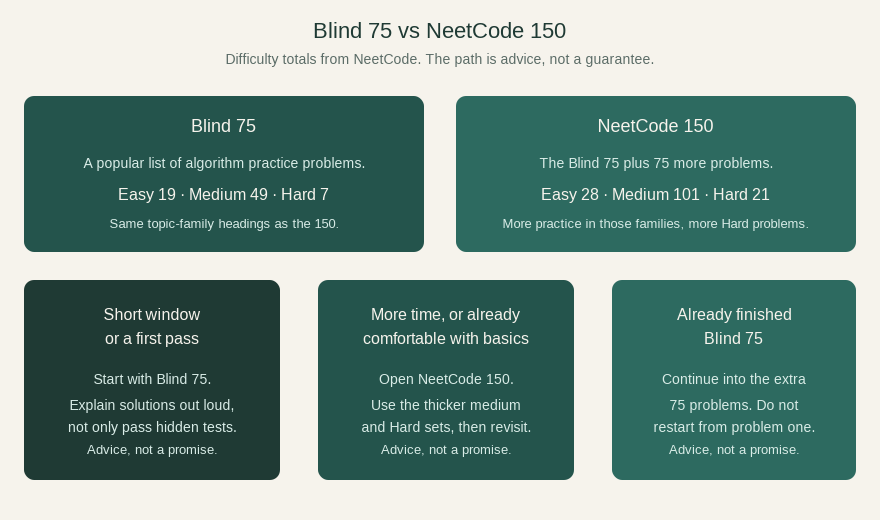 Difficulty totals are from NeetCode’s Blind 75 and NeetCode 150 pages. The path on the right is advice, not a published guarantee.
A compact comparison
| Blind 75 | NeetCode 150 | |
|---|---|---|
| NeetCode’s description | A popular list of algorithm practice problems | The Blind 75 plus 75 more problems; framed as the ideal list for people already familiar with basic algorithms and data structures |
| Official difficulty mix | Easy 19, Medium 49, Hard 7 | Easy 28, Medium 101, Hard 21 |
| Topic families | Same family headings on both pages | Same families, with more problems in them and more Hard problems |
| My advice | First pass, or a short window | More time, already comfortable with basics, or a continuation after Blind 75 |
The first three rows are from NeetCode’s pages or from a direct reading of those totals. The last row is mine.
How to practice the list so it still works in a room with a person
Passing hidden tests is the easy part to fake, even to yourself. You stare, you peek at a solution, you retype it, the bar goes green, you check the box. Two weeks later someone asks you to talk, and the window logic is gone.
I’d run a simple loop. Attempt the problem with a timer. If you solve it, write a three or four sentence explanation in your own words, then say it out loud, including one edge case. If you don’t solve it, study a good solution, close it, and retry the next day from a blank file. Then put the problem back on a spaced schedule: a few days later, then a couple of weeks later. I will not prescribe a magic interval. The point is that you see it again after you have started to forget it.
 A paper trace for practice. The boxes are empty on purpose; this is not a worked official solution.
The interview skill is explaining, not only passing hidden tests. Practice the talk the way you would in how to communicate your thought process during technical interviews: restate the prompt, give a brute force, say why you are switching, then code. A fictional walk-through, not a listed Blind 75 spoiler and not a verbatim script:
“I need the longest substring without repeating characters. I’ll assume the input can be empty, and that we’re talking about a standard character set, not a trick with grapheme clusters. Brute force would check every substring and I’d blow time. I’d keep a window of unique characters, grow the right pointer, and if a character is already inside, move the left pointer until it isn’t. I’d trace abba by hand, because that’s the case that punishes you if you don’t move left far enough. Linear time, extra space for the map.”
Say that to a wall, a roommate, or a voice mock. Then interrupt yourself: “What if every character is the same?” If you cannot answer without rereading the editorial, the checkbox was cosmetic.
A slightly more structured version, still fictional, if you like the letters labeled. This is a practice monologue, not a behavioral STAR story from a real job.
Situation. A timed medium I had marked “done” last month came back blank.
Task. Recover the approach in twenty minutes, then explain it without the editorial open.
Action. I retried from scratch, got stuck on the left-pointer move, drew the abba case on paper, and only then re-read one paragraph of the solution. The next morning I did a fresh file and recorded a two-minute voice note.
Result. The tests passed again, which was nice, and I could say the edge case without peeking, which was the actual point.
Do a handful of problems this way and the list gets slower, which is the point. A finished Blind 75 you cannot narrate is a weaker position than fifty problems you can restart on a whiteboard. If you want a broader data-structures backbone while you work the list, that data structures and algorithms post is the reading, not another checklist.
 Rehearse the talk after you close the editor. This is interview practice, not a stand-in for a coding screen.
OfferBull is an AI mock interview app for iOS and Android. A voice interviewer asks questions aloud. You answer by speaking. Paste the job description or upload a resume for tailored questions. Follow-ups based on what you said and what’s on the resume. While you practice, you get answer suggestions and STAR structures. English and Chinese. Use it to rehearse the explanation, not as a helper during a real coding interview or an online assessment.
FAQ
What is the difference between Blind 75 and NeetCode 150? NeetCode describes the NeetCode 150 as the Blind 75 plus 75 more problems. The official difficulty mix is 19 easy, 49 medium, and 7 hard on Blind 75, against 28, 101, and 21 on the 150, with the same topic-family headings and more depth in those families.
Should I start with Blind 75 or go straight to NeetCode 150? If this is your first pass or the calendar is short, I’d start with Blind 75. If you already know the basics and have more time, or you already finished the 75, use the 150 and keep going rather than restarting.
How long does each list take? It depends on your starting point and on whether you only make the tests pass or you can also explain the approach later. I will not invent a guaranteed two-to-four-week finish time.
Do I need to finish every Hard problem? Not as a rule. Blind 75 has seven Hard problems and the 150 has twenty-one. I’d rather explain a smaller set cleanly than skim every Hard with an editorial open. If you have time, the extra Hard practice on the 150 is useful.
Is finishing the list enough for interviews? No. A list builds pattern reps. Interviews still ask you to talk, to handle follow-ups, and sometimes to sit a timed assessment with its own rules. Keep some practice for explanation and for the format you were actually invited to.
Practice This Out Loud
Tonight: pick one list, not both. Do two problems under a timer. For each one, close the editor and explain the approach out loud in about two minutes, including an edge case. Put any miss back on tomorrow’s list instead of checking it off. Then a short voice mock, as interview practice, not as a stand-in for the coding screen. → Practice Now
Take Control of Your Career Path:
- Official Site: www.offerbull.net/mock-interview
- iOS App: Download for iPhone/iPad
- Android App: Download for Android