 OfferBull
Azure Interview Questions for Cloud and DevOps Engineers | OfferBull

Azure Interview Questions for Cloud and DevOps Engineers
They sketch a box for the API and a box for storage, then stop drawing. “This API must not be on the public internet. How does the app get permission to the files, and how do callers reach it?”
If you say “put it in a VNet and use a key in the config” and stop, you have not answered. They want a private path, and an identity that does not leave a secret in a settings file.
That is what Azure interview questions feel like for cloud and DevOps loops. Identity first, then networking, storage, and compute choices, then a pipeline or a failed deploy. This is a spoken question bank, not a week-by-week platform study plan. For the broader prep loop, use how to prepare for cloud and platform engineering interviews. If the round leans into CI/CD or on-call habits, how to prepare for DevOps and SRE interviews covers the process. If they ask how this compares to AWS, use AWS interview questions as the complement. Don’t answer an Azure design by swapping service names.
The sample answers are illustrative, not a script from a real loop. Say them out loud anyway. The weak lines only show up when you have to finish the sentence.
Identity first: Entra ID, RBAC, and managed identities
I’d open with the current name. Microsoft Entra ID is what Azure Active Directory is called now. After that, I’d just say Entra ID. It is the directory for users, groups, and the identities your apps use. Role-based access control is how you grant access to an Azure resource: a role, a security principal, and a scope. I’d assign the narrowest role that still does the job, at the narrowest scope I can defend, a resource or a resource group rather than the whole subscription, unless the work really is subscription-wide.
The question they actually care about is: how would this app get permission to storage without a key in a config file?
If the app runs on Azure, I’d use a managed identity. Azure issues the credentials and rotates them. The app requests a token and calls storage, Key Vault, or a database that accepts Entra authentication. You never put an account key in App Settings and hope nobody copies the slot. A system-assigned identity lives and dies with that resource. A user-assigned identity is a standalone resource you can attach to more than one compute instance when several apps should share the same access. I’d grant that identity a data-plane role on the storage account, such as a blob reader or contributor, not “Owner” on the resource group.
A service principal is the portable application identity: the local representation of an app in a tenant. I’d use one when the workload is not on Azure, or when you need an identity you can hand to a pipeline runner that isn’t itself an Azure resource. You then have to manage a credential. A certificate or workload identity federation is safer than a client secret sitting in a variable group. Managed identities are still the first choice for an Azure-hosted app, because you are not holding a secret at all.
A spoken version I’d actually use:
“If the API runs on Azure, I’d give it a managed identity and grant that identity a tight role on the storage account. No account key in the config. System-assigned if only this app needs it; user-assigned if more than one resource should share the same access. If the job ran outside Azure, I’d use a service principal, preferably with federation or a certificate, not a long-lived secret in a file.”
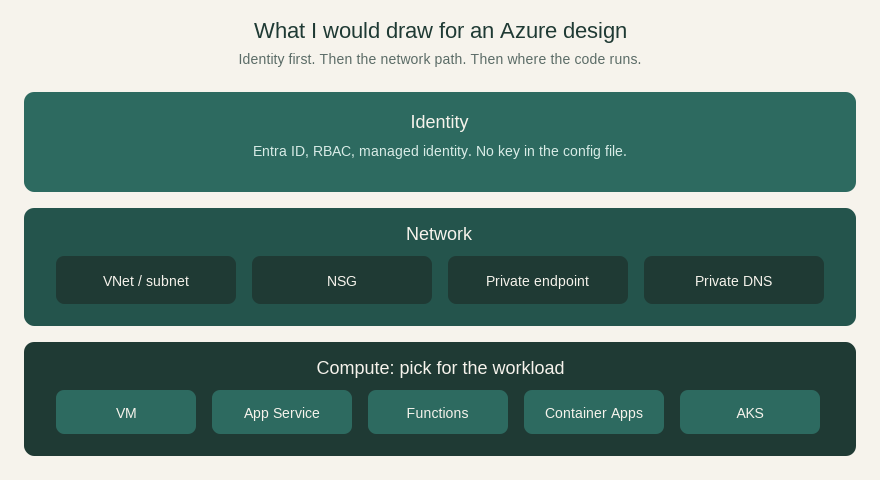
The three layers I’d draw first: who the app is, how traffic moves, and where the code runs.
Networking, storage, and compute choices
Then they want you to pick services for a workload, not recite a catalog.
Compute is a “when would you pick this” question. A virtual machine is the right call when you need the OS, a custom runtime, or a lift-and-shift that is not ready to be a managed app. App Service is the better default for a web API when you don’t want to patch the OS. Functions fit short, event-driven work: a queue message, a blob arrival, a timer. I’d mention cold starts if the latency budget is tight, and I would not force a long-running process into Functions just to sound modern. AKS is for a container platform you are actually going to operate. If you only need to run a container without that control plane, Container Apps is the lighter middle ground (including scale to zero), and Azure Container Instances fit a simple burst or a one-off job. I’d pick AKS only if the team is ready to own Kubernetes, not because the job description mentioned it.
Storage follows the same habit. Blob Storage is objects: images, backups, a data lake. Azure Files is a shared file system, SMB or NFS, when an app still wants a file share. Disks are block storage attached to VMs. If access tiers come up, the official online tiers are Hot, Cool, and Cold; Archive is offline, with retrieval measured in hours. I would not park a frequently read asset there, and I would not invent a price.
Networking is where the “API must not be on the public internet” walkthrough lives. The API sits in a subnet on a virtual network, with no public inbound endpoint. Network security groups restrict what can reach that subnet, and what it can call. For Azure PaaS such as storage or SQL, a private endpoint gives the service a private IP on your VNet, so the app does not go out to a public data-plane endpoint. Private DNS has to resolve that name to the private IP, or the app will still try the public path and you’ll spend an hour blaming the firewall. Callers reach the API through something private or controlled: a VPN, ExpressRoute for a private circuit from on-premises, or an internal load balancer or application gateway, depending on the traffic. I wouldn’t invent a latency number, and I wouldn’t leave a management port open “just for debugging.”
A spoken walkthrough I’d rehearse:
“The API has no public IP. It lives on a subnet, NSGs tighten what can talk to it, and storage is reached through a private endpoint, not a public blob URL. The app uses a managed identity, not a key. Callers come in through a private front end or a VPN. If name resolution still points at the public endpoint, the private path isn’t actually in use.”

A private-app board: the API off the public internet, and a private path to storage.
Azure DevOps pipelines, and the teams that use GitHub Actions
Many teams still live in Azure DevOps. Many others run GitHub Actions against the same Azure subscription. I’d say which one this job actually uses, and I would not pretend Azure DevOps is universal.
What I’d put in a build: restore, compile, unit tests, lint if the repo has it, and a versioned artifact. The deploy stage takes that artifact and pushes it to an environment. I’d keep dev, test, and production separate, with production gated by an approval if the team works that way. Secrets do not belong in a YAML file. In Azure DevOps, variable groups and service connections should pull from Key Vault, or use a federated identity to deploy, rather than a client secret baked into the pipeline. In GitHub Actions, the same idea is a federated credential from the workflow to Entra ID, not a long-lived publish profile in a repo secret if you can avoid it.
A failed deploy is a reasoning question, not a “rerun the job” question. I’d look at the stage that broke, the last successful artifact, and whether the change was code, config, or infrastructure. If production is half-updated, I’d rather roll back to the previous artifact than push a second deploy I cannot explain. Environment-specific settings are a frequent cause: a connection string still pointing at test, a flag that was never set, a private endpoint that exists in one environment and not in the other. The pipeline should make that visible. It should not be a script only one person can run from a laptop.
A spoken version I’d use:
“Build produces an artifact and runs the tests. Deploy takes that artifact into an environment, with production behind an approval. Secrets come from Key Vault, and I’d rather the pipeline authenticate with a federated identity than a stored secret. If a deploy fails, I read the logs and compare to the last good release before I rerun anything. I wouldn’t hotfix production from my laptop.”
Scenarios they actually walk you through
“The VM is fine, but the app can’t reach the database.”
I’d start with the path, not with a reboot. Can the VM resolve the database hostname to the address you expect, especially if you moved to a private endpoint? Do the NSG and any database firewall allow this subnet, on this port? Is the app using the right connection string, and is it authenticating with a managed identity that was actually granted access? A route table, a Network Watcher connectivity check, and the database’s own firewall are more useful than “the VM looks healthy in the portal.” I’d also ask whether this started after a network change, a key rotation, or a pipeline that updated app settings.
“We saw a cost spike this week. How would you investigate?”
I would not guess a service and start deleting it. I’d open Cost Management, split by service, resource group, and tag if they have tags, and compare to the prior period. Common causes I would actually check: a scale-out that never scaled in, a leftover public IP or disk after a VM was deleted, an analytics job that ran all weekend, egress nobody budgeted, an App Service plan or AKS node pool left at a size meant for a test. Then I’d look at who can create resources, whether a budget alert existed, and what I’d change so the next spike is visible on day one, not at the invoice. I would not recite a pricing table.
“A zone is having trouble. Then, separately, the region is.”
Stay at official-docs depth. Many Azure regions have availability zones: separate groups of datacenters in the region, with independent power, cooling, and networking. A zone-redundant resource is spread across zones, and the service manages failover for a single-zone outage. A zonal resource is pinned to one zone; you own the design if you need it to survive that zone. If the whole region is affected, zone redundancy will not save you. That is a disaster-recovery conversation: another region, a failover plan you have already rehearsed, and a clear statement of how much data you are willing to lose. I would not invent an SLA percentage in the room.
“Rotate the storage key. The app still has to work.”
If I had designed this, the app would not be using the storage key. I’d move it to a managed identity and retire the key after the cutover. If keys are already in use, I’d create or roll the key in a controlled way, put the new value in Key Vault, update the app (or recycle the configuration), confirm traffic, then retire the old key. I’d search App Settings, pipeline variables, and local runbooks so a forgotten copy doesn’t keep working until it suddenly doesn’t. I’d also say this is why identity is the first topic, not a footnote.

Talk through the scenario out loud: where you’d look first, and what you would not do from a laptop.
Night-before drill
I’d run these out loud, timer on, no notes after the first pass:
- How an Azure-hosted app reaches storage or Key Vault with a managed identity, and when you’d use a service principal instead
- When you’d pick a VM, App Service, Functions, Container Apps, or AKS, in a few sentences each
- The private-only API: VNet, NSG, private endpoint, DNS, and how callers get in
- A failed deploy: artifact, environment, secrets, rollback versus a blind rerun
- The cost-spike investigation, and the “VM is up, database is unreachable” path
If a line sounds like a product slogan (“we use zero-trust” or “we’d lift and shift”), say it again until it names a resource, a role, or a network hop.
Practicing with OfferBull
A list of service names will not tell you whether you paused before putting a key in the config.
OfferBull is an AI mock interview app, available on iOS and Android. A voice interviewer asks questions aloud. You answer by speaking. Paste a cloud, DevOps, or Azure-heavy job description, or upload a resume, for tailored questions. Follow-ups based on what you said and what’s on the resume. While you practice, you get answer suggestions and STAR structures. English and Chinese. It’s for rehearsal before the interview, not a helper during one.
FAQ
Is Azure Active Directory still the right name in an interview? Use Microsoft Entra ID, and mention the rename once if you want to be precise. After that, Entra ID is enough. The old name still appears in docs and portals, so recognizing it matters.
Do I have to know Azure DevOps if the team uses GitHub Actions? Know the shape of a build versus a deploy, secrets, and environments in whichever tool the job uses. Many Azure shops run GitHub Actions. Say so, and don’t pretend every team lives in Azure DevOps.
What’s the difference between a private endpoint and a service endpoint? A private endpoint puts a private IP for the PaaS service on your VNet. A service endpoint keeps the service’s public data-plane address but restricts access to your subnet. If the requirement is “this must not use the public endpoint,” you’re in private-endpoint territory, and DNS has to match.
Will zone redundancy save me if the whole region fails? No. Availability zones help inside a region. A region-wide incident is a disaster-recovery problem: another region and a failover plan.
Should I memorize SLA percentages? No. Know the design: zone-redundant versus zonal, and when you need a second region. Don’t invent a number you didn’t check.
Practice This Out Loud
Tonight, talk through a managed-identity answer, a compute-choice set, and the private-only API, each in under a minute. Then do the unreachable-database story and the cost spike with no portal in front of you: path, identity, logs, and what you would not change blindly. Record it and listen for filler, and for answers that stop at a service name. After that, run the same questions in a voice mock that pushes back, and close the app before any real interview. → Practice Now
Take Control of Your Career Path:
- Official Site: www.offerbull.net/mock-interview
- iOS App: Download for iPhone/iPad
- Android App: Download for Android