 OfferBull
Apple Software Engineer Interview: What to Expect Team by Team | OfferBull
Apple Software Engineer Interview: What to Expect Team by Team
The email doesn’t say “Welcome to the Apple interview.” It says you’ll meet the Photos team. Or Core OS. Or a services group whose public job post is three vague sentences and a list of languages. That’s the whole plot, really. You’re not interviewing at a company with one shared question bank. You’re interviewing with a team that wrote its own.
I keep seeing people prep as if Apple ran a Google-style centralized loop. Then they get a take-home in a framework they’ve never used, or a hiring manager who spends forty minutes on a project they shipped two years ago, and they think they somehow missed the official guide. There isn’t one on jobs.apple.com that lays out rounds the way Google’s careers pages do, or the way Amazon publishes its Leadership Principles. For Apple, the useful public writeup is interviewing.io’s guide to Apple interviews, built from people who interviewed there as interviewers. I’ll stick to that plus patterns candidates report, label them as such, and skip invented pass rates.
OfferBull is not affiliated with Apple. Your recruiter’s version of the loop wins every argument with a blog post, including this one.
There is no single Apple interview
interviewing.io puts it the way Apple interviewers themselves tend to put it: you apply to a team, not to “Apple” as a machine. Teams decide whether you get an online assessment or a recruiter call first, whether there’s a take-home, what language the coding rounds use, and whether the onsite is six conversations or something closer to eight. Some interviewers on that guide described almost no formal interviewer training. A senior engineer invents a question tied to the team’s actual work, runs it past a lead, and uses it.
That sounds messy. It is messy. It’s also why “I did 200 medium algorithm problems” is incomplete prep. It might be exactly what one team wants. The next team may hand you a concurrency problem in the language they ship, or a debugging session in a large unfamiliar file, or a walkthrough of a side project until you run out of “why.”
Apple also lets candidates talk to more than one team at a time, according to the same guide. If you have the appetite, that’s worth asking about instead of assuming a rejection from Photos kills a Services pipeline.
What I would do in the first recruiter call is ask forced-choice questions, the way interviewing.io suggests. Not “what should I study?” which gets you a smile and “the fundamentals.” Try: “Is the coding round closer to a standard algorithm problem, or a deep dive into the stack this team uses day to day?” And: “Should I expect a take-home, or are we going straight to a live screen?” Write down the answer. Build the week around that, not around a forum thread from a different org.
Looping at other companies in the same season? The shapes are more standardized at Google, Meta, Microsoft, and Amazon SDE. Use those pages for those loops. Don’t import their round counts into Apple.
The shape most people still see
Treat this as a common skeleton, not a promise.
Recruiter conversation. Background, timeline, which team, sometimes a compensation range, always “why this team?” If you cannot name anything specific about the product or the posting, you’re already in a hole.
Sometimes an online assessment. Some teams use one. Many experienced loops skip it and go to a live screen. Don’t study for an assessment you haven’t been told you’re getting.
Technical phone screen, often 30 to 60 minutes. Shared editor (CoderPad comes up in reports). One interviewer, sometimes more. It may be a hiring manager mixing coding with project questions. Expect to talk while you type, give complexity, and handle a follow-up that changes a constraint.
Sometimes a take-home. interviewing.io notes that the hiring manager usually decides this. Timeboxes vary; some teams have used something close to a week and then debugged your work in a later round. Read the instructions twice. If they say no outside assistance, that includes AI tools. Ship something you can explain line by line.
Onsite or virtual loop. interviewing.io describes roughly six to eight interviews with future teammates, each with one or two interviewers. Candidate reports wander around that range. The mix might include two or three coding rounds, a design conversation, a project deep dive, a debugging or domain round, and behavioral time that can show up inside a technical hour instead of as its own calendar block. Some teams have cut a loop short when early rounds clearly missed the bar. That’s reported, not a published policy.
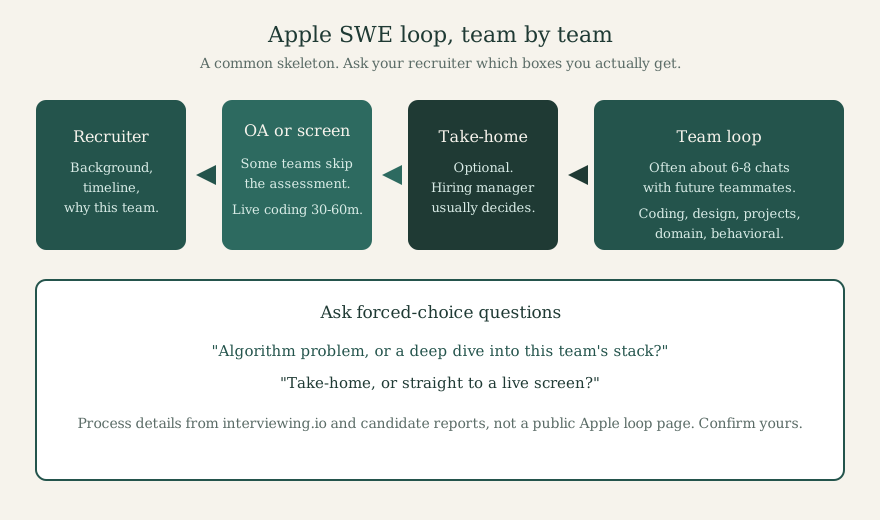 A common skeleton. Your recruiter’s list beats this diagram.
Virtual rounds add the usual video tax. Camera, audio, and a quiet room still matter; we collected the general habits in video interview tips and the coding-specific ones in remote technical interviews.
Coding: fundamentals plus the team’s actual work
Two styles show up again and again.
One is a medium algorithm problem. Arrays, graphs, strings, trees. They care that you clarify, pick a straightforward solution first, then improve it, and that your code looks like someone else could maintain it. Variable names that mean something. Edge cases you mention before they poke you. Talking through tests. The pattern drill lives in top coding interview patterns; the spoken habits live in live coding interviews.
The other style is domain depth. This is where Apple loops feel different from a centralized software interview.
If you’re talking to an iOS or macOS team, they may want Swift (sometimes still Objective-C), memory, concurrency, how a view hierarchy invalidates, what you’d do with a hang on the main thread. Broader mobile prep: how to prepare for mobile developer interviews. Don’t show up having only reviewed binary search if the posting is about frameworks.
Systems, compilers, graphics: C++, memory models, threads, performance. A whole round on concurrency in the language they use is not a surprise, per interviewer anecdotes on interviewing.io. Services teams wander into APIs, data stores, and failure modes; if you stall, talk about what happens when a dependency dies. ML teams care about data, evaluation, latency, and what you’d do when the offline metric and the online metric disagree. Don’t bluff a paper you skimmed.
I would practice one “clean algorithm” session and one “explain a system I actually built” session every prep day. Apple interviewers, more than most, will leave the puzzle and start asking why you chose an eviction policy in a cache you mentioned on your resume. If you can’t go three levels down on your own work, that’s a bigger gap than a missing puzzle pattern.
When they ask you to think out loud, do it. “I’d start with a hashmap and a list so get and put are constant time, then we can talk about evicting the least recently used entry when we hit capacity.” Then write it. Then break it on purpose with a concurrent caller if the team cares about threads.
A sample, so the shape is concrete. This one is fictional.
Interviewer: implement a bounded cache with get and put.
I’d say: “Need a max size. I assume get of a missing key returns something explicit, and put on an existing key updates the value and treats it as freshly used. Single-threaded first unless you want locks now.” Then the hashmap plus doubly linked list version. Then: “If two threads put at once, this corrupts the list. For a services team I’d wrap the structure in one lock first, then talk about splitting the locks if they care about contention.” I would not jump to a lock-free design to sound clever. Correct and boring beats a race you can’t explain.
Design rounds that sound like the team’s product
System design at Apple, as interviewing.io describes it, tends to follow the work. A photos-adjacent team may care about sync, storage, and what happens on a flaky phone network. A web services team may want APIs, backpressure, retries. Frontend-heavy teams may stay closer to client architecture than to a global unique-ID service.
Start with users and constraints. Sketch the pieces. Dig into one or two of them instead of naming every tool you know. Reliability is a good place to spend extra minutes if you don’t know what they want next: timeouts, retries that don’t make an outage worse, what the user sees when sync is behind.
A fuller framework, if you want structure: system design interview template. Broader prompt practice: top FAANG system design questions. Translate those prompts into the team’s world. “Design a photo app” is less useful than “design the piece of sync this posting keeps hinting at.”
Behavioral: why this team, and can they work with you
interviewing.io’s interviewers said behavioral weight is high, sometimes higher than a rusty coding round, and that “Why Apple?” is not a warm-up you can shrug off. Generic answers (“best products,” “everyone knows the brand”) get people rejected even when the code was fine.
You don’t need a speech about a logo. You need one true connection: a product you use in a specific way, a craft problem this team owns, a constraint you actually like working under. If you’ve never used the platform they build, say something honest about the engineering problem, not a fake childhood story about a music player.
Privacy and secrecy come up as culture, not as a trivia quiz for most software seats. Don’t brag about leaking roadmap details from a past employer. Don’t ask the interviewer to tell you what unreleased thing the team is shipping. “I keep project boundaries clean and I don’t brief friends on work that isn’t public” is enough, backed by one example of handling sensitive data or a silent launch.
Cross-functional stories matter because these teams are picky about the last bit of polish that other groups feel. Design, product, adjacent engineering, sometimes a privacy review. They want to know you can push back without being a roadblock, and that you can commit once the decision is made.
Sample answers are illustrative. The names and numbers are made up. Please don’t recite them.
“Why Apple? Why this team?”
How I might say it if I were interviewing for a client performance team (fictional):
“I spent two years chasing jank in a shopping app on mid-range Android phones, and the thing I liked wasn’t the firefighting. It was measuring frame time, cutting work off the main thread, and watching a screen that used to hitch start to feel cheap in a good way. Your posting calls out scrolling performance and battery. That’s the work I already argue about in code review. I also care that the product is something people keep in their pocket all day. I don’t need a speech about changing the world. I want to make the interaction in front of them feel inevitable.”
That’s specific. “I’ve always been a fan” is not.
“Tell me about a time you raised the quality bar.”
Spoken, with a beginning and an end:
“We shipped a share sheet that dropped location data on about one in forty photos. QA caught it late. I owned the feature, so I stopped the rollout, wrote a repro on the oldest phone we still supported, and found we were reading metadata after a compression step that stripped it. I added a test for a photo with location and a photo without, plus a checklist item for ‘open this on the slow device before we call it done.’ The next two releases didn’t have the drop. The checklist felt fussy. It also meant we stopped finding this class of bug after launch.”
Craft at Apple often looks like that: the unglamorous check that keeps a defect from traveling. If you want a fuller scaffold for stories like this, use the STAR method.
“Tell me about a disagreement with a partner team.”
“Design wanted a transition that took 400 milliseconds because it felt premium. On older phones it felt sticky, and support already had comments about the last animation we added. I recorded both versions on a device from three years ago and sent the side-by-side without a speech. We met in the middle at a shorter motion that still had a curve they liked. I didn’t win a debate. The video did. After we shipped, I asked them to keep that device in their review kit so we weren’t arguing from my laptop again.”
More engineer-shaped prompts: software engineer behavioral interview questions. A wider bank: behavioral interview questions and answers.
Other questions that show up
- Walk me through a project on your resume as if I were reviewing the design.
- Tell me about a time you shipped something you weren’t proud of, and what you did next.
- How do you handle a request you think will hurt the user?
- Describe a time you had to learn a stack quickly.
- Tell me about giving feedback that was uncomfortable.
- What would you do in your first 90 days on this team?
That last one should mention reading the code, finding one small reliable win, and learning how this group reviews. Not a fantasy reorg.
AI during the interview
interviewing.io states that AI use in Apple interviews is prohibited. Apple does not publish a long public candidate page on this the way some other companies do, so confirm with your recruiter. The safe rule is the same one I’d use anywhere: practice tools stay off during the live session, during a take-home unless they explicitly allow them (do not assume they do), and during any recorded portion. No second-monitor chat. No suggested answers in your ear.
OfferBull is for the weeks before. Not for the meeting window.
How I’d practice for two or three weeks
You cannot prep every possible Apple loop. You can get fluent at the parts that transfer.
One algorithm session a day out loud. A written inventory of three projects you can defend for twenty minutes each: the diagram, the tradeoffs you actually made, what you’d change. Later in the week, a design prompt tied to the team’s public product, plus two behavioral stories spoken to about two minutes, then interrupt yourself with “what data did you look at?” and “what would you do differently?”
If they mentioned a take-home, spend an evening building something you can explain line by line. If you have a friend, run a dummy loop: coding, a project dive, and “Why this team?”
OfferBull is an AI mock interview app for iOS and Android. A voice interviewer asks questions aloud. You answer by speaking. Paste the job description, even a vague Apple one, or upload a resume for tailored questions. Follow-ups based on what you said and what’s on the resume. While you practice, you get answer suggestions and STAR structures. English and Chinese. Close it before the real call starts.
FAQ
Does Apple use a standardized level name like L4? Apple’s public job posts don’t spell out a Google-style level chart. Candidate sites often use their own labels. Don’t walk in reciting a framework Apple didn’t put in your email. Ask the recruiter what scope they want.
Will I code in Swift? Only if the team does, or they asked you to. Many teams let you use a language you’re fluent in for algorithm rounds and then test the stack they ship in a domain round. Ask.
Is the hiring manager the most important interview? interviewing.io’s interviewers said the hiring manager has a lot of weight and that debriefs can be informal live discussions. Treat every round as if that person will hear about it, because they will. Impress the manager without ignoring the engineer who would sit next to you.
Can I interview with more than one Apple team? The interviewing.io guide says yes, and that some candidates do several in parallel. Your recruiter can tell you how that works in practice right now.
How long does it take? Reports vary from a few weeks to a few months. I wouldn’t plan a resignation around a forum average.
What if I freeze on “Why Apple?” Don’t invent a commercial. Name the team’s problem, one piece of work you’ve already done that maps to it, and why you want that constraint rather than a generic backend seat.
Practice This Out Loud
Tonight: a resume project you can defend for twenty minutes, one bounded-cache style coding prompt with spoken tests, and a two-minute “Why this team?” that names a real constraint from the posting. Interrupt yourself once. Then a voice mock with follow-ups. → Practice Now
Take Control of Your Career Path:
- Official Site: www.offerbull.net/mock-interview
- iOS App: Download for iPhone/iPad
- Android App: Download for Android